

Perishable goods logistics focuses on the efficient movement, storage, and handling of products such as food, flowers, pharmaceuticals, and dairy that have limited shelf life. Effective strategies help reduce waste, maintain product integrity, and ensure timely delivery through cold chain systems, inventory control, packaging, and real-time tracking.
For businesses entering new regions, a strong market entry strategy must consider local infrastructure, temperature-control capabilities, regulations, and consumer demand. A well-planned perishable goods logistics entry strategy supports quality preservation, minimizes losses, and builds customer trust, making it essential for successful expansion in competitive markets.
Global estimates indicate that 13.2% of food is lost in the supply chain after harvest and before retail, while 19% of food available to consumers was wasted in 2022, equal to about 1.05 billion tonnes. These figures show why cold chain efficiency, faster distribution, and quality monitoring must be central to any market entry strategy for perishable goods logistics.
Developing a Market Entry Strategy for Perishable Goods Logistics
Developing a market entry strategy for perishable goods logistics involves assessing demand, cold chain infrastructure, regulations, partnerships, and distribution efficiency to reduce waste, preserve product integrity, and ensure successful expansion.
- Market Demand and Consumer Preferences: Understanding local demand, buying habits, and freshness expectations helps businesses position perishable goods effectively in a new target market.
- Cold Chain Infrastructure Assessment: Evaluating refrigerated storage, transport systems, and handling facilities ensures product quality is maintained throughout the logistics journey.
- Regulatory and Quality Compliance: Meeting food safety, import, labeling, and storage regulations reduces entry barriers and protects product integrity in new markets.
- Local Partnership Development: Collaborating with reliable logistics, warehousing, and distribution partners supports smoother market entry and reduces operational risks.
Nexdigm Inventory Planning to Minimize Spoilage and Stock Losses
Nexdigm inventory planning helps businesses minimize spoilage and stock losses by aligning demand forecasting, stock rotation, storage capacity, and replenishment cycles. For perishable goods logistics, this approach supports better product freshness, reduced wastage, optimized inventory levels, and stronger market entry execution across temperature-sensitive supply chains.
Nexdigm Waste Reduction Strategy for Perishable Supply Chains
Nexdigm waste reduction strategy for perishable supply chains focuses on improving forecasting, storage, handling, and distribution efficiency to minimize spoilage, reduce losses, preserve freshness, and strengthen product integrity:
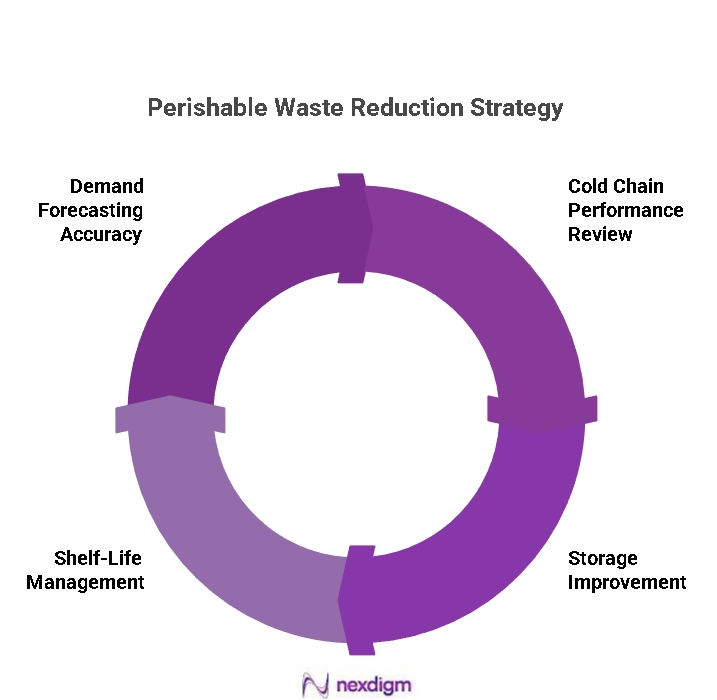
- Demand Forecasting and Inventory Accuracy: Nexdigm supports demand planning to align supply with market needs, reducing excess stock, spoilage, and avoidable product losses.
- Cold Chain Performance Review: Nexdigm helps assess temperature-controlled storage and transport processes to maintain freshness, prevent quality deterioration, and reduce perishable goods waste.
- Stock Rotation and Shelf-Life Management: Nexdigm enables structured stock rotation practices to prioritize near-expiry products and improve shelf-life utilization across supply chains.
- Storage and Handling Process Improvement: Nexdigm reviews storage, loading, unloading, and handling processes to reduce damage, contamination, temperature abuse, and product rejection.
Nexdigm’s case:
Nexdigm helped a perishable goods company reduce supply chain waste by reviewing demand forecasting, inventory rotation, storage practices, and cold chain performance. Through improved replenishment planning and route optimization, the company reduced spoilage from 12% to 7%, improved on-time delivery by 18%, and increased product integrity across key distribution points.
To take the next step, simply visit our Request a Consultation page and share your requirements with us.
Harsh Mittal
+91-8422857704