

The transportation of perishable goods requires logistics providers to maintain specific handling conditions throughout the supply chain. Food products, dairy, meat, seafood, pharmaceuticals and fresh produce can deteriorate when exposed to unsuitable temperatures, excessive handling or prolonged transit times. For businesses operating in these sectors, selecting a logistics supplier involves evaluating more than transportation capacity and freight rates.
A reliable supplier must demonstrate temperature control, suitable vehicle infrastructure, delivery consistency, traceability and the ability to manage disruptions without compromising product quality.
Why Perishable Logistics Supplier Evaluation Matters
Perishable goods have limited shelf lives and often require specific environmental conditions during transportation. A delay at a loading facility, inadequate refrigeration or repeated exposure to ambient temperatures can affect product quality and increase inventory losses.
In India, the Food Safety and Standards Authority of India (FSSAI) establishes hygiene and sanitary requirements for food transportation. Its requirements include suitable vehicles, temperature control and appropriate handling practices for high-risk and perishable food products.
Internationally, the United Nations Economic Commission for Europe (UNECE) Agreement on the International Carriage of Perishable Foodstuffs (ATP) establishes technical requirements for temperature-controlled transportation equipment and the preservation of perishable goods.
These requirements make supplier due diligence important for organisations handling temperature-sensitive cargo.
Key evaluation parameters include:
- Fleet capability: Availability of refrigerated vehicles, insulated containers and specialised transportation equipment.
- Cold chain integrity: Ability to maintain prescribed temperature and humidity conditions throughout transit.
- Delivery performance: On-time delivery, transit duration and handling efficiency.
- Monitoring capabilities: Temperature sensors, GPS tracking, automated alerts and shipment records.
- Cost efficiency: Transportation charges, fuel costs, refrigeration expenses and additional handling fees.
Evaluating Fleet Capability and Cold Chain Integrity
Fleet evaluation should begin with the type of products being transported. Fresh produce, dairy products, frozen food and pharmaceutical products have different temperature and handling requirements.
Procurement teams should assess whether suppliers have suitable vehicle configurations and refrigeration systems for the cargo category.
Important considerations include:
- Vehicle suitability: Evaluate refrigerated trucks, insulated vehicles, multi-temperature compartments and specialised containers.
- Temperature control: Examine refrigeration capacity, temperature consistency and monitoring arrangements.
- Equipment maintenance: Review refrigeration unit servicing, calibration records and preventive maintenance schedules.
- Hygiene standards: Assess vehicle cleaning procedures, food-grade surfaces and contamination prevention.
- Contingency arrangements: Determine how suppliers respond to equipment failure, power interruptions and unexpected delays.
Temperature monitoring should extend beyond departure and arrival checks. Continuous records provide better visibility into potential temperature excursions and help establish accountability when shipments are compromised.
Comparing Delivery Performance and Transportation Costs
Delivery reliability is particularly important for products with short shelf lives. A supplier may offer extensive geographical coverage but still struggle with timely deliveries during peak demand or congested transportation periods.
Procurement teams should compare:
- On-time delivery percentage.
- Average transit time by route.
- Temperature excursion frequency.
- Shipment rejection and damage rates.
- Vehicle availability during peak periods.
- Average breakdown and recovery time.
Commercial comparisons should include refrigeration-related expenses, fuel surcharges, waiting charges, route deviations and additional handling costs.
A low freight quotation may not represent the best commercial option if the provider has limited monitoring capabilities or a higher incidence of shipment damage.
Businesses should also evaluate whether the supplier can provide digital proof of delivery, temperature logs and shipment-level reporting.
Perishable Logistics Supplier Evaluation Framework
A structured perishable goods transport supplier research exercise should assess suppliers across operational, technical and commercial parameters.
The evaluation can follow six stages:
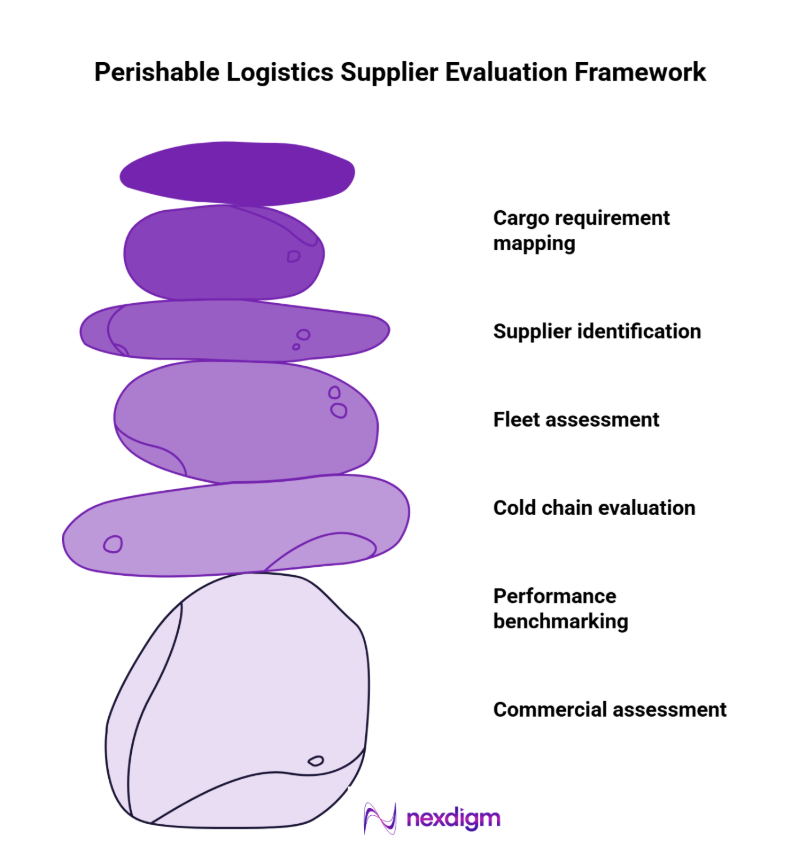
- Cargo requirement mapping: Identify product categories, temperature ranges, shipment volumes and delivery schedules.
- Supplier identification: Map logistics providers offering refrigerated transportation and specialised handling.
- Fleet assessment: Compare vehicle availability, refrigeration systems, equipment maintenance and geographical coverage.
- Cold chain evaluation: Review temperature monitoring, excursion management, hygiene procedures and traceability.
- Performance benchmarking: Compare transit times, delivery reliability, shipment condition and incident response.
- Commercial assessment: Evaluate transportation rates, refrigeration charges, service levels and contractual provisions.
Nexdigm can support organisations through supplier market research, cold chain logistics benchmarking, vendor due diligence and commercial comparisons. These assessments help businesses identify logistics providers aligned with product-specific requirements and evaluate potential risks across temperature-controlled supply chains.
Nexdigm’s Case Study
Nexdigm assessed 11 perishable logistics providers across 5 distribution routes, comparing refrigerated fleet capacity, temperature monitoring and delivery performance. The assessment shortlisted 4 suppliers, identified a 15% cost variation across comparable routes and established temperature compliance and delivery benchmarks for supplier selection.
To take the next step, simply visit our Request a Consultation page and share your requirements with us.
Harsh Mittal
+91-8422857704