

Petrochemical demand stems from diverse end-use products such as packaging, automotive parts, and textiles, meaning aggregate GDP or total plastics metrics obscure material-specific growth.
While the IEA projects petrochemicals will drive global oil-demand growth from 2026, reaching 18.4 million barrels per day by 2030 (over one-sixth of global demand), opportunities differ sharply by polymer, sector, and region.
To capture value, producers must analyze specific manufacturing trends, end-use resin requirements, and realistic domestic market share rather than relying on top-line plastic consumption.
Measure Chemical Intensity by End Use
The demand model should begin with physical production and consumption indicators, then translate them into material requirements.
- Packaging: Separate flexible films, rigid containers, bottles and protective packaging. Demand reflects food distribution, e-commerce, consumer spending, product shelf life and packaging design.
- Automotive: Link vehicle production and vehicle type to polymer content per vehicle. Electric vehicles, lightweighting and battery-system design can change the mix of plastics and engineering polymers required.
- Construction: Track building activity, infrastructure spending and renovation separately for pipes, insulation, cables, roofing and other applications. Long asset lifecycles can support demand even when consumer spending weakens.
- Textiles: Forecast synthetic-fibre production, fabric composition and demand for polyester, nylon and other fibres, accounting for changes in apparel production and recycled-fibre adoption.
- Agriculture: Assess irrigation systems, greenhouse films, crop-protection applications and other polymer-intensive uses against agricultural output and planted area.
The model should then translate physical activity into resin demand using application-specific material-intensity assumptions. Imports, exports, inventory changes and production losses must also be considered. Otherwise, demand can be overstated when finished goods are imported or when local converters source polymers from overseas suppliers.
Growth Is Shifting Across Regions and Materials
The geographical distribution of production provides an important signal for market assessment. Plastics Europe’s Plastics the Fast Facts 2025 reports that global plastics production grew 4.1% in 2024 and increased 16.3% between 2018 and 2024. Europe’s share of global production fell from 22% in 2006 to 12% in 2024, reflecting a substantial shift in manufacturing competitiveness and capacity towards other regions.
For market entrants and existing producers, this creates two separate questions: where is consumption growing, and where can local production compete with imported material?
A region with rapid growth in packaging or automotive production may still be unattractive for a new resin facility if capacity additions outpace consumption. Conversely, a market with slower overall growth may present an opportunity in specialised grades where local converters depend on imports, qualification requirements create barriers to entry or supply reliability is a concern.
The analysis should compare end-market growth with announced capacity, existing utilisation, import dependence, feedstock access and delivered production costs. This helps distinguish genuine supply gaps from temporary shortages that may disappear when new capacity comes online.
Recycling Changes the Composition of Demand
Recycling affects how much virgin petrochemical material is required to supply finished products. Its impact depends on collection systems, processing capacity, material quality and whether recycled polymers can meet the specifications of individual applications.
The OECD’s Global Plastics Outlook projected that global plastics use could rise from 460 million tonnes in 2019 to approximately 1.23 billion tonnes in 2060 under its baseline scenario.
In that scenario, recycled plastics would account for only 12% of plastics use by 2060. Under its more ambitious policy scenario, the projected share rises to 41%.
These are long-term modelled scenarios, not current market shares, but the difference illustrates how regulation and recycling investment could alter future virgin-material demand.
A credible demand assessment should therefore examine:
- Collection and sorting capacity.
- Recycled-material availability and quality.
- Food-contact and technical requirements.
- Recycled-content mandates and their implementation.
- Competition from alternative materials.
- The price difference between virgin and recycled resin.
Substitution should be modelled at the application level. Recycled material may displace virgin resin in some packaging grades while remaining unsuitable for other applications. Likewise, paper, glass, aluminium and reusable formats compete with particular products rather than eliminating plastics demand uniformly.
Convert Material Demand Into Commercial Opportunity
For petrochemical demand analysis research, the objective is to connect end-use forecasts with specific polymers, grades, customer segments and supply gaps. That requires combining physical production indicators with material-intensity estimates, trade data and planned capacity additions.
The analysis should test at least three outcomes: a base case reflecting expected end-market growth, a downside case with weaker industrial activity or faster substitution, and an upside case supported by stronger production and consumption. Recycling penetration and new petrochemical capacity should be varied separately because their effects on virgin-resin demand and market pricing differ.
The final output should show where demand is growing, which products are likely to benefit, whether the market can absorb additional capacity and what conditions would make an investment commercially sustainable.
Petrochemical Demand Opportunity Framework
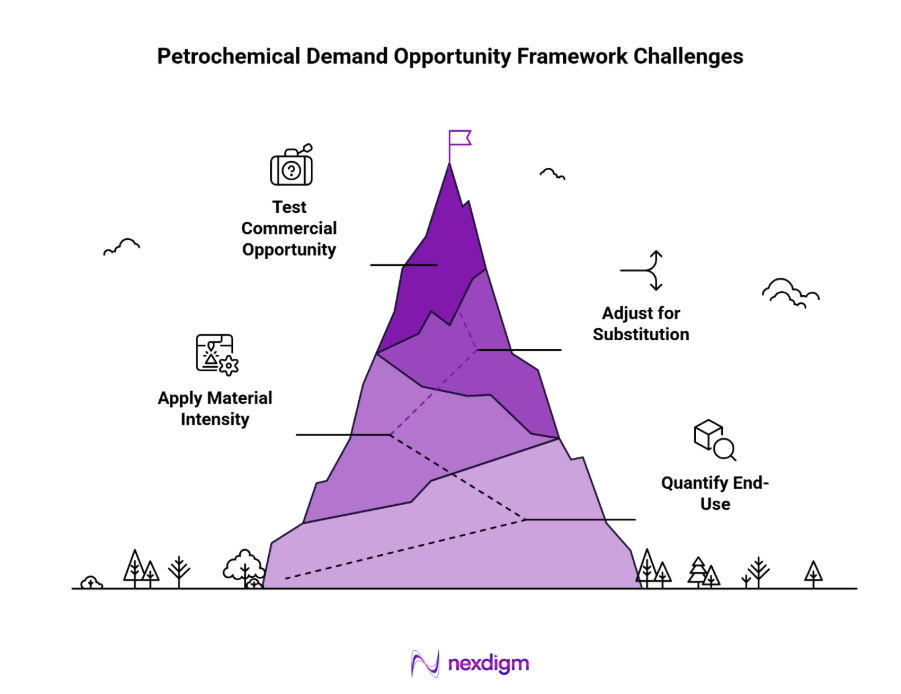
- Quantify the End-Use Base
Forecast packaging, automotive, construction, textile and agricultural activity using physical output, production volumes and relevant consumption indicators. - Apply Material Intensity
Translate end-market activity into polymer and intermediate requirements by application, product grade and geography. - Adjust for Substitution
Account for recycled content, competing materials, lightweighting, product redesign and regulatory requirements to estimate demand for virgin petrochemicals. - Test the Commercial Opportunity
Compare projected demand with domestic production, planned capacity, imports, delivered costs and customer requirements. Identify grades and regions where demand is durable and supply is competitively positioned.
Nexdigm Case Study: Identifying High-Potential Petrochemical Grades
Nexdigm assessed petrochemical demand across six regional markets, covering packaging, automotive, construction and textiles. The team modelled consumption across 12 polymer grades, compared projected demand with domestic capacity and imports, and tested three scenarios for recycled-material penetration. The analysis identified four grades with projected annual demand growth above 5%, alongside three where planned capacity additions risked pushing utilisation below 75%. The client prioritised investment in the four higher-growth grades and deferred capacity expansion in the oversupplied segments.
To take the next step, simply visit our Request a Consultation page and share your requirements with us.
Harsh Mittal
+91-8422857704