

Petrochemical distribution is shaped by more than market size. Customer concentration, product characteristics, industrial clusters, logistics infrastructure, distributor capabilities, import flows, and purchasing patterns determine how efficiently products can reach end users. A strong distribution strategy must therefore balance market opportunity with the cost and complexity of serving customers.
India offers a substantial addressable market. Domestic petrochemical production reached 42.16 million tonnes against installed capacity of 52.29 million tonnes in FY2023–24, while chemicals and petrochemicals excluding pharmaceuticals and fertilizers accounted for approximately ₹6.32 lakh crore of imports in FY2024–25. These dynamics create opportunities for distributors, but also expose them to international supply and pricing movements.
For petrochemical manufacturers, importers, distributors, and investors evaluating expansion, petrochemical distribution entry consulting services can help identify attractive markets, prioritize channels, assess partner capabilities, and develop distribution networks aligned with customer demand.
Understanding the Petrochemical Market Size
Petrochemical demand is distributed across packaging, automotive, construction, textiles, consumer products, agriculture, electronics, and industrial manufacturing. Each downstream sector has different purchasing volumes, technical requirements, order frequencies, and geographic concentrations.
A market with high consumption may not necessarily be the easiest to enter. Established supplier relationships, strong incumbent distributors, transportation costs, and customer switching barriers can affect the commercial opportunity. Distribution planning therefore needs to identify contestable demand, not simply total demand.
Selecting the Right Channel Dynamics
Direct sales can provide greater control over pricing, relationships, and technical support, while distributors can offer established customer access, local inventory, and faster geographic penetration. Hybrid models can combine direct management of strategic accounts with distributor coverage for fragmented markets.
Recent route-to-market research highlights the importance of selecting channels according to customer behavior, partner capability, market coverage, and economics. It notes that partner-led models can generate up to 58% of revenue for top-performing companies, while 72% of companies report lower customer-acquisition costs through partners.
How Nexdigm Identifies High-Potential Petrochemical Distribution Opportunities
Identifying attractive petrochemical distribution opportunities requires more than evaluating market size. Nexdigm assesses demand, channel dynamics and distribution of economics through Petrochemical Distribution Entry Consulting Services to determine where sustainable growth opportunities are most likely to emerge. This is done through:
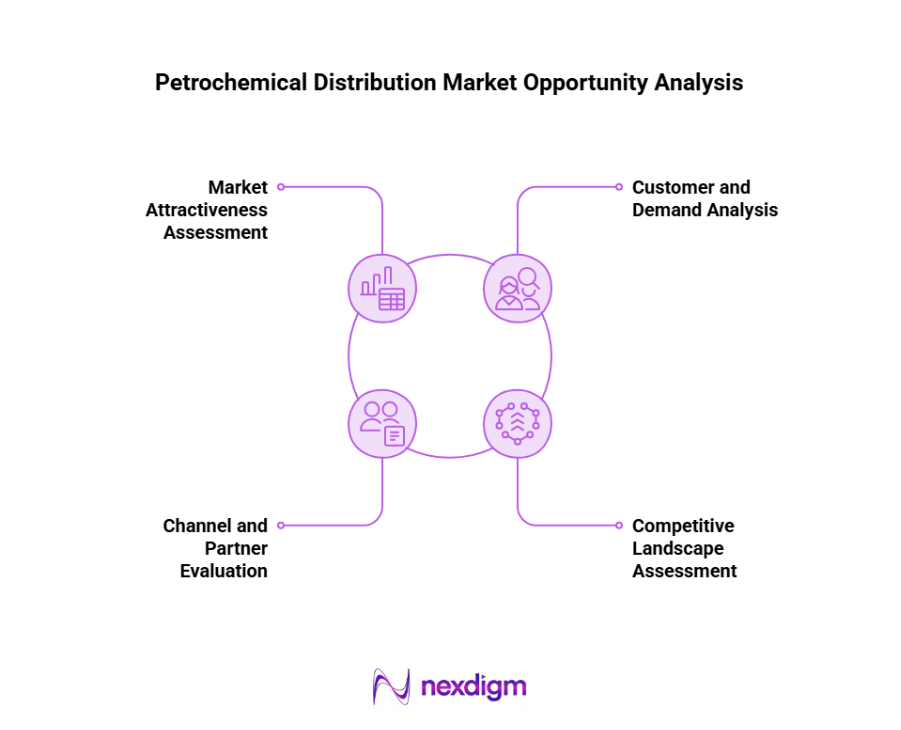
- Market Attractiveness Assessment: Evaluate demand across end-use industries, regional consumption patterns, industrial clusters, and growth outlook to identify high-potential markets.
- Customer and Demand Analysis: Assess customer segments, purchasing behavior, volume requirements, and sourcing preferences to understand distribution opportunities.
- Channel and Partner Evaluation: Analyze distributor capabilities, market coverage, inventory infrastructure, technical support capacity, and customer relationships.
- Competitive Landscape Assessment: Examine existing suppliers, distributor networks, market fragmentation, and entry barriers that could influence commercial success.
By combining market intelligence with channel and operational analysis, Nexdigm helps petrochemical businesses prioritize the most commercially attractive distribution opportunities and develop effective market-entry strategies.
Nexdigm’s Opportunity Analysis in Enhancing Petrochemical Distribution Networks
Identifying attractive markets is only the first step in distribution expansion. Long-term success depends on building networks that can efficiently connect supply with demand while supporting customer service, inventory availability, and commercial growth. Nexdigm helps petrochemical businesses evaluate such factors through:
- Customer and Market Coverage Optimization: Assessing distribution reach across industrial clusters, end-use sectors, and customer segments to identify coverage gaps and growth opportunities.
- Distributor Capability Assessment: Evaluating partner strengths across sales, inventory management, logistics infrastructure, technical support, and customer relationships.
- Inventory and Network Efficiency: Analyzing inventory positioning, warehousing requirements, and replenishment models to improve product availability and working-capital efficiency.
- Supply Chain and Service Performance: Assessing logistics capabilities, delivery responsiveness, and supply reliability to support customer expectations and business continuity.
- Scalable Distribution Growth Planning: Developing distribution structures that can support future geographic expansion, customer acquisition, and increasing demand volumes.
By combining market intelligence with distribution-network analysis, Nexdigm helps petrochemical businesses build high-performance distribution models that strengthen market access, improve operational efficiency, and support sustainable growth.
Nexdigm in Supporting Petrochemical Distribution Expansion Decisions
Converting distribution opportunities into sustainable growth requires a clear understanding of market attractiveness, channel effectiveness, partner capabilities, and operational feasibility.
Nexdigm helps petrochemical businesses evaluate these factors holistically, enabling them to prioritize high-potential markets, identify the most suitable route-to-market strategies, assess distributor partnerships, and align distribution investments with long-term growth objectives.
Through a structured assessment of market, channel, and network dynamics, Nexdigm supports informed expansion decisions that enhance market reach, improve operational efficiency, and strengthen competitive positioning.
Nexdigm’s Case
Nexdigm supported a consumer-products company seeking to improve route-to-market execution across four priority regions. The engagement tracked performance across 120 distributor locations and 2,500 retail touchpoints, identifying underperforming territories, partner-productivity gaps, and availability issues. Following channel reallocation, coverage improved by 32%, channel conversions increased by 21%, and the network became more scalable.
To take the next step, simply visit our Request a Consultation page and share your requirements with us.
Harsh Mittal
+91-8422857704