

Petrochemical market size can create a misleading sense of opportunity. A country may report strong plastics consumption growth while individual polymers remain oversupplied, import-dependent or exposed to substitution. Ethylene availability does not necessarily translate into attractive polyethylene economics, just as propylene availability does not guarantee a viable polypropylene project.
The first task is therefore to define the actual product opportunity. Ethylene, propylene, aromatics, intermediates and polymers have different feedstock relationships, production technologies, trade patterns and customer requirements. The IEA’s 2025 oil outlook continues to identify petrochemicals as an important source of future oil demand, but that broad trend does not determine the feasibility of an individual plant. A naphtha-based complex in Asia faces a fundamentally different cost structure from an ethane-based cracker in the Gulf region.
For investors, the relevant question is where a persistent product-level imbalance exists after existing capacity, announced projects and actual utilisation are taken into account.
Trace the Margin Back to the Feedstock
Once the product has been defined, the economics need to be followed backwards.
Ethane, propane, naphtha and refinery off-gases create different product slates and expose producers to different price relationships. Feedstock availability, contract terms and transportation costs can therefore determine competitiveness before the molecule enters the production unit.
Existing supply also needs to be assessed beyond nameplate capacity. Map plants by technology, grade, age, integration and operating rate. Include projects under construction and credible additions, while treating early announcements cautiously. Retirements, maintenance cycles and persistent underutilisation can materially change the effective supply position.
The resulting product balance should then be tested against demand generated by actual end-use activity. Packaging, automotive production, construction, appliances, textiles and consumer goods each create different resin requirements. Recycling and material substitution can further alter demand, but their effects need to be assessed at the application level. A recycled-content mandate may materially affect one polymer grade while leaving another relatively insulated.
What Happens When the Cycle Turns?
A project that works at peak margins may become uneconomic when utilisation falls or feedstock prices move against it. Petrochemical feasibility therefore depends heavily on how the asset behaves across a cycle.
Model the full conversion economics, including feedstock, utilities, catalysts, logistics, tariffs, carbon costs and plant utilisation. Integrated complexes may gain from shared infrastructure and intermediate capture, while standalone plants can have lower capital requirements but greater exposure to feedstock and logistics risk.
Customer qualification adds another layer. Certain polymer grades require technical approval before they can be supplied to major converters or manufacturers. A theoretical supply deficit therefore has limited value if a new producer cannot qualify its product or secure sufficient contracted demand.
This is where product mix becomes a strategic variable. A project designed around one high-growth polymer may be more exposed to oversupply than a flexible configuration capable of serving several grades or applications.
Petrochemical Product Opportunity Assessment Framework
A proposed petrochemical investment can be screened through four commercial questions:
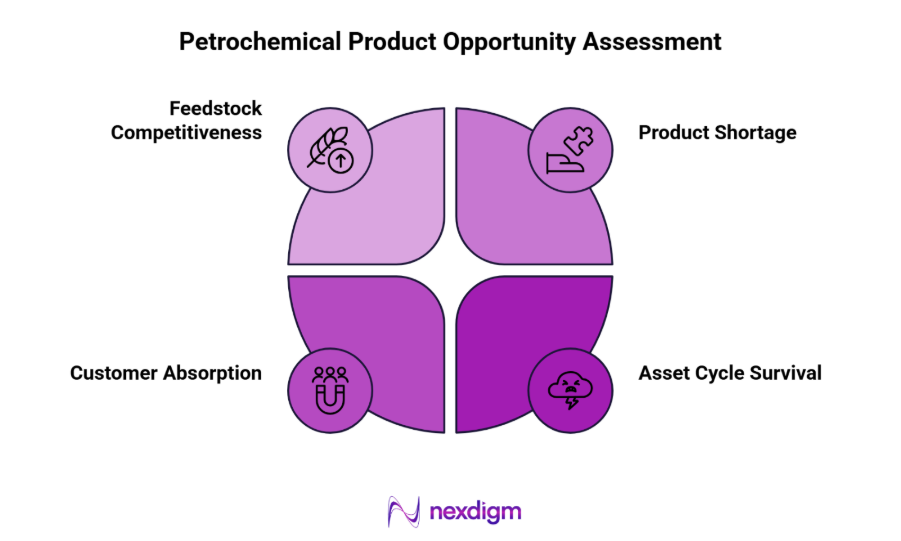
- Is the Product Structurally Short?
Test current and future supply against actual operating rates, credible capacity additions, imports, exports and retirements to identify persistent product-level deficits. - Can the Feedstock Support Competitiveness?
Compare feedstock availability, delivered cost, contractual security and conversion yields against competing producers and technologies. - Will Customers Absorb the Output?
Map demand by application, customer qualification requirements, substitution, recycling and contracted offtake to establish the quality of the demand base. - Can the Asset Survive the Cycle?
Stress-test utilisation, feedstock prices, product spreads, logistics costs and alternative product configurations to determine whether returns remain viable under weaker market conditions.
Nexdigm can use this assessment to distinguish between apparent market gaps and investable product opportunities, then shape the product slate and phasing around the most resilient demand pockets.
Nexdigm Case Study
Nexdigm assessed polyethylene, polypropylene, PET and selected aromatics across four end-use sectors for an investor evaluating a new petrochemical complex. The analysis identified two grades with stronger structural demand and import dependence, while a broad polymer configuration showed weaker cycle utilisation. A modular product slate supported by contracted packaging customers improved downside economics.
To take the next step, simply visit our Request a Consultation page and share your requirements with us.
Harsh Mittal
+91-8422857704