

Pharmaceutical sourcing networks are changing as manufacturers balance input costs, supplier reliability, regulatory requirements and geopolitical exposure. Trade records help companies track these changes by showing where ingredients and finished medicines originate, which countries supply them, and how trading relationships evolve over time. For procurement and commercial teams, the objective is to identify meaningful changes in sourcing patterns before they affect production costs, supplier negotiations, or product availability.
The analysis must distinguish between different stages of the pharmaceutical value chain. Active pharmaceutical ingredients (APIs), chemical intermediates, excipients and finished formulations have different production requirements and trade routes. A shift in finished-medicine imports does not necessarily indicate a corresponding shift in API sourcing.
What Pharmaceutical Trade Patterns Reveal
Customs statistics provide a starting point for understanding sourcing relationships. Product-level import and export data can show changes in supplier shares, reported origin countries, shipment values, and quantities. Shipment-level records, where available, can add details about recurring transactions, importers, exporters, and logistics routes.
The United Nations Comtrade database allows users to examine merchandise trade by product classification, reporting country, trading partner and period. These dimensions make it possible to compare sourcing patterns across years and identify whether a supplier is gaining share, or a previously important trade relationship is weakening.
However, trade data has limits. The country exporting a product may differ from its manufacturing origin, particularly when distributors or regional trading hubs are involved. Customs values can also change because of pricing, currency movements or product mix rather than changes in physical supply. Companies should therefore compare value with quantity where reliable units are available and corroborate important findings with supplier disclosures and procurement records.
Where Sourcing Concentration Is Becoming Visible
India provides a useful example of why pharmaceutical sourcing must be analysed at product level. According to a February 2026 government statement, India imported approximately US$4.35 billion worth of 200 categories of APIs, bulk drugs and drug intermediates in FY2024–25. China accounted for about 73.7% of that import value.
The aggregate figure indicates substantial concentration, but it does not mean every ingredient has the same dependency.
NITI Aayog’s 2026 Trade Watch analysis found that India’s five largest API import categories represented nearly 84% of total API imports in 2025. Within the antibiotic category, China accounted for 86.1% of imports, illustrating how concentration can be substantially higher for products than the overall average.
A manufacturer sourcing a critical antibiotic ingredient from a concentrated supplier base faces a different exposure from one purchasing an ingredient available from several qualified origins. Procurement teams need to identify the specific products driving dependency rather than treat all imported APIs as equally vulnerable.
Tracking Shifts Across Manufacturers and Distributors
Effective pharma sourcing trade pattern analysis compares product-level import flows, supplier shares and trading relationships over time to identify where sourcing networks are changing. It should examine whether a change reflects a new manufacturing source, a different distributor, a revised logistics route, or a genuine reduction in upstream concentration.
Several signals can guide investigation:
- Changing origin shares: Track which countries are gaining or losing share for individual APIs, intermediates and finished products.
- New trading relationships: Identify emerging exporter-importer connections and test whether they represent sustained supply arrangements or isolated transactions.
- Supplier overlap: Investigate whether apparently different suppliers rely on the same upstream producer or country of manufacture.
- Route changes: Distinguish a change in shipping or re-export location from a change in the underlying production source.
- Price and quantity movements: Compare declared values with quantities to identify potential changes in pricing, purchasing volume, or product mix.
These indicators help companies focus on due diligence, where it is most valuable. A new exporter appearing in customs records is not automatically a qualified alternative. Pharmaceutical sourcing depends on product quality, regulatory approvals, manufacturing consistency, and the time required to qualify a new supplier.
Turning Trade Signals into Sourcing Decisions
Trade intelligence is most useful when external patterns are connected to internal procurement data. Companies can compare import trends with purchase orders, approved vendor lists, inventory levels, lead times, and production requirements. This helps establish whether an observed trade shift affects their own supply exposure or reflects activity elsewhere in the market.
Supplier diversification also requires economic evaluation. An alternative source may reduce concentration but increase unit costs, freight expenses, minimum order quantities or qualification requirements. The relevant comparison includes the cost of switching, the time needed for approval, and the consequences of a disruption to the existing source.
Trade data should therefore support, rather than replace, supplier audits and quality-system checks. It identifies relationships and changes worth investigating; it cannot independently verify a manufacturer’s capacity, compliance status, or ability to deliver consistently.
Nexdigm’s Pharma Sourcing Intelligence Framework
Nexdigm can structure sourcing analysis around four connected steps:
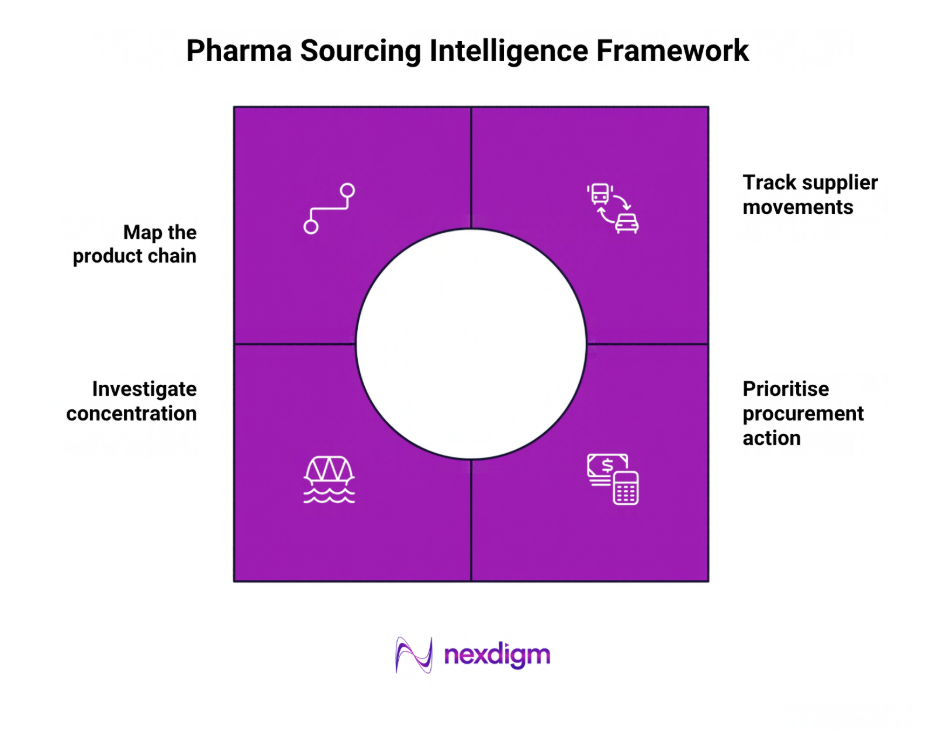
- Map the product chain: Separate APIs, intermediates, and finished medicines using relevant product classifications.
- Track supplier movements: Compare origin shares, trade values, quantities and recurring relationships across reporting periods.
- Investigate concentration: Identify shared upstream dependencies and distinguish route changes from genuine source diversification.
- Prioritise procurement action: Combine trade signals with supplier qualification, lead times, inventory exposure and switching costs to guide sourcing reviews.
This framework helps procurement and supply-chain teams turn cross-border trade records into a clearer view of sourcing dependencies and changing supplier networks.
Case Study: Reviewing API Sourcing Patterns
A pharmaceutical manufacturer reviewed 18 APIs across seven origin countries and compared trade patterns with its approved-vendor records. The analysis flagged four ingredients for concentration review. Procurement initiated alternative-source qualification for two and updated contingency plans for the other two.
To take the next step, simply visit our Request a Consultation page and share your requirements with us.
Harsh Mittal
+91-8422857704