

Pharmaceutical bills of lading can provide a closer view of cross-border product movement than aggregate trade statistics. Where shipment records are available, they may identify shippers, consignees, product descriptions, ports, carriers, and shipment dates. Analysed over time, these details can help businesses investigate sourcing patterns, customer relationships, and changes in competitor activity.
Coverage differs by country; some fields may be withheld or incomplete, and a shipment record does not establish the final commercial terms or prove that a buyer has entered an exclusive relationship with a supplier. The value comes from combining repeated shipment signals with other evidence.
Reading Shipment Records as Commercial Signals
A single shipment offers a snapshot. A sequence of shipments can reveal a more meaningful pattern: whether a supplier serves a destination regularly, whether a buyer is receiving a new product category or whether a shipping route has changed.
For pharmaceutical analysis, the first step is to distinguish finished formulations from active pharmaceutical ingredients, intermediates, and other inputs. These products serve different buyers and have different implications for market demand and supply-chain resilience.
Shipment records can help answer several questions:
- Who is shipping? Identify recurring exporters and distinguish manufacturers from trading intermediaries where the data supports that classification.
- Who is receiving? Track consignees and importers to identify active buying organisations and changes in their sourcing relationships.
- What is moving? Normalise product descriptions and use available classification codes to group comparable medicines or ingredients.
- How frequently does it move? Compare shipment timing and frequency to distinguish recurring supply from one-off transactions.
- Which routes are changing? Monitor origin, destination and port patterns to investigate possible sourcing shifts or logistics changes.
Why Pharmaceutical Sourcing Needs Upstream Visibility
The commercial stakes can be significant when a product depends on a concentrated upstream supply base. In 2025, China accounted for 86% of EU imports of penicillin active pharmaceutical ingredients, up from 44% in 2019, according to reporting on the European supply chain. This sharp increase demonstrates how dependence can grow within a specific ingredient category even when broader pharmaceutical trade looks diversified.
Shipment analysis can help companies investigate whether their own sourcing relationships show similar concentration. However, it cannot reliably establish the full manufacturing origin if the available records identify only an intermediary or shipment location. Companies should verify critical supplier relationships through qualification documents, manufacturer disclosures and regulatory information.
The same caution applies to competitor analysis. A rise in observed shipments may indicate increased activity, but it could also reflect inventory replenishment, changes in reporting coverage or shipments routed through a new intermediary.
Using Shipment Records for Pharmaceutical Market Intelligence
Effective pharmaceutical bill of lading analysis combines shipment records, supplier relationships, product descriptions and destination data to identify sourcing shifts, customer connections and competitor movements.
Tracking these signals over time helps companies distinguish sustained changes in trade activity from isolated shipments, reporting gaps, or changes in logistics routes.
- Map supplier-customer relationships: Identify recurring shipment links and determine which relationships merit further validation.
- Detect changes in activity: Track shipment frequency, product mix and route changes to flag possible expansion, sourcing shifts or interruptions.
- Compare competitor presence: Assess which exporters appear to serve a destination or product segment, while accounting for gaps in data coverage.
- Investigate sourcing risk: Identify concentration in origins, intermediaries and critical ingredients, then verify whether apparently different suppliers share upstream exposure.
- Validate the signal: Cross-check findings against customs statistics, regulatory records, company disclosures and direct market research.
Before using a dataset, buyers should confirm which countries are covered, whether records are direct or mirrored, how far back the data extends, and whether company names, quantities and product descriptions are consistently reported. Those details determine how confidently the results can be interpreted.
Nexdigm’s Shipment-Signal Validation Framework
Nexdigm can turn shipment observations into a structured decision process:
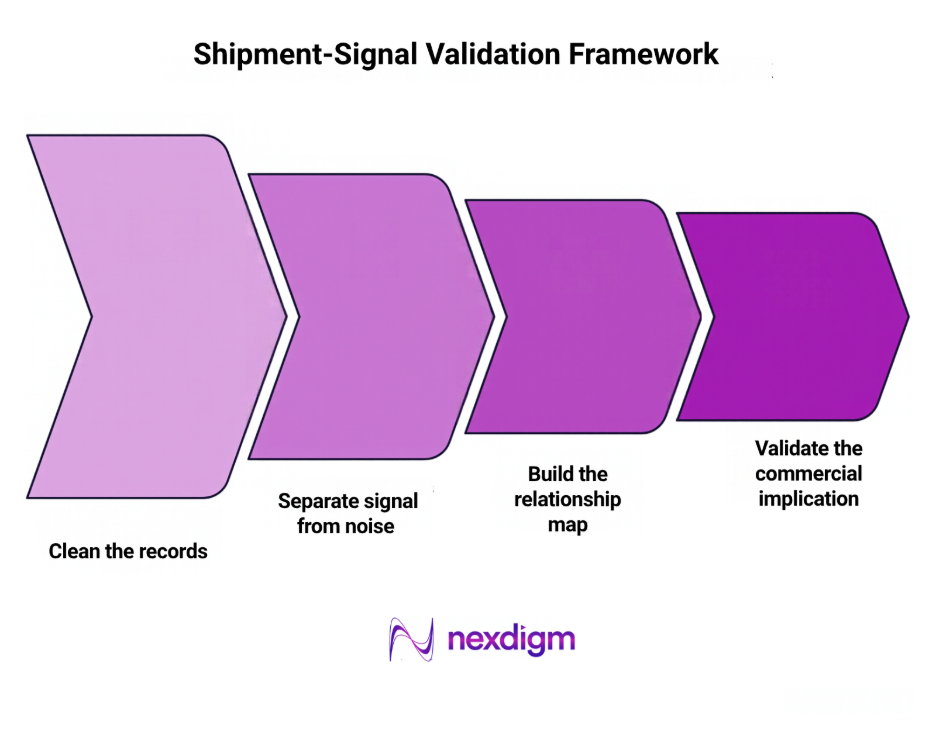
- Clean the records: Standardise entity names, product descriptions, dates and available shipment identifiers.
- Build the relationship map: Link recurring exporters, importers, products and routes without assuming that every link is a formal partnership.
- Separate signal from noise: Test whether changes persist across multiple shipments and periods and identify alternative explanations.
- Validate the commercial implication: Confirm the most important findings through independent trade statistics, regulatory information and market research before making sourcing or competitive decisions.
This process helps businesses use shipment intelligence as an early-warning and market-discovery tool, rather than treating it as a complete record of commercial activity.
Case Study: Detecting a Sourcing Shift
A pharmaceutical procurement team reviewed 1,250 shipment records covering 18 months across 12 suppliers. The analysis flagged a 31% rise in observed shipments from a new origin and identified two incumbent suppliers using the same intermediary. The team-initiated qualification checks before changing its approved sourcing mix.
To take the next step, simply visit our Request a Consultation page and share your requirements with us.
Harsh Mittal
+91-8422857704