

Contract manufacturing gives pharmaceutical companies access to production infrastructure, specialised processes and technical expertise without requiring them to build every capability internally. It can support portfolio expansion, market entry, capacity flexibility, and the manufacture of products that require specialised facilities.
The sourcing challenge is finding a partner whose manufacturing capabilities match the product and destination market. A low conversion charge is of limited value if the facility cannot manufacture the required dosage form, accommodate the intended batch size or meet the relevant regulatory expectations. The most suitable partner is therefore determined by the relationship between product requirements, facility capability, and commercial terms.
The Product Determines Which Manufacturing Partner Is Relevant
Pharmaceutical contract manufacturing covers several distinct production categories. Conventional tablets and capsules require different infrastructure from sterile injectables, topical formulations, or complex biological products. A manufacturer should be assessed against the process it will actually perform, rather than its total facility size or broad product portfolio.
The main categories include:
- Oral solid dosage: Tablets, capsules and other solid formulations, with capabilities influenced by granulation, compression, coating and packaging equipment.
- Sterile manufacturing: Injectable products requiring specialised aseptic processing, environmental controls and container-closure systems.
- Liquid and topical formulations: Products such as syrups, suspensions, creams and ointments, which require formulation-specific production and packaging capabilities.
- Specialised formulations: Modified-release products, complex generics and other formulations requiring more advanced process development or manufacturing controls.
This distinction also clarifies the difference between contract manufacturing organisations (CMOs) and contract development and manufacturing organisations (CDMOs). A CMO may manufacture an established formulation, while a CDMO can also support development, scale-up, process optimisation and technology transfer. Buyers should establish which services are actually available at the proposed facility.
Facility Capability and Regulatory Readiness Determine Partner Fit
The manufacturer’s facility is often more important than its corporate profile. Pharmaceutical groups may operate multiple plants with different product portfolios, equipment, approvals and inspection histories. A company with experience in regulated markets may still have facilities that are not approved for every product or destination.
The assessment should examine the specific site, dosage form, and regulatory market. Relevant considerations include GMP credentials, manufacturing licences, inspection history, quality documentation, data integrity, and the facility’s experience with comparable products.
Technology transfer also deserves attention. Moving a formulation from one manufacturer to another can involve changes in equipment, process parameters, analytical methods, and packaging. The partner needs technical resources to manage these activities without compromising product consistency.
For this reason, regulatory readiness should be treated as a product- and facility-specific requirement. A general statement that a company exports to regulated markets is not enough to establish the suitability of every manufacturing site.
Production Economics Depend on Batch Size and the Scope of Services
Contract manufacturing quotations can be difficult to compare because suppliers may include different activities in their prices. One manufacturer may quote only the conversion charge, while another may include packaging, testing or selected development services.
A fair comparison needs to account for the complete manufacturing arrangement. Raw materials, batch size, production yield, packaging, quality testing, technology transfer, product development and freight can all affect the final cost. Minimum order quantities are particularly important when the buyer’s demand is variable or relatively small.
Capacity availability can also change economics. A facility may have substantial installed capacity, but limited production windows because of existing customer commitments. Specialised equipment, sterile lines and particular packaging formats can create bottlenecks even when the overall plant appears underutilised.
India’s Manufacturing Investment Is Expanding the Potential Partner Base
India’s pharmaceutical manufacturing ecosystem has attracted investment through production-linked incentive programmes and other policy initiatives. These investments cover selected high-value products, APIs, intermediates, and manufacturing capabilities.
For buyers, this creates a broader set of potential manufacturing partners, but it does not mean every new facility is suitable for contract production. New capacity needs to be assessed by product category, technology, regulatory status, and commercial availability.
Companies such as Akums Drugs and Pharmaceuticals, Syngene International and Laurus Labs participate in different parts of the contract manufacturing and development ecosystem. Their operating models vary, so buyers should distinguish between formulation manufacturing, API production, development services, and broader CDMO capabilities.
A focused pharmaceutical contract manufacturing sourcing exercise helps identify relevant partners and compare their actual production scope. Nexdigm’s procurement research can support CMO and CDMO mapping, facility profiling, capacity analysis and regional market comparisons. Technical audits, product qualification and manufacturing approval remain with the pharmaceutical company and its quality and regulatory teams.
Pharmaceutical Contract Manufacturing Sourcing Framework
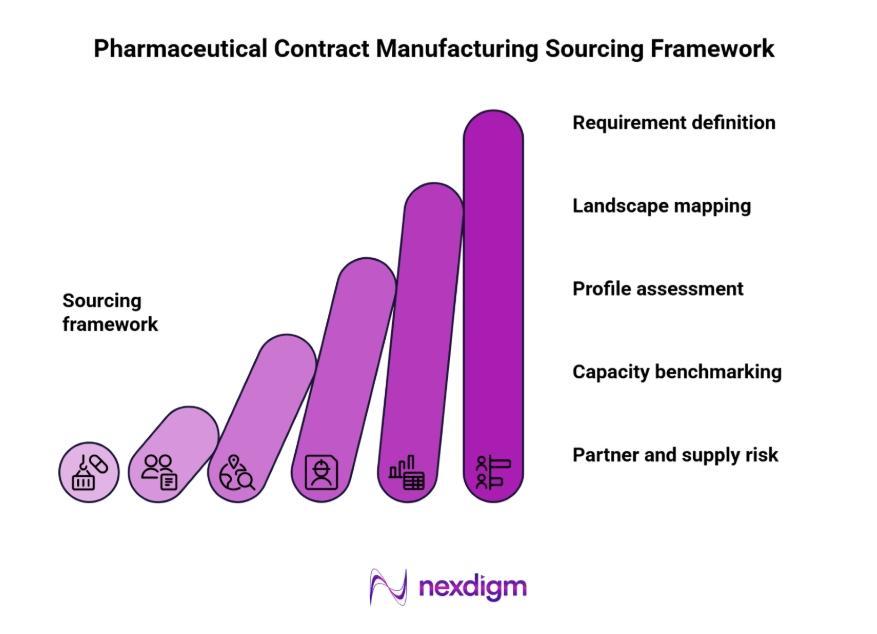
- Product and outsourcing requirement definition: Specify dosage form, formulation, batch size, packaging, annual demand and target markets.
- CMO and CDMO landscape mapping: Identify manufacturers by production technology, facility location, product category and service scope.
- Regulatory and technical-profile assessment: Review site credentials, relevant market experience, documentation capabilities and development or technology-transfer support.
- Capacity and cost benchmarking: Compare production capacity indicators, minimum batch sizes, conversion charges, testing, packaging and logistics costs.
- Partner-fit and supply-risk assessment: Evaluate geographic concentration, customer commitments, input dependencies, expansion potential and alternative manufacturing options.
Case Study: Identifying Contract Manufacturing Partners
A pharmaceutical company planning to outsource 2 formulation categories needed to compare production partners across domestic and export markets. Nexdigm’s research mapped 19 manufacturers across 4 regions, assessed dosage-form capabilities and regulatory-market presence, and identified 5 facilities for further technical and commercial evaluation.
To take the next step, simply visit our Request a Consultation page and share your requirements with us.
Harsh Mittal
+91-8422857704