
Pharmaceutical logistics is moving beyond conventional warehousing as biologics, specialty medicines, vaccines, advanced therapies, and temperature-sensitive products become a larger part of healthcare supply chains.
The global prescription medicine market reached approximately $1.7 trillion in 2025, growing around 10% year over year, according to IQVIA. At the same time, biologics are taking a larger share of pharmaceutical spending. In the United States, biologics represented 54% of manufacturer net drug spending in 2024, compared with 43% in 2019.
Temperature-sensitive products are particularly important. IQVIA estimates that cold-chain medicines represented 32% of global pharmaceutical value in 2021, worth approximately $384 billion, despite representing only 0.2% of pharmaceutical volume.
These shifts are changing requirements across storage, transportation, packaging, monitoring, inventory management, compliance, and distribution.
For pharmaceutical manufacturers, distributors, wholesalers, 3PL providers, healthcare companies, logistics operators, cold-storage developers, investors, and technology providers, the priority is understanding where pharmaceutical logistics demand is expanding, what capabilities are required, and where infrastructure investment can create value.
A Pharmaceutical logistics market opportunity analysis connects pharmaceutical growth with logistics capacity, product requirements, geographic demand, operating economics, and infrastructure readiness.
Pharmaceutical Logistics Is Becoming More Specialized
Pharmaceutical supply chains are becoming more complex as product portfolios shift toward high-value and temperature-sensitive therapies.
Traditional medicines may require standard controlled storage, while biologics, vaccines, cell and gene therapies, and other advanced products can demand tighter temperature management and specialized handling.
WHO guidance specifies that temperature-sensitive pharmaceuticals may require controlled conditions during transportation, including calibrated temperature monitoring and appropriate packaging.
This means logistics infrastructure must evolve alongside the pharmaceutical products it serves.
How Nexdigm Reads the Changing Logistics Need
Pharmaceutical growth does not create the same logistics requirement in every market.
A market with strong vaccine distribution may need refrigerated transport and 2–8°C storage. A biologics-heavy market may require more sophisticated monitoring and specialized facilities. Advanced therapies can create additional requirements around speed, security, handling, and shipment visibility.
Nexdigm connects product characteristics, pharmaceutical demand, geographic distribution, infrastructure, transportation, and operational requirements to understand how logistics needs are changing. This provides a broader view of the opportunity than simply measuring warehouse capacity.
The Main Demand Drivers
Several pharmaceutical trends are reshaping logistics requirements.
- Biologics expansion: Increasing biologics adoption creates greater demand for temperature-controlled storage, specialized packaging, and reliable transportation.
- Advanced therapies: Cell and gene therapies can require highly coordinated logistics because of sensitivity, value, timing, and specialized handling.
- Healthcare access: Expanding healthcare systems create additional demand for pharmaceutical distribution networks beyond established markets.
Nexdigm’s Pharmaceutical Logistics Opportunity Framework
Nexdigm’s experts use framework model to conduct Pharmaceutical logistics market opportunity analysis. This process focuses on five major areas. The framework connects pharmaceutical growth with the practical logistics capabilities required to store, transport, monitor, and distribute increasingly specialized products by conducting:
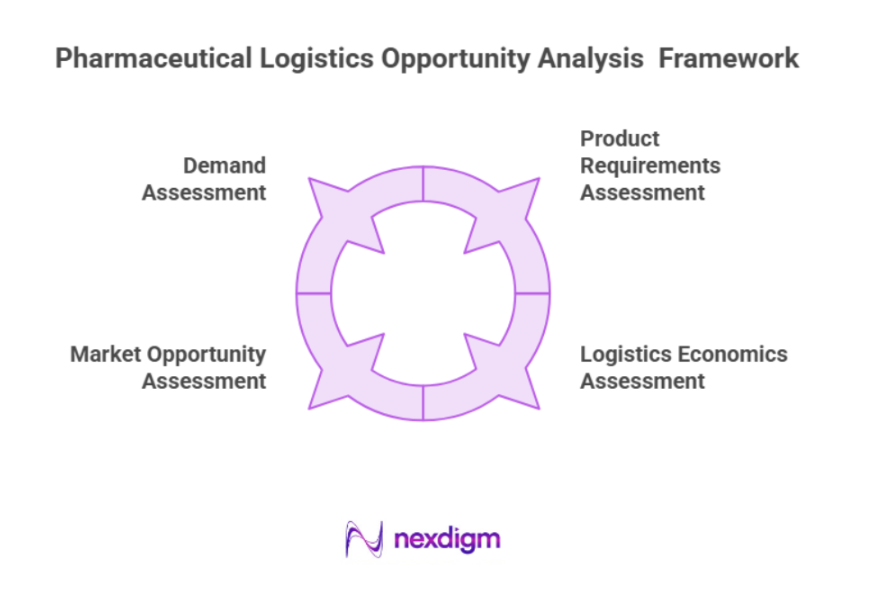
- Demand Assessment: Assessment of current and future pharmaceutical demand by evaluating medicine consumption, biologics adoption, specialty therapy growth, and healthcare expansion trends. The analysis helps identify markets where increasing healthcare needs may drive demand for specialized logistics services.
- Product Requirements Assessment: Evaluation of the storage, handling, and distribution requirements of pharmaceutical products. The assessment focuses on temperature sensitivity, handling complexity, product stability, and compliance needs that influence logistics design and operational capabilities.
- Logistics Economics Assessment: Analyzing the economic factors associated with pharmaceutical logistics operations, including transportation costs, storage expenses, compliance requirements, and capital investment needs. The evaluation helps assess the financial viability of logistics infrastructure and service expansion.
- Market Opportunity Assessment: Identifying areas where demand growth, infrastructure gaps, and specialized pharmaceutical requirements may create attractive opportunities for logistics providers and investors. The assessment highlights potential markets for capacity expansion and differentiated service offerings.
How Nexdigm Finds the Strongest Opportunities
The strongest pharmaceutical logistics opportunities typically emerge where medicine demand, specialty-product growth, infrastructure gaps, transportation connectivity, and favorable economics overlap.
Nexdigm brings these factors together to identify markets where specialized warehouses, cold-chain facilities, transportation capacity, monitoring systems, or logistics technology can create measurable value.
The objective is not simply to add pharmaceutical logistics capacity. It is to build the right capabilities around the products, markets, and healthcare networks driving future demand.
Nexdigm in Selecting Priority Growth Opportunities
Nexdigm assesses opportunities through a combination of market demand, infrastructure readiness, operational feasibility, and investment attractiveness. This helps organizations identify the pharmaceutical logistics areas with the greatest potential for growth, scalability, and long-term value creation, enabling more focused and informed investment decisions.
Nexdigm’s Case
A pharmaceutical distributor used Nexdigm’s Pharmaceutical logistics market opportunity analysis to identify capacity gaps and improve distribution planning. Within 10 months, inventory accuracy increased 26%, delivery reliability improved 21%, logistics costs declined 16%, and temperature-related shipment exceptions fell 24%, strengthening operational performance and supporting scalable growth.
To take the next step, simply visit our Request a Consultation page and share your requirements with us.
Harsh Mittal
+91-8422857704