

A pharmaceutical product’s purchase price does not always reveal whether it is being sourced competitively. The total cost is shaped by API prices, excipients, formulation complexity, packaging, manufacturing, logistics and commercial conditions. A low quotation may become less attractive when it carries high minimum order quantities, expensive freight or inflexible payment terms.
For pharmaceutical companies, hospitals and institutional buyers, cost benchmarking should establish where price differences originate and whether current purchasing arrangements reflect market conditions. The answer depends on the product, supplier market, regulatory environment and structure of the commercial agreement.
API and Material Prices Set the Foundation for Product Economics
For many formulations, the API is one of the most significant cost inputs. Its price depends on the complexity of the molecule, manufacturing route, availability of key intermediates, production scale and concentration of qualified suppliers. Excipients, solvents and specialised packaging materials add further exposure.
The impact varies by product. A conventional tablet may be particularly sensitive to API and packaging costs, while sterile injectables involve additional requirements for aseptic processing, specialised containers and testing. Biologics have different production economics because of their complex manufacturing processes and specialised infrastructure.
Procurement teams should therefore avoid applying a uniform inflation assumption across an entire pharmaceutical portfolio. The cost structure of each major product category needs to be understood separately.
Manufacturing Complexity Explains Why Similar Products Can Have Different Costs
Manufacturers with large production volumes may benefit from better facility utilisation and purchasing economies. However, scale does not guarantee the lowest unit price. Product complexity, batch size, process yield, technology requirements and regulatory-market obligations all influence manufacturing economics.
Consider two suppliers producing the same broad dosage form. One may operate a highly automated facility with large batches, while the other may manufacture smaller quantities across a more specialised production line. Their conversion costs and overhead allocation will differ, even before material prices are considered.
A meaningful comparison should account for the product specification, batch size, yield, production process, packaging configuration and testing requirements. Without these adjustments, price comparisons may reflect different manufacturing assumptions rather than genuine differences in supplier competitiveness.
Price Controls Influence the Commercial Conditions of Pharmaceutical Sourcing
India’s pharmaceutical pricing framework adds another dimension to procurement analysis. Under the Drugs (Prices Control) Order, 2013, the National Pharmaceutical Pricing Authority fixes ceiling prices for scheduled formulations included in the relevant schedule. Other provisions apply to non-scheduled formulations.
This means that buyers need to distinguish between regulated ceiling prices, manufacturer selling prices, distributor margins and the final landed cost under their purchasing arrangements. The commercial scope for price changes can differ depending on the product’s regulatory classification.
The relevant pricing conditions should be checked for the specific formulation and pack configuration. Two products with similar names may have different strengths, dosage forms or packaging, making direct comparison unreliable.
Commercial Terms Can Change the Value of a Quotation
The lowest unit price may not produce the lowest total procurement cost. A supplier may offer a lower rate in exchange for larger order quantities, shorter payment periods or longer purchase commitments. Another may charge more per unit but provide greater delivery flexibility or better regional availability.
A commercial comparison should examine the full purchasing arrangement, including:
- Minimum order quantities and batch-size commitments.
- Volume discounts and price validity periods.
- Payment terms and credit arrangements.
- Freight, insurance, packaging, and taxes.
- Inventory holding and expiry-related exposure.
- Price revision clauses and contract duration.
These factors are particularly important for products with uneven demand or limited shelf life. Large purchases may improve unit pricing but increase working-capital requirements and the risk of unused inventory.
External Market Benchmarks Help Explain Internal Purchase Prices
Internal procurement records can show which products have become more expensive, but they do not necessarily explain why. External market intelligence helps distinguish between increases driven by APIs and other inputs, supplier-specific pricing, regional manufacturing costs or changes in commercial terms.
A structured pharmaceutical procurement cost benchmarking exercise can compare product prices, input-cost exposure, regional manufacturing economics and supplier commercial arrangements. It can also identify categories where the buyer’s purchasing conditions differ from prevailing market conditions.
Nexdigm’s procurement research can support this work through supplier-market mapping, API and input-price analysis, regional cost comparisons and examination of commercial structures. This gives procurement teams an external reference point for assessing supplier competitiveness and understanding the market conditions behind price movements.
Pharmaceutical Procurement Cost Benchmarking Framework
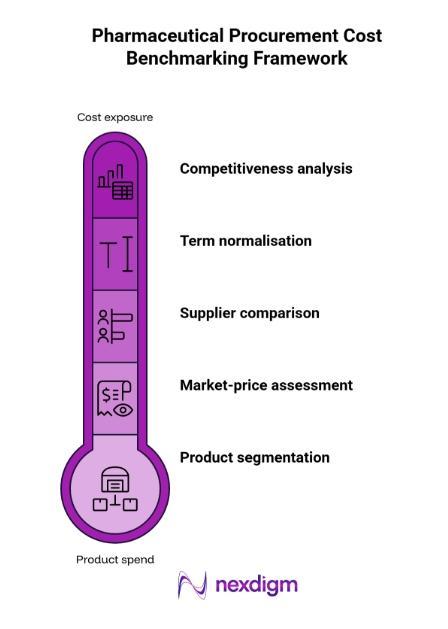
- Product and spend segmentation: Organise purchasing data by molecule, dosage form, strength, pack size, supplier and purchasing volume.
- Input and market-price assessment: Examine API, excipient, packaging, energy and freight cost movements relevant to each product category.
- Manufacturing and supplier comparison: Compare production scale, process complexity, facility footprint and supplier-market positioning.
- Commercial-term normalisation: Align minimum order quantities, discounts, payment terms, freight, taxes and price revision conditions.
- Cost competitiveness and exposure analysis: Identify price differences, regulatory constraints, supplier concentration and categories requiring deeper sourcing review.
Case Study: Benchmarking Pharmaceutical Procurement Costs
A pharmaceutical buyer reviewing expenditure across multiple formulations needed to understand supplier price differences. Nexdigm’s research compared 35 product categories across three markets, examined input-cost and commercial factors, and identified eight categories where pricing structures or supplier concentration warranted further review.
To take the next step, simply visit our Request a Consultation page and share your requirements with us.
Harsh Mittal
+91-8422857704