

Pharmaceutical raw material sourcing has become a strategic supply-chain issue as manufacturers manage geographically dispersed production, concentrated suppliers, regulatory requirements, and recurring shortages. In 2025, 44% of API manufacturing sites serving the U.S. market were located in India and 22% in China, compared with only 11% in the U.S.
The exposure extends beyond APIs. Pharmaceutical supply chains can involve key starting materials, intermediates, excipients, and other inputs sourced through multiple tiers and geographies. The OECD notes that pharmaceutical supply chains are highly complex and multi-tiered, with raw materials and APIs frequently sourced internationally.
Supply concentration can also create resilience concerns. OECD analysis found that more than half of all APIs were produced by only one to five suppliers, highlighting the potential impact of limited sourcing options.
Against this backdrop, pharmaceutical raw material sourcing research can help companies understand supplier concentration, geographic exposure, manufacturing capabilities, sourcing alternatives, cost dynamics, and supply-continuity risks before making strategic procurement decisions.
Global Sourcing Creates Both Efficiency and Exposure
Global sourcing can provide pharmaceutical companies with cost advantages, specialized manufacturing capabilities, broader supplier access, and production scale. However, dependence on concentrated markets can also increase exposure to disruptions. Three factors are particularly important:
- Cost & Manufacturing Scale: Access global suppliers offering competitive pricing, specialized capabilities, established infrastructure, and production capacity for critical pharmaceutical materials.
- Geographic & Supply Exposure: Assess dependence on specific countries, regions, suppliers, logistics routes, and manufacturing clusters that could amplify disruption risks.
- Resilience & Diversification: Identify alternative suppliers, sourcing markets, and geographic options that can reduce concentration while maintaining quality and regulatory requirements.
A balanced sourcing strategy therefore needs to consider both the economic benefits of global supply markets and the resilience risks they can create.
Critical Materials Require a More Resilient Sourcing View
Sourcing decisions for critical pharmaceutical materials increasingly involve more than price and supplier availability. Quality requirements, geographic concentration, manufacturing capacity, regulatory exposure, lead times, and alternate-source availability can all influence supply continuity. Companies therefore need a broader view of sourcing markets to identify where cost advantages may be offset by concentration or disruption risks and where diversification could strengthen long-term procurement resilience.
Supplier Qualification Can Reshape Sourcing Options
A potentially attractive sourcing market may still have limited practical value if suppliers cannot meet pharmaceutical qualification requirements. Quality systems, regulatory documentation, manufacturing consistency, audit readiness, technical capabilities, and qualification timelines can influence how quickly an alternative source can become viable.
Nexdigm can help organizations factor these considerations into market research, providing a more realistic view of which suppliers are commercially available versus those that are practically accessible for qualified pharmaceutical sourcing.
Nexdigm’s Expertise in Assessing Supplier Qualification and Readiness
Nexdigm can evaluate potential raw material suppliers beyond basic availability by examining the factors that determine their practical readiness for pharmaceutical sourcing. These factors are:
- Quality & Regulatory Readiness: Assess quality systems, certifications, regulatory standing, documentation, audit readiness, and other requirements relevant to supplier qualification.
- Manufacturing Capability: Examine production capacity, technical expertise, manufacturing processes, product consistency, and ability to meet required specifications and volumes.
- Supply & Commercial Readiness: Evaluate lead times, geographic location, logistics, scalability, pricing considerations, and continuity capabilities to understand the supplier’s broader sourcing potential.
This helps pharmaceutical companies distinguish between suppliers that appear available in the market and those that are realistically capable of becoming qualified and reliable sourcing partners.
How Nexdigm’s Experts Turn Supplier Readiness Into Sourcing Resilience
Once supplier readiness is established, pharmaceutical companies can evaluate how each qualified or potentially qualified supplier contributes to overall sourcing resilience. Nexdigm can help compare supplier concentration, geographic diversity, capacity availability, lead times, commercial attractiveness, and alternative-source potential to identify where the sourcing base may remain exposed. This can support decisions around dual sourcing, geographic diversification, secondary suppliers, and contingency planning for critical materials.
Nexdigm’s Pharmaceutical Raw Material Sourcing Assessment
As part of its pharmaceutical raw material sourcing research, experts at Nexdigm can structure the assessment to move from global market understanding to supplier prioritization and sourcing-risk mitigation through the following steps:
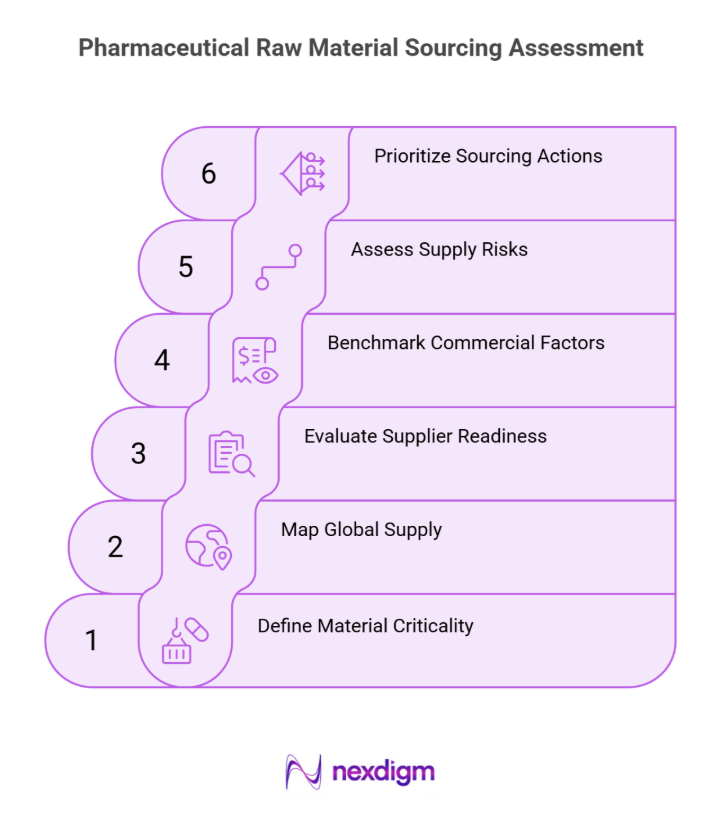
- Define Material Criticality: Identify APIs, intermediates, excipients, and other materials based on strategic importance, supply sensitivity, and business requirements.
- Map Global Supply: Identify relevant suppliers, manufacturing locations, production capabilities, sourcing markets, and geographic dependencies.
- Evaluate Supplier Readiness: Assess quality, regulatory standing, manufacturing capacity, technical capabilities, lead times, and qualification requirements.
- Benchmark Commercial Factors: Compare pricing dynamics, cost drivers, minimum order requirements, contractual considerations, logistics, and overall sourcing economics.
- Assess Supply Risks: Examine supplier concentration, geographic exposure, capacity constraints, disruption history, logistics dependencies, and continuity capabilities.
- Prioritize Sourcing Actions: Translate findings into supplier shortlists, diversification priorities, qualification opportunities, and risk-mitigation actions.
This provides a structured basis for balancing cost, quality, availability, qualification feasibility, and supply resilience across critical pharmaceutical raw materials.
Nexdigm’s Case
Nexdigm supported a pharmaceutical manufacturer in reviewing 42 critical raw material supply relationships across 18 sourcing markets. The analysis found that 23% of materials had high single-source exposure, while 31% depended heavily on one geographic region. Nexdigm’s assessment identified 14 diversification opportunities, helping the company prioritize alternate suppliers and markets for qualification.
To take the next step, simply visit our Request a Consultation page and share your requirements with us.
Harsh Mittal
+91-8422857704