

Pharmaceutical sourcing involves a supplier ecosystem that extends from active pharmaceutical ingredients (APIs) and excipients to finished formulations, packaging materials and contract manufacturing services. Each category has different technical requirements, regulatory obligations and supply-chain dependencies. A supplier that offers competitive pricing may still be unsuitable if its manufacturing capacity is constrained, its product portfolio does not match the required specifications or its regulatory documentation is inadequate.
For pharmaceutical companies, distributors, healthcare institutions and procurement teams, supplier evaluation must connect commercial considerations with manufacturing capability and regulatory standing. The objective is to understand which suppliers can meet the required product, market and supply conditions.
Understanding the Pharmaceutical Supplier Base
Pharmaceutical suppliers operate at different stages of the value chain:
- API manufacturers: Produce active ingredients used in finished drug formulations. Their capabilities depend on chemistry, process technology, production scale and regulatory approvals.
- Excipient suppliers: Provide materials used to support formulation stability, consistency, delivery and manufacturing.
- Finished dosage manufacturers: Produce tablets, capsules, injectables, liquids, topical products and other formulations.
- Contract development and manufacturing organisations (CDMOs): Support selected development, scale-up and commercial manufacturing requirements.
- Packaging suppliers: Provide primary and secondary packaging materials, including blister packs, bottles, closures and specialised packaging systems.
Supplier comparisons should be conducted within relevant product categories. An API producer and a finished formulation manufacturer have different manufacturing processes, quality requirements and commercial structures.
Quality Systems and Regulatory Compliance
Quality is a fundamental consideration in pharmaceutical supplier assessment. Buyers should examine the supplier’s manufacturing credentials, product documentation, quality-management systems and regulatory track record.
Relevant evaluation areas include:
- Applicable manufacturing licences and regulatory registrations.
- Good Manufacturing Practices (GMP) compliance.
- Product specifications and certificates of analysis.
- Batch traceability and documentation controls.
- Stability data and product shelf-life information.
- Change-control and deviation-management processes.
- Regulatory inspection history and publicly available enforcement information.
Regulatory standing must be assessed in the context of the intended destination market. A supplier authorised to manufacture for one market may require additional approvals or documentation to supply another. WHO-GMP, national regulatory requirements and market-specific standards should not be treated as interchangeable.
India has strengthened its drug-quality oversight through risk-based inspections and regulatory action. A March 2026 government update reported that CDSCO and state authorities had conducted risk-based inspections of more than 960 drug manufacturing premises since December 2022, with more than 860 regulatory actions taken in response to non-compliance. This reinforces the importance of examining current supplier credentials rather than relying solely on historical approvals. <Cite refs={[“turn941171search7”]} />
Manufacturing Capacity and Supply Reliability
Nominal production capacity does not necessarily indicate the quantity available to a new customer. Suppliers may have existing commitments, product-specific bottlenecks, maintenance requirements or dependence on limited upstream inputs.
A capacity assessment should examine:
- Installed manufacturing capacity by product category.
- Current utilisation and available production windows.
- Number and location of manufacturing facilities.
- Production technology and batch-size flexibility.
- Availability of critical raw materials and intermediates.
- Expansion plans and investment in manufacturing infrastructure.
- Dependence on external manufacturers or specialist service providers.
Supply reliability also depends on the supplier’s upstream ecosystem. API manufacturers may depend on chemical intermediates, solvents and specialised inputs. Finished formulation producers may face exposure to imported APIs, packaging materials or specific excipients.
This makes sub-tier mapping important. A supplier with multiple manufacturing facilities may still depend on a concentrated source for a critical input.
Cost and Commercial Competitiveness
Pharmaceutical pricing depends on product complexity, input costs, production scale, regulatory requirements, packaging, logistics and market conditions. API prices may fluctuate with the availability of intermediates and manufacturing capacity, while finished dosage economics can depend on formulation complexity, batch size and packaging requirements.
Commercial comparisons should consider:
- Product price and applicable price controls.
- Minimum order quantities and batch-size requirements.
- Packaging and labelling costs.
- Freight, storage and distribution conditions.
- Payment terms and credit arrangements.
- Price revision mechanisms and contract duration.
- Availability of alternative strengths or formulations.
India’s Drugs (Prices Control) Order, 2013 provides the framework for regulating specified medicines, with NPPA fixing ceiling prices for formulations included in the relevant schedule. Buyers should account for applicable price controls when comparing domestic pharmaceutical suppliers and commercial offers.
Mapping the Pharmaceutical Supplier Landscape
India has a substantial pharmaceutical manufacturing ecosystem, spanning APIs, formulations, generics, biologics and contract manufacturing. Companies such as Sun Pharmaceutical Industries, Dr. Reddy’s Laboratories, Cipla, Lupin, Aurobindo Pharma, Zydus Lifesciences and several specialist manufacturers operate across different therapeutic and product categories.
Their scale, regulatory market exposure and product specialisation differ. A supplier with a broad formulation portfolio may not be the most relevant option for a specialised injectable or a particular API.
A structured pharmaceutical supplier analysis can help procurement teams compare manufacturers by product range, facility footprint, capacity indicators, regulatory-market presence and commercial positioning. Nexdigm’s procurement research can support supplier identification, market mapping, manufacturing footprint analysis and examination of regional supply conditions. Formal quality audits, regulatory inspections and product-release decisions remain the responsibility of qualified organisations and relevant authorities.
Pharmaceutical Supplier Assessment Framework
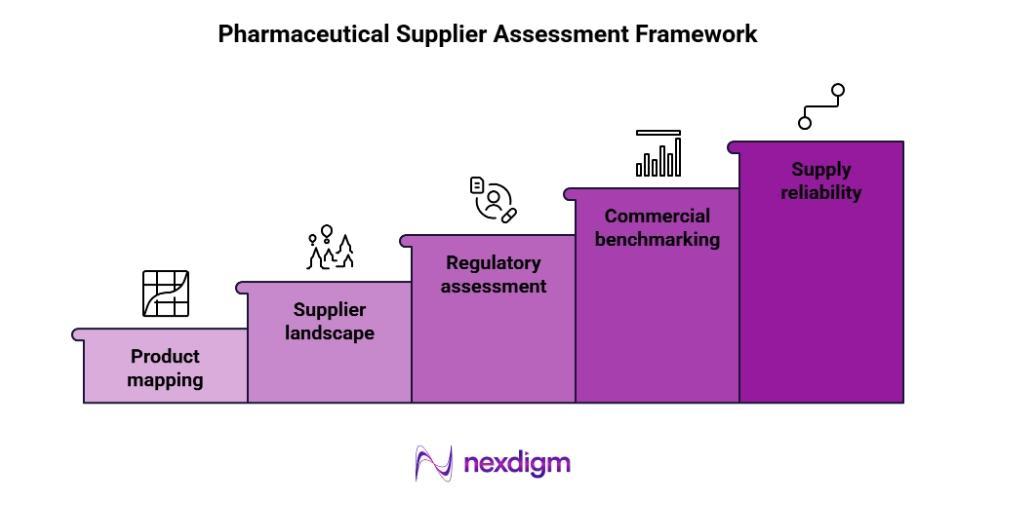
- Product and specification mapping: Define the API, formulation, strength, dosage form, quality specifications, target market and expected volumes.
- Supplier landscape identification: Map relevant manufacturers by product portfolio, manufacturing location, market presence and business specialisation.
- Regulatory and quality-profile assessment: Review applicable licences, GMP credentials, product documentation and publicly available regulatory history.
- Capacity and commercial benchmarking: Compare manufacturing scale, utilisation indicators, input dependencies, pricing, batch sizes and logistics conditions.
- Supply reliability and alternative-source analysis: Assess geographic concentration, upstream dependencies, product availability, expansion plans and potential alternative suppliers.
Case Study: Comparing Pharmaceutical Manufacturers
A pharmaceutical buyer reviewing suppliers for selected oral formulations needed greater visibility into manufacturing scale and regulatory-market presence. Nexdigm’s research mapped 25 manufacturers across four markets, compared product portfolios and facility footprints, and identified six suppliers for further regulatory, quality and commercial assessment.
To take the next step, simply visit our Request a Consultation page and share your requirements with us.
Harsh Mittal
+91-8422857704