

Pharmaceutical supply chains extend well beyond the finished medicine supplied to a pharmacy or hospital. Active pharmaceutical ingredients (APIs), chemical intermediates, excipients, packaging materials and finished formulations may cross several borders before reaching the final buyer. Trade intelligence helps companies trace these movements, identify concentrated sourcing relationships and investigate how upstream dependencies affect production continuity.
The challenge is that customs data does not automatically connect an ingredient shipment to the finished medicine made from it. Pharmaceutical supply-chain analysis therefore requires a structured approach to product classification, trading partners, manufacturing relationships and regulatory requirements.
Connecting Trade Data Across the Pharmaceutical Value Chain
Pharmaceutical products and inputs can appear under different HS headings. Finished medicines, bulk formulations and active ingredients are not always grouped together, while some chemicals used in pharmaceutical production also serve other industries. This makes broad import totals an unreliable measure of dependence on a particular ingredient.
The World Trade Organization’s Pharmaceutical Tariff Elimination Agreement illustrates the complexity: its coverage includes finished pharmaceutical products and thousands of active ingredients and chemical compounds identified through a combination of HS codes and product-specific references. The same source notes that pharmaceutical inputs do not share one common classification structure.
A useful trade dataset should therefore distinguish finished products from APIs and intermediates, then link them to known manufacturing sites and supplier relationships wherever evidence is available. Companies should document the limitations of each link rather than assume that a chemical import necessarily serves a particular drug-production line.
Identifying Hidden Dependencies in API Sourcing
Effective pharmaceutical supply chain trade intelligence connects ingredient-level import patterns with finished-product trade, supplier concentration and changes in origin-country shares. This can help procurement and supply-chain teams investigate dependencies that may not be visible in their immediate vendor lists.
For example, two API suppliers may appear to be independent while sourcing from the same upstream producer. Similarly, a company may purchase ingredients through distributors in several countries without meaningfully diversifying the manufacturing origin. Trade records can help identify these possibilities, but supplier disclosures and technical documentation are needed to confirm the actual relationship.
Concentration is not inherently a failure. A specialised ingredient may have few qualified producers because of technical complexity, regulatory requirements or limited production capacity. The commercial question is whether the concentration creates an exposure that the company can reduce at an acceptable cost.
A current European example illustrates the stakes. Reuters reported on 21 October 2026 that China accounted for 86% of EU imports of penicillin APIs in 2025, compared with 44% in 2019. This sharp change in origin concentration demonstrates why companies need to track critical ingredients separately rather than rely on aggregate pharmaceutical import figures.
From Trade Signals to Sourcing Decisions
Trade intelligence can support several practical decisions:
- Prioritise critical ingredients: Combine supplier concentration with product criticality, inventory cover, lead times and the availability of qualified alternatives.
- Investigate changes in sourcing: Track shifts in import quantities, origin shares and recurring supplier relationships to identify changes that warrant procurement review.
- Compare sourcing routes: Assess whether alternative trading partners represent genuinely different manufacturing sources or simply different routes for the same underlying supply.
- Review finished-product exposure: Connect ingredient dependencies with the medicines and production lines they support, using validated supplier and manufacturing information.
- Evaluate diversification costs: Compare alternative supplier pricing, qualification timelines, quality requirements, minimum order quantities and switching costs.
Trade values alone should not be treated as a direct measure of physical supply. Higher values can reflect prices or product mix, while a fall in recorded imports may result from stock drawdowns, reporting gaps or changes in purchasing schedules. These signals are most useful when checked against internal procurement and production data.
Nexdigm’s Pharmaceutical Supply-Chain Trade Framework
Nexdigm can support a structured review through four stages:
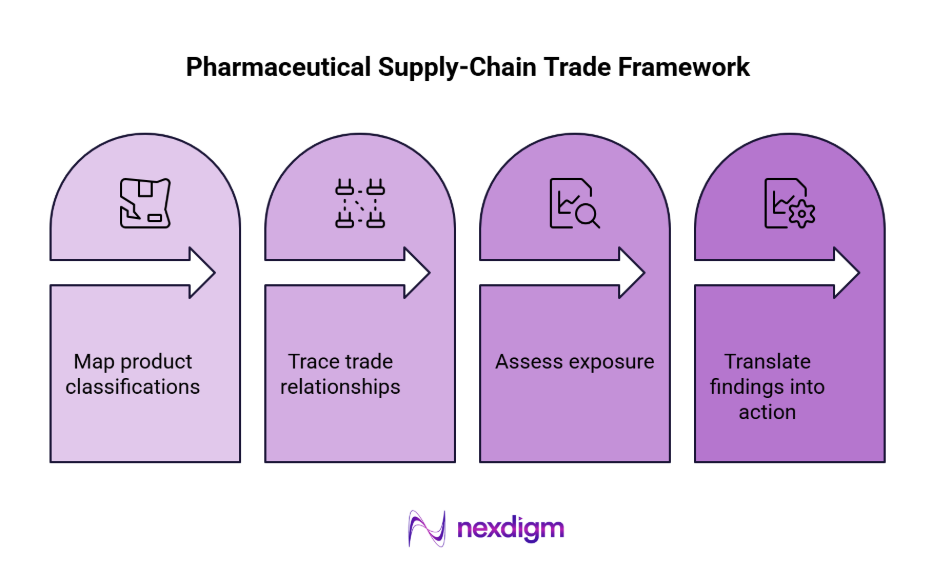
- Map product classifications: Separate APIs, intermediates and finished formulations, documenting relevant customs codes and data limitations.
- Trace trade relationships: Compare origins, exporters, importers and recurring flows to identify potential upstream dependencies.
- Assess exposure: Prioritise ingredients by supplier concentration, production criticality, lead time and availability of qualified alternatives.
- Translate findings into action: Support supplier due diligence, sourcing diversification and contingency planning using evidence from trade data and internal procurement records.
This approach links external trade patterns to operational decisions without treating customs records as a complete map of pharmaceutical manufacturing.
Case Study: Reviewing API Dependencies
A generic-medicines producer reviewed 20 APIs across nine origin countries and compared trade patterns with its approved supplier records. The analysis flagged five ingredients for deeper concentration review. Procurement initiated qualification discussions for two alternatives and updated contingency plans for three production-critical inputs.
To take the next step, simply visit our Request a Consultation page and share your requirements with us.
Harsh Mittal
+91-8422857704