

Pharmaceutical shipment data can help companies distinguish a market with growing medicine demand from one experiencing a temporary price increase, a stock-building cycle, or a change in sourcing. It can also reveal how suppliers compete across destinations and where manufacturers may face concentrated exposure to ingredients or intermediates.
The commercial value lies in linking trade flows to product economics. A market with rising imports may be attractive for a finished-dose exporter, while the same data may warn a manufacturer that its supply chain depends heavily on a narrow set of upstream producers.
What Shipment Data Can and Cannot Tell You
Shipment records and customs statistics help map product movement, origin countries, destination markets, shipment frequency, and declared value. When tracked over time, they can reveal changing supplier positions and potential shifts in demand.
But trade values need careful interpretation. A higher value can result from a greater quantity of medicines, a shift toward higher-priced therapies, changing product specifications, or currency effects. Shipment data also does not automatically identify the ultimate manufacturer when goods move through distributors or trading hubs.
Pharmaceutical analysis should therefore combine trade flows with product-level information and regulatory context. Finished formulations, active pharmaceutical ingredients (APIs), intermediates, and packaging materials occupy different positions in the value chain. Their supply risks and commercial opportunities should not be combined into one total.
Sourcing Concentration Is a Strategic Issue
Pharmaceutical supply chains can be globally distributed even when finished medicines appear to come from a diverse set of countries. A manufacturer may buy an API from one source, contract formulation to another producer, and sell the finished product through a third market. This can create hidden common dependencies across suppliers.
A 2026 report on Europe’s penicillin supply chain highlighted the extent of this exposure: China accounted for 86% of EU imports of penicillin APIs by 2025, compared with 44% in 2019. The change illustrates how quickly dependence can intensify within a critical product segment. It also shows why an aggregate pharmaceutical import figure is too broad to identify supply vulnerabilities.
For procurement teams, the implication is to map upstream inputs and qualified production sites, not just the immediate supplier. For exporters, concentrated sourcing may create opportunities for alternative supply, but qualification, quality assurance and cost competitiveness remain decisive.
Applying Shipment Data to Pharma Strategy
A robust assessment of pharmaceutical trade intelligence connects market demand, competitive positioning, and sourcing resilience. The analysis should answer three commercial questions: where can the company sell more, where is competition changing, and which inputs threaten continuity or margin?
- Identify demand by product: Track imports at the most specific reliable product level and compare value with quantity wherever available.
- Map competitive movement: Measure origin-country shares and identify whether suppliers are gaining ground through price, capacity, product mix or market access.
- Trace critical inputs: Connect finished medicines to APIs and intermediates to identify dependencies that may be shared across apparently different suppliers.
- Test market feasibility: Review registration requirements, pricing rules, tender structures, intellectual property constraints and distribution access.
- Model the economics: Compare selling price, manufacturing cost, freight, duties, distributor margins and working-capital exposure.
This combined view helps companies avoid two common errors: entering markets where import growth cannot be converted into viable margins, and diversifying suppliers without reducing the underlying dependency.
Nexdigm’s Pharmaceutical Trade Decision Framework
Nexdigm can turn shipment and customs data into an actionable strategy through four linked stages:
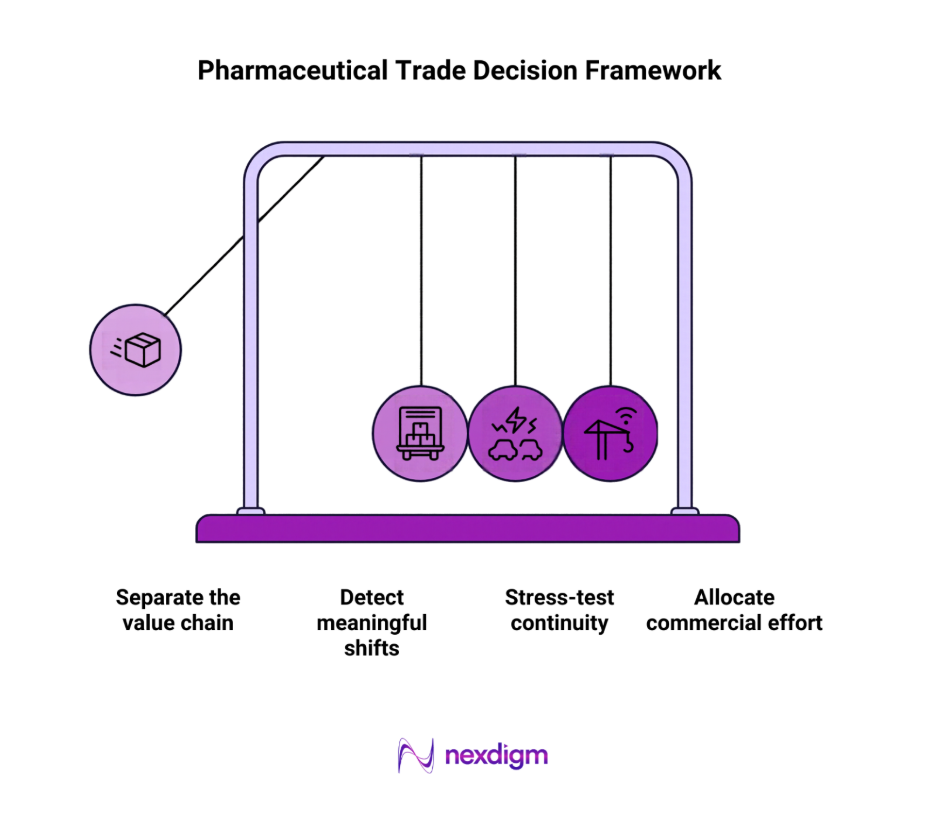
- Separate the value chain: Analyse finished products, APIs and intermediates independently, then map their commercial and supply relationships.
- Detect meaningful shifts: Distinguish volume growth from price and product-mix changes; identify sustained changes in supplier shares.
- Stress-test continuity: Assess concentration, alternative qualified sources, lead times and the cost of switching suppliers.
- Allocate commercial effort: Prioritise export markets, sourcing alternatives or product categories according to expected margin, access and supply resilience.
This approach connects market expansion with supply-chain strategy, allowing growth decisions to account for both revenue potential and exposure to disruption.
Case Study: Rebalancing Pharma Sourcing
A generic-medicines producer reviewed 22 products across 10 destination markets and traced 14 critical APIs to their origin countries. The assessment identified five products with concentrated upstream exposure and three export markets with improving import demand. Management prioritised two supplier qualification projects and focused export planning on the strongest two markets.
To take the next step, simply visit our Request a Consultation page and share your requirements with us.
Harsh Mittal
+91-8422857704