

The education sector remains one of the largest service industries, valued around USD 7 trillion with steady expansion driven by rising enrollment, digital learning adoption, and skills-focused education demand.
While the Philippines education sector is expanding steadily, supported by a large student base, digital learning adoption, and sustained public investment. The broader education market is valued around USD 31.2 billion,
Within this evolving education environment, employee engagement surveys help institutions strengthen teaching effectiveness, service delivery, and student experience.
They capture faculty and staff motivation, capability gaps, and workplace barriers, linking workforce engagement with academic quality and institutional reputation. Such insights support leadership decisions that enhance performance of culture, retention, and long-term institutional growth.
Education Engagement and Customer Insight Synergy
Education employee engagement surveys provide a holistic view of institutional performance by linking staff experience with student satisfaction and learning outcomes. They reveal how faculty motivation, support systems, and workplace conditions influence teaching quality, service responsiveness, and overall student perception of institutional value and credibility.
It also capture student and parent expectations, experience gaps, and loyalty drivers, while employee engagement surveys explain the workforce factors behind those outcomes. Integrating both insights enables institutions to align people strategy with learner needs, improve retention and reputation, and sustain academic and service excellence that supports long-term institutional growth.
Stepwise Benefits of Education Engagement and Customer Surveys
Education employee engagement and customer surveys create a structured pathway for institutions to diagnose workforce effectiveness, align it with learner expectations, and implement targeted improvements. Stepwise measurement from insight to action enables institutions to enhance teaching quality for institutional growth outcomes:
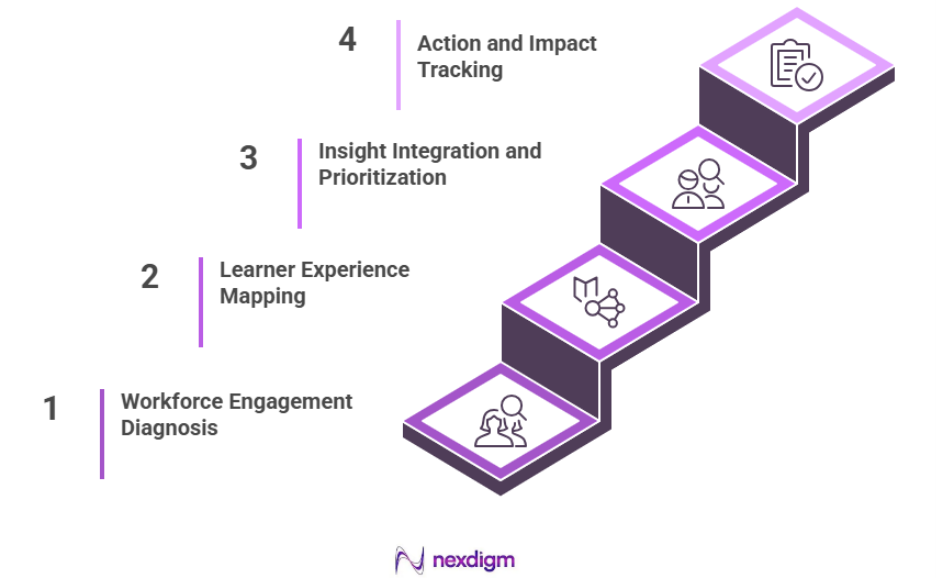
Workforce Engagement Diagnosis
Measures faculty and staff motivation, capability, and workplace enablers influencing teaching and service performance. Detailed diagnostics assess role clarity, workload balance, leadership support, collaboration culture, and professional development access and identifying barriers.
Learner Experience Mapping
Captures student and parent satisfaction, expectations, and perception gaps across academic and support journeys. Surveys examine classroom experience, communication quality, administrative efficiency, facilities, and support services, revealing how institutional interactions shape trust, engagement and loyalty throughout enrollment.
Insight Integration and Prioritization
Links workforce drivers with learner outcomes to identify highest-impact improvement areas for institutions. Advanced analytics correlate engagement factors with satisfaction, retention, and outcome indicators, enabling leadership to prioritize interventions were faculty capability.
Action and Impact Tracking
Implements targeted interventions and monitors progress in engagement, satisfaction, and institutional performance indicators. Institutions deploy training, support resources, and process improvements, while continuous pulse surveys and benchmarking track changes in faculty engagement ensuring sustained institutional growth.
Nexdigm’s Education Employee Engagement Survey
Nexdigm’s education employee engagement services help institutions align workforce effectiveness with student and parent experience outcomes that drive institutional growth.
Nexdigm’s consumer survey approach integrates faculty engagement diagnostics with learner satisfaction and expectation mapping, revealing how teaching capability, support systems, and service culture influence retention, outcomes, and reputation across academic and administrative environments.
Clients benefit from Nexdigm’s education-specific analytics that translate survey insights into targeted interventions across pedagogy support, staff development, and service delivery processes.
Workforce–Learner Experience Integration
Combines employee engagement and student or parent perception data to identify workforce drivers of satisfaction, learning quality, and institutional loyalty across academic journeys.
Action-Driven Education Performance System
Converts survey findings into prioritized actions in teaching support, staff training, and student services, with ongoing tracking to ensure measurable institutional growth outcomes.
Nexdigm Case:
A university partnered with Nexdigm to integrate faculty engagement and student experience surveys across five campuses. Analytics revealed teaching support gaps affecting satisfaction. Targeted development programs improved student satisfaction by 13% and faculty engagement by 15 percent within one academic year.
To take the next step, simply visit our Request a Consultation page and share your requirements with us.
Harsh Mittal
+91-8422857704