

The Philippines education market is expanding rapidly as a young population and digital adoption reshape demand for institutions. The online education segment alone reached USD 1,769.70 million and is projected to grow at about 24.48% annually through the late decade, reflecting strong enrollment and platform uptake.
Purchase intent refers to the likelihood that a prospective student plans to enroll in a specific institution or program within a defined period. In education surveys, purchase intent survey measures factors such as perceived value, affordability, trust, and fit with career goals, helping institutions forecast enrollment and optimize recruitment strategies with evidence-based targeting.
Insights from Purchase Intent–Focused Consumer Surveys
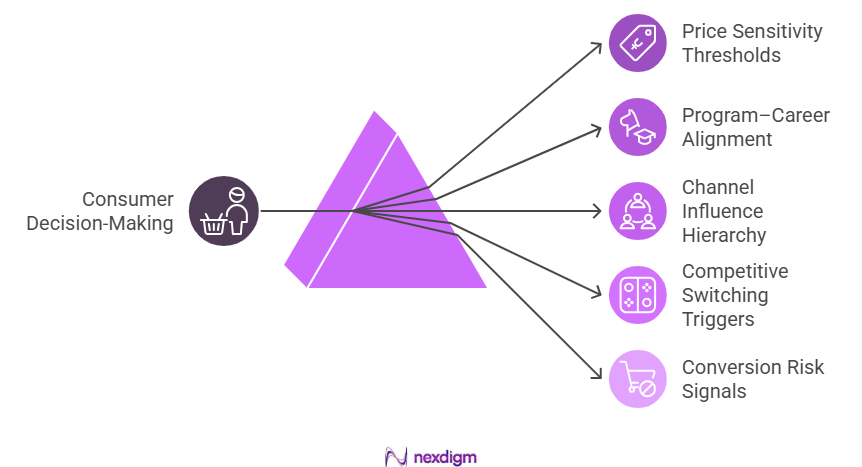
-
Decision drivers mapping
Identifies academic reputation, outcomes, affordability, and location factors shaping intent across segments, clarifying which attributes most strongly influence shortlist formation and final enrollment decisions among Filipino students and parents.
-
Price sensitivity thresholds
Reveals tuition tolerance, scholarship dependence, and financing expectations across income tiers, enabling institutions to calibrate pricing, aid packages, and payment structures to maximize conversion without eroding perceived value.
-
Program–career alignment
Measures perceived employability and industry relevance of courses, highlighting gaps between curriculum messaging and labor-market expectations that affect intent among students targeting overseas or high-growth sectors.
-
Channel influence hierarchy
Determines which touchpoints—school visits, digital platforms, counselors, alumni, or social proof—most affect intent formation, guiding marketing investment toward channels with highest conversion impact.
-
Competitive switching triggers
Identifies reasons prospects prefer or abandon competing institutions, such as facilities, faculty, or international links, enabling targeted differentiation strategies in crowded metropolitan education hubs.
-
Conversion risk signals
Flags barriers like documentation complexity, financial uncertainty, or location constraints that weaken intent late in the journey, allowing institutions to intervene before applicants withdraw.
We provide a framework that aligns survey design with enrollment realities, producing reliable purchase intent signals across Filipino education segments and pathways. These insights guide admissions, pricing, and positioning decisions.
Nexdigm Purchase Intent Consumer Survey Framework
-
Market and segment scoping
Defines target cohorts by geography, income, and program aspiration, ensuring intent measurement reflects real enrollment pools across domestic and international-seeking Filipino students.
-
Intent scoring architecture
Applies calibrated scales combining likelihood, timeframe, and commitment indicators to produce actionable enrollment probability scores rather than generic preference metrics.
-
Driver and barrier analytics
Integrates statistical modeling to quantify how price, reputation, facilities, and outcomes influence intent, separating high-impact levers from hygiene factors in education choice.
-
Competitive benchmarking grid
Benchmarks client institutions against alternatives on intent drivers, exposing positioning gaps and relative strengths that directly affect shortlist inclusion and yield rates.
-
Action translation layer
Converts survey outputs into admissions, pricing, and communication actions—such as scholarship targeting or messaging refinement—linking consumer insight to measurable enrollment growth outcomes.
Nexdigm Case
A Southeast Asian private university group faced declining conversion despite strong inquiry volumes in a competitive education market. Nexdigm’s purchase intent survey across 2,400 prospective students showed only 38% high-intent likelihood and identified tuition clarity and employability messaging as primary barriers. After scholarship restructuring and outcome-focused communication, high-intent share rose to 57% and confirmed enrollments increased 21% in the next intake cycle. Application-to-enrollment conversion improved by 14 percentage points across priority programs.
To take the next step, simply visit our Request a Consultation page and share your requirements with us.
Harsh Mittal
+91-8422857704