

Plant-based raw materials are used across food and beverage manufacturing, nutraceuticals, personal care, pharmaceuticals, textiles and bio-based industrial products. Their commercial value depends on more than agricultural availability. Manufacturers need suppliers capable of delivering the required ingredient composition, processing standard, quality consistency and volume at a commercially viable cost.
The supplier landscape includes agricultural producers, commodity aggregators, extraction companies, ingredient processors and specialised manufacturers. Some focus on minimally processed botanical materials, while others produce refined extracts, oils, proteins, fibres, starches and functional ingredients. For procurement teams, understanding these differences is essential before qualifying suppliers or entering long-term sourcing agreements.
Understanding the Plant-Based Raw Material Landscape
Plant-based ingredients cover a wide range of source materials and processing formats. Cereals, pulses, oilseeds, fruits, vegetables, herbs, spices and plantation crops can supply ingredients for different industrial applications. Their suitability depends on the required functional or chemical properties.
For example, a food manufacturer sourcing plant protein may prioritise protein concentration, solubility, taste and functional performance. A personal care company purchasing botanical extracts may require defined active compounds, extraction specifications and contaminant controls. An industrial buyer sourcing natural fibres may place greater emphasis on fibre length, strength, moisture and processing consistency.
These differences influence the supplier base. Agricultural commodity traders may be suitable for bulk raw materials, but they may not have the extraction or standardisation capabilities required for specialised ingredients. Conversely, an ingredient manufacturer may offer technical consistency but depend on a limited number of upstream agricultural sources.
Comparing Suppliers Across Processing and Technical Capabilities
Supplier evaluation should distinguish between access to raw material and the ability to convert it into a usable industrial ingredient. Buyers should examine whether a supplier performs cleaning, drying, milling, pressing, extraction, concentration, filtration or other relevant processing activities.
Processing infrastructure can influence product quality, yield and cost. Extraction methods, for instance, may affect the concentration and stability of botanical compounds. Drying conditions can influence moisture levels, colour and functional properties. The supplier’s equipment, process controls and technical expertise should therefore be evaluated against the buyer’s intended application.
Manufacturers should also assess production capacity and scalability. A supplier may be able to provide trial quantities but struggle to meet commercial volumes across multiple production cycles. Buyers should verify installed capacity, actual utilisation, raw material access, processing lead times and the ability to manage seasonal fluctuations.
Using Supplier Intelligence to Compare Ingredient Sources
A structured plant based raw material supplier analysis helps organisations compare suppliers across source materials, processing capabilities, quality systems and commercial scale. It should identify upstream sourcing regions, manufacturing locations, product portfolios and the relationship between agricultural supply and finished ingredient production.
The research should also distinguish between manufacturers and intermediaries. A trading company may offer access to multiple origins, while a vertically integrated processor may provide greater control over raw material selection and transformation. Neither model is automatically superior. The right choice depends on the buyer’s requirements for traceability, specification control, flexibility and volume.
Commercial benchmarking should account for more than the quoted price per kilogram. Buyers should compare active ingredient concentration, processing yield, moisture content, purity, packaging, freight and the quantity of usable material delivered. For extracts and concentrates, pricing should be normalised against relevant composition or standardisation parameters wherever possible.
Assessing Quality, Traceability and Regulatory Requirements
Quality assurance is central to plant-based ingredient procurement because agricultural raw materials can vary with growing conditions, harvest timing, storage and processing. Buyers should establish specifications that reflect the intended application and relevant regulatory requirements.
Depending on the ingredient, testing may cover identity, purity, moisture, microbiological limits, pesticide residues, heavy metals, allergens, adulterants and active compound concentration. Certificates of analysis should be supported by appropriate testing procedures and batch traceability.
For food applications in India, suppliers and products must meet applicable Food Safety and Standards Authority of India requirements. Buyers serving export markets may also need to consider destination-specific regulations, customer standards and certification requirements. Organic, non-GMO, sustainably sourced or other claims should be supported by relevant documentation rather than accepted as general marketing statements.
A supplier audit should review:
- Agricultural sourcing practices and origin traceability.
- Processing methods, equipment and production controls.
- Batch testing, laboratory capabilities and quality documentation.
- Storage conditions, packaging and contamination prevention.
- Production capacity, subcontracting arrangements and change controls.
Managing Supply Continuity and Commercial Exposure
Plant-based ingredient supply is often exposed to crop seasonality, regional concentration and changes in agricultural market prices. A processor may have strong manufacturing infrastructure but remain vulnerable if its key botanical or oilseed input comes from a single region.
Procurement teams should map upstream sources and identify whether suppliers rely on multiple agricultural clusters. They should also assess inventory policies, alternative feedstocks, contract farming arrangements and the availability of qualified secondary processors.
Long-term agreements can improve supply visibility, but they should include clear specifications, volume commitments, price adjustment mechanisms and procedures for handling quality deviations. Where raw material prices are seasonal, contracts may need to account for harvest cycles and agreed review periods.
Nexdigm supports manufacturers through supplier intelligence, ingredient market research, product benchmarking and sourcing analysis. Its research can help organisations identify potential suppliers, compare processing capabilities, assess quality and traceability systems, and evaluate commercial opportunities across plant-based ingredient markets.
Plant-Based Raw Material Supplier Evaluation Framework
A practical assessment should cover:
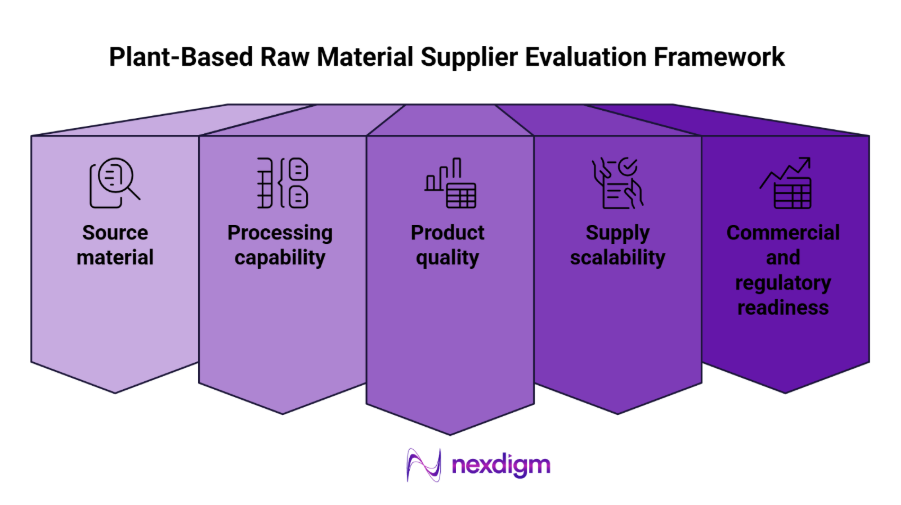
- Source material: Botanical or agricultural origin, sourcing regions and seasonal availability.
- Processing capability: Extraction, refining, drying, milling and other relevant operations.
- Product quality: Composition, purity, consistency, testing and application suitability.
- Supply scalability: Installed capacity, upstream sourcing, inventory and alternative production options.
- Commercial and regulatory readiness: Pricing, traceability, certifications and market-specific compliance.
Nexdigm’s Case Study: Evaluating Plant-Based Ingredient Suppliers
Nexdigm assessed 35 ingredient suppliers across 8 plant-based material categories, comparing source traceability, processing methods, quality systems and production scale. The analysis shortlisted 9 suppliers and identified 4 ingredient categories with opportunities for sourcing diversification.
To take the next step, simply visit our Request a Consultation page and share your requirements with us.
Harsh Mittal
+91-8422857704