

Planting material procurement extends beyond the purchase of seeds. Depending on the crop, an agribusiness may need seedlings, saplings, cuttings, tubers, bulbs, rhizomes or other propagation material. Each category has different quality requirements, storage conditions, handling needs and sourcing channels. A supplier capable of delivering reliable vegetable seeds may not have the infrastructure required to provide healthy fruit-tree planting material or disease-free potato seed.
For organisations operating across multiple crops or regions, planting material supplier mapping provides a structured view of where suitable suppliers operate, what they can provide and how reliably they can fulfil demand. It is particularly useful when sourcing involves multiple production cycles, specialised varieties or geographically dispersed farms.
Define the Material Before Identifying Suppliers
The term planting material covers several product categories. Treating them as a single procurement category can lead to unsuitable supplier selection and incomplete quality specifications.
Field and vegetable seeds require attention to germination, purity, variety identity and seed health. Nursery seedlings need to be assessed for age, uniformity, root development and physical condition. Fruit and plantation saplings require verification of varietal authenticity, grafting quality and disease status. Tubers and bulbs may need specific checks for size, viability, dormancy and disease. Cuttings and rhizomes require assessment of genetic identity, health, maturity and handling conditions.
The exact requirements depend on crop type, propagation method and applicable regulations. Procurement specifications should be developed before supplier identification begins.
Where Do Suppliers Operate?
Planting material can be sourced through several channels, each offering different levels of specialisation and control.
- Government nurseries and public agricultural institutions may provide varieties developed or supported through public research programmes. They can be relevant for regionally suitable planting material and government-supported agricultural initiatives.
- Private nurseries and commercial propagators often specialise in fruit crops, horticulture, ornamental plants, plantation crops and commercial seedlings. Their suitability depends on production practices, varietal authenticity, quality controls and capacity.
- Seed companies and specialist producers supply field crop and vegetable seeds, including hybrids and specialised varieties. Some also operate through licensing and contract production arrangements.
- Farmer producer organisations and cooperative networks can support local sourcing and aggregation, particularly where community-based nurseries or decentralised multiplication systems are established.
- Tissue culture laboratories provide planting material for crops where controlled propagation is commercially relevant. Buyers should evaluate laboratory processes, plant health, acclimatisation procedures and post-delivery survival.
What Makes a Planting Material Supplier Reliable?
Supplier selection should begin with product identity and quality. A buyer needs confidence that the material supplied is the variety or type specified in the purchase agreement.
The assessment should cover the following areas:
- Genetic and varietal authenticity: Verify source material, labelling, variety documentation and traceability.
- Health and phytosanitary condition: Review inspection, testing, certification and disease-management procedures where applicable.
- Physical quality: Assess seedling vigour, root development, size uniformity, maturity and visible damage.
- Production practices: Examine nursery infrastructure, propagation methods, irrigation, growing media and hygiene protocols.
- Handling and transport: Determine whether packaging, temperature management, delivery timing and transit arrangements protect viability.
- Replacement and complaint procedures: Establish how the supplier responds to non-conforming material, damage or quality disputes.
These checks should be tailored to the product. Germination testing, for instance, is not an adequate substitute for assessing the health and root development of a nursery-grown sapling.
Mapping Supply Across Regional Markets
The location of a supplier can influence both cost and product condition. Planting material may be sensitive to transport duration, temperature, humidity and handling. A supplier located closer to the cultivation area may offer logistical advantages, but proximity should not replace quality verification.
A regional mapping exercise should identify production clusters, nursery concentrations, suppliers serving major crop-growing regions, available varieties and propagation specialisations. It should also examine seasonal production capacity, order lead times, transport routes, delivery coverage and local technical support networks.
Buyers should identify alternative sources for critical planting material. A single nursery or seed producer may not have sufficient capacity to meet demand across several locations, particularly during peak planting periods.
Seed Distributor Benchmarking and White-Space Framework
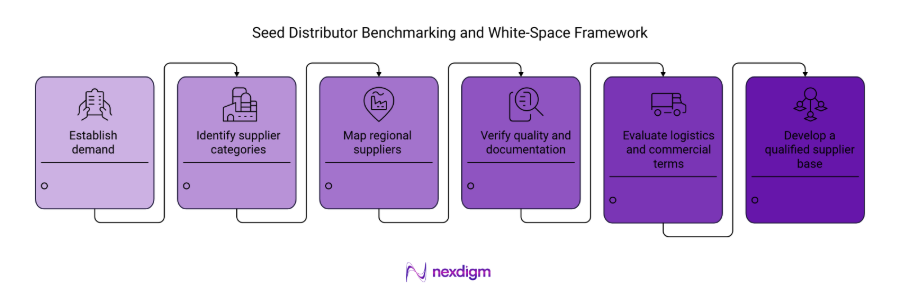
- Step 1: Establish demand. Define the crop, variety, quantity, quality specification, planting schedule and destination.
- Step 2: Identify supplier categories. Determine whether the requirement is best served by seed producers, nurseries, tissue culture laboratories, public institutions or specialist propagators.
- Step 3: Map regional suppliers. Build a list of providers based on production locations, distribution reach and crop specialisation.
- Step 4: Verify quality and documentation. Review applicable certifications, source records, inspection reports and product specifications.
- Step 5: Evaluate logistics and commercial terms. Compare lead times, transport conditions, minimum quantities, prices and replacement provisions.
- Step 6: Develop a qualified supplier base. Shortlist providers, conduct sample assessments and maintain alternatives for seasonal or regional demand fluctuations.
How Nexdigm Supports Planting Material Supplier Mapping
Nexdigm supports agribusinesses through market research, supplier identification, regional market mapping and commercial benchmarking. Its research can help clients identify planting material providers across crop categories, assess supplier capabilities, compare regional availability and evaluate sourcing options for multi-location agricultural operations.
Nexdigm’s Case Study: De-Risking Multi-Market Planting Material Procurement
Rather than relying on single-source or proximity-only assumptions during peak planting windows, Nexdigm evaluated 32 planting material suppliers across six crop categories and 10 regional markets on quality documentation, production capacity, and delivery reach, narrowing the field to eight vetted providers ready for commercial and sample assessment.
To take the next step, simply visit our Request a Consultation page and share your requirements with us.
Harsh Mittal
+91-8422857704