

Policy administration systems are becoming a central focus of insurance modernization as carriers seek faster product launches, greater automation, improved data access, and more adaptable operating models. In a 2025 survey of insurance technology professionals, 73.3% of respondents planned upgrades to policy administration systems, while 51.8% were already engaged in broader core-system modernization. The same research found that 58.1% favored complete legacy replacement with a unified platform covering policy administration, claims, and billing.
The modernization agenda continues into 2026. A 2026 survey of 175 P&C insurers across 26 countries found that IT spending is expected to increase, with Asia-Pacific P&C insurers projected to increase IT spending by nearly 14% in 2026. AI, cloud, and operational modernization are increasingly shaping investment priorities.
As insurers evaluate replacement, enhancement, or consolidation, policy administration system vendor intelligence can help them compare providers beyond basic functionality, considering product configuration, automation, integration, scalability, implementation readiness, and strategic fit.
Policy Administration Is Becoming a Modernization Anchor
A modern PAS increasingly needs to support more than policy issuance and servicing. Insurers expect platforms to accommodate changing products, configurable rules, automated workflows, digital distribution, data connectivity, and integration with surrounding claims, billing, underwriting, and analytics environments. The challenge is heightened by the complexity of legacy estates. Research indicates that 60% of insurers cited data-migration complexity as a modernization barrier, while 50% pointed to potential disruption to ongoing operations. This makes supplier intelligence important because platform selection must balance functional flexibility with implementation feasibility and long-term operating requirements.
Modern PAS Value Extends Across These Core Dimensions
A useful initial view of policy administration platforms can focus on three areas:
- Product Configuration: Assess how easily insurers can create, modify, price, and manage products, rules, workflows, and policy variations without extensive development effort.
- Automation & Workflow: Evaluate capabilities for automated underwriting support, policy issuance, servicing, renewals, endorsements, document generation, and exception handling.
Together, these dimensions provide a clearer view of whether a PAS can support faster product change and efficient policy operations while fitting into the insurer’s broader technology environment.
Nexdigm’s View of the PAS Vendor Landscape
Nexdigm can combine insurance-domain expertise, supplier intelligence, market research, technology assessment, and commercial analysis to examine policy administration system providers. Through policy administration system vendor intelligence, Nexdigm can assess suppliers across product configuration, workflow automation, integration, scalability, deployment models, implementation capabilities, insurance experience, and technology maturity. This helps insurers distinguish between providers with broad platform functionality and those offering capabilities that are more closely aligned with their specific transformation requirements.
How Nexdigm Assesses Product Configuration for Long-Term Flexibility
Product configuration can influence how quickly insurers respond to market opportunities and changing customer requirements. Nexdigm can assess the extent to which platforms support in the following areas:
- Product Rules: The conditions governing a policy, such as eligibility, coverage limits, exclusions, deductibles, and policy terms.
- Rating Logic: The rules used to calculate premiums based on factors such as risk characteristics, coverage, location, customer profile, or other pricing variables.
- Eligibility Criteria: The conditions that determine whether a customer or risk qualifies for a particular insurance product or coverage.
- Workflows: The sequence of activities involved in processes such as quotation, underwriting, policy issuance, endorsements, renewals, and approvals.
The assessment of these areas helps insurers understand the platform’s potential to support product agility without creating additional technology complexity.
Automation Can Differentiate Administration Platforms
Automation can reduce manual intervention across policy issuance, endorsements, renewals, servicing, document processing, and exception management. Nexdigm can examine the maturity of workflow automation, rules engines, straight-through processing, decision support, and integration with surrounding applications. The objective is to determine whether a platform merely digitizes individual tasks or can support more connected policy-administration processes with greater consistency, speed, and operational control.
Nexdigm’s Framework for Assessing Policy Administration System Vendors
Nexdigm can bring the different PAS assessment dimensions together through a structured framework designed around the insurer’s technology and business priorities:
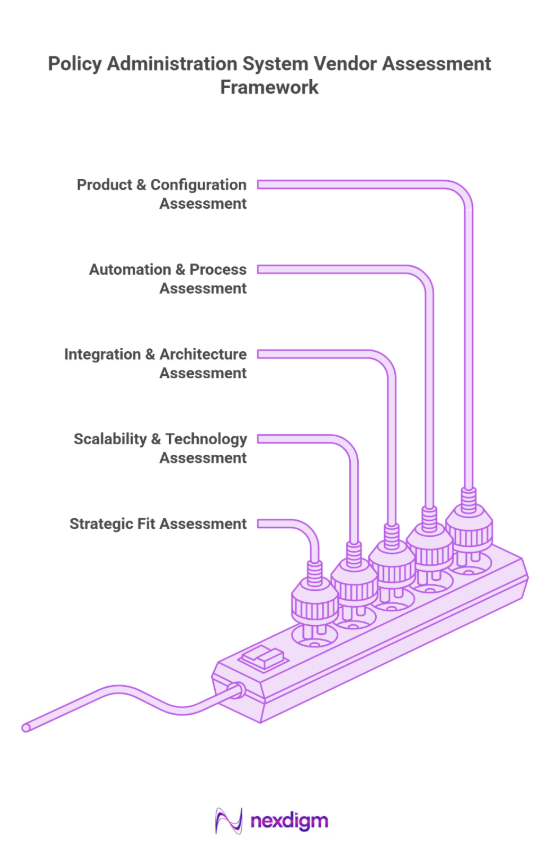
- Product & Configuration Assessment: Evaluate product flexibility, rating logic, rules, workflows, and the ability to introduce or modify products with limited customization.
- Automation & Process Assessment: Examine workflow automation, straight-through processing, decision support, exception handling, and the potential to reduce manual intervention across policy operations.
- Integration & Architecture Assessment: Assess APIs, interoperability, data exchange, legacy compatibility, and the platform’s ability to connect with surrounding insurance applications.
- Scalability & Technology Assessment: Evaluate performance, deployment models, resilience, cloud or SaaS capabilities, and the ability to support increasing policy volumes and future requirements.
- Strategic Fit Assessment: Compare supplier capabilities with the insurer’s operating model, product portfolio, modernization roadmap, implementation requirements, and long-term technology objectives.
This framework helps Nexdigm move from individual feature comparisons to a structured view of platform capability, operational suitability, and strategic fit, providing a stronger basis for vendor prioritization and detailed evaluation.
Nexdigm’s Case
Nexdigm assessed 43 policy administration system vendors for an insurer across product configuration, automation, integration, scalability, and strategic fit. 26% demonstrated strong configuration flexibility, 21% showed advanced automation capabilities, and 15% required further validation around integration and migration complexity. The assessment helped the insurer prioritize platforms for detailed technical, commercial, and implementation evaluation.
To take the next step, simply visit our Request a Consultation page and share your requirements with us.
Harsh Mittal
+91-8422857704