

Ports remain critical gateways for global trade, but cargo growth is increasingly influenced by more than berth capacity. Connectivity, vessel turnaround, inland transportation, industrial activity, and access to major consumption markets can determine which ports capture future volumes.
Around 80% of the volume of international goods trade is carried by sea, according to UN Trade and Development (UNCTAD). Maritime trade grew 2.2% in 2024, although UNCTAD expected growth to slow to just 0.5% in 2025 amid geopolitical disruptions and changing shipping routes.
For port operators, shipping companies, logistics providers, freight forwarders, infrastructure developers, investors, manufacturers, and governments, the opportunity is to identify which ports can translate cargo growth into sustainable throughput and commercial value.
A Port logistics market assessment connects throughput, connectivity, capacity, hinterland access, trade flows, infrastructure, and future demand to evaluate port growth potential.
Understanding the Port Competitiveness
A port with high throughput is not automatically the best-positioned port for future growth. Cargo owners increasingly consider vessel turnaround, reliability, inland connectivity, terminal productivity, storage availability, road and rail access, and proximity to major markets.
A port can gain cargo because it has available capacity, but lose competitiveness if inland congestion makes the total logistics journey expensive or unpredictable. This makes end-to-end cargo connectivity increasingly important when evaluating future port opportunity.
Nexdigm in Connecting Port Performance With Market Opportunity
At Nexdigm, port assessment extends beyond current cargo volumes and throughput metrics. The experts evaluate the broader ecosystem that influences a port’s long-term competitiveness, growth potential, and ability to support evolving trade and supply chain requirements by:
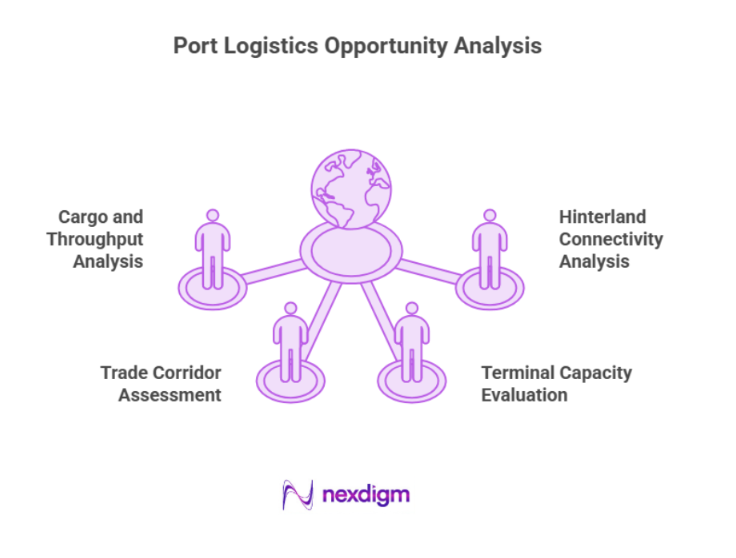
- Cargo and Throughput Analysis: Assessing cargo volumes, throughput trends, and vessel activity to understand current operational performance and capacity utilization.
- Trade Corridor Assessment: Evaluating a port’s position within domestic and international trade corridors to identify growth opportunities and strategic importance.
- Terminal Capacity Evaluation: Reviewing existing terminal infrastructure, operational efficiency, and expansion capabilities to determine future scalability.
- Hinterland Connectivity Analysis: Examining road, rail, inland waterways, and multimodal connections that enable efficient cargo movement beyond the port.
Through a holistic assessment, Nexdigm helps stakeholders distinguish between high-volume ports and high-opportunity ports. This enables informed investment, expansion, and development decisions that align with long-term trade and logistics growth.
How Nexdigm Identifies the Strongest Port Opportunities
The strongest port opportunities generally emerge where growing cargo volumes, efficient terminals, strong shipping connectivity, available capacity, reliable hinterland access, and supportive industrial activity overlap.
Nexdigm brings these factors together to identify ports with the potential to attract additional cargo and support expanding logistics ecosystems.
With the thorough assessment, Nexdigm helps businesses to determine which ports have the infrastructure, connectivity, market access, and growth conditions required to convert future cargo demand into sustainable commercial value.
Nexdigm’s Port Logistics Framework
Nexdigm’s framework conducts Port logistics market assessment which focuses on five major areas to evaluate how effectively a port can handle existing cargo while determining whether its infrastructure and surrounding logistics ecosystem can support future volumes.
- Throughput: Nexdigm examines container, bulk, vehicle, and other cargo volumes alongside historical growth to identify ports demonstrating sustained demand and increasing commercial relevance.
- Connectivity: The assessment evaluates shipping routes, liner connectivity, road, rail, air, and intermodal links to determine how effectively a port connects cargo with regional and international markets.
- Capacity: Nexdigm compares terminal capacity, berth availability, yard space, equipment, utilization, expansion plans, and operational constraints to determine whether ports can accommodate future cargo growth.
- Hinterland Access: The framework evaluates roads, railways, inland terminals, industrial clusters, warehouses, and distribution networks to understand how efficiently cargo can move beyond the port.
- Growth Potential: Nexdigm considers trade forecasts, industrial investment, consumption, competing ports, infrastructure development, and emerging corridors to identify ports with stronger long-term cargo growth opportunities.
The framework connects port activity with the wider logistics ecosystem, helping stakeholders identify ports capable of converting cargo growth into reliable throughput, stronger connectivity, and sustainable commercial opportunity.
Strategic Applications of the Port Logistics Framework
The framework can support decisions across port development and logistics planning.
- Port Investment: Nexdigm helps investors compare throughput growth, capacity, connectivity, infrastructure requirements, competitive positioning, and long-term cargo potential before allocating capital.
- Capacity Planning: Port operators can identify future capacity requirements by comparing projected cargo volumes with existing terminal, yard, berth, equipment, and hinterland capabilities.
- Expansion Strategy: The assessment helps determine where terminal expansion, additional berths, yard development, equipment investment, or inland infrastructure can provide the greatest commercial value.
- Market Entry: Shipping companies and logistics providers can identify ports and corridors where growing cargo demand and improving connectivity create opportunities for new services.
These applications can help organizations reduce infrastructure investment risk, identify underserved cargo corridors, improve capacity planning, optimize gateway selection, strengthen network resilience, and prioritize high-potential markets.
Nexdigm’s Case
A port logistics operator used Nexdigm’s Port logistics market assessment to evaluate cargo flows, capacity, connectivity, and hinterland access. Within 12 months, terminal utilization increased 24%, cargo handling efficiency improved 22%, vessel turnaround times fell 18%, and logistics costs declined, strengthening growth readiness and network performance.
To take the next step, simply visit our Request a Consultation page and share your requirements with us.
Harsh Mittal
+91-8422857704