

Port-related expenditure extends across several service categories, including cargo handling, terminal operations, storage, documentation, customs support and equipment usage. For businesses involved in international trade, these costs can form a significant part of overall logistics expenditure. However, they are often distributed across shipping lines, terminal operators, port authorities, freight forwarders and independent service providers.
This fragmented structure makes it difficult for procurement teams to establish the true cost of port operations. A shipment may involve multiple handling stages, additional storage charges and documentation fees, each billed by a different provider. Without consolidated visibility, organisations may overlook recurring expenses, contractual discrepancies and opportunities to improve supplier allocation.
A structured port services procurement spend analysis helps businesses map expenditure across service categories, understand cost drivers and assess the commercial efficiency of their port-related procurement.
Mapping Expenditure Across Port Service Categories
The first step is to classify port expenditure according to the services purchased and the suppliers responsible for delivering them.
Cargo handling is one of the primary cost categories. It includes loading, unloading, movement between vessels and terminals, container handling and other cargo-related activities. Charges can vary according to cargo type, container size, handling requirements and equipment used.
Terminal costs cover access to port infrastructure and the services required to process cargo through terminal facilities. These may include terminal handling charges, equipment usage, security and other operational fees.
Storage expenditure is influenced by the time cargo remains within port facilities. Container storage, demurrage and detention-related costs can increase when documentation is delayed, customs clearance takes longer than expected or transportation arrangements are not coordinated effectively.
Documentation and administrative expenses form another category. These can include bills of lading, shipping documentation, cargo declarations, customs processing and other compliance-related services.
A consolidated spend structure allows procurement teams to distinguish core service charges from additional fees and identify where expenditure is accumulating.
Identifying Cost Concentration Across Providers
Port services are often procured through several suppliers, even when the services relate to the same shipment or trade lane.
For example, an organisation may use one terminal operator for cargo handling, a separate provider for storage and an external agent for documentation. While this arrangement may be operationally necessary, it can create fragmented commercial terms and limit visibility into total expenditure.
Supplier-level spend analysis should examine total payments, service volumes, average cost per transaction and the proportion of expenditure allocated to each provider.
Businesses should also identify whether different business units or locations use the same providers under separate contracts. Consolidating procurement information can reveal overlapping supplier relationships and opportunities for improved commercial terms.
Spend concentration should be evaluated alongside supplier dependency. Heavy reliance on a single terminal or service provider may create operational exposure, particularly where alternative facilities are limited.
Understanding Storage, Demurrage and Additional Charges
Storage-related expenditure deserves particular attention because it can increase without any corresponding increase in shipment volume.
Demurrage and detention charges may arise when containers remain beyond the permitted free time. These costs can be influenced by customs clearance delays, incomplete documentation, port congestion, limited transport availability and coordination issues between stakeholders.
Procurement teams should compare contracted free-time arrangements, applicable charge structures and actual container dwell times.
A review of shipment-level invoices can help identify recurring cost patterns. For instance, if a particular port or service provider consistently generates higher storage expenses, the organisation can investigate whether the issue is linked to operational delays, commercial terms or inadequate coordination.
The objective is to distinguish unavoidable port costs from expenditure that can be reduced through better planning and supplier management.
Comparing Port Costs Across Locations and Trade Routes
Port service costs vary according to infrastructure, cargo volumes, handling capabilities, operating conditions and local commercial arrangements.
A major container port may offer extensive connectivity and efficient cargo processing but involve higher terminal charges. A smaller port may have lower service costs but create additional inland transportation expenses or longer transit times.
Comparisons should therefore consider the complete logistics cost associated with using a particular port.
Procurement teams should also examine differences in service scope. A terminal charge may include certain handling activities in one location but exclude them in another. Comparing headline rates without accounting for these differences can produce misleading conclusions.
Standardised shipment profiles and service definitions are essential for meaningful benchmarking.
Turning Spend Analysis into Procurement Improvements
Once expenditure has been consolidated, organisations can identify opportunities through contract renegotiation, supplier rationalisation, alternative port selection and improved shipment coordination.
The analysis may also support revised storage arrangements, better free-time negotiations and more transparent billing structures.
However, lower service charges should not be pursued without considering operational performance. Delays in cargo handling or documentation can create additional transportation, inventory and storage costs. Procurement decisions should therefore account for service reliability alongside commercial competitiveness.
Port Services Procurement Spend Analysis Framework
A structured port services procurement spend analysis should include:
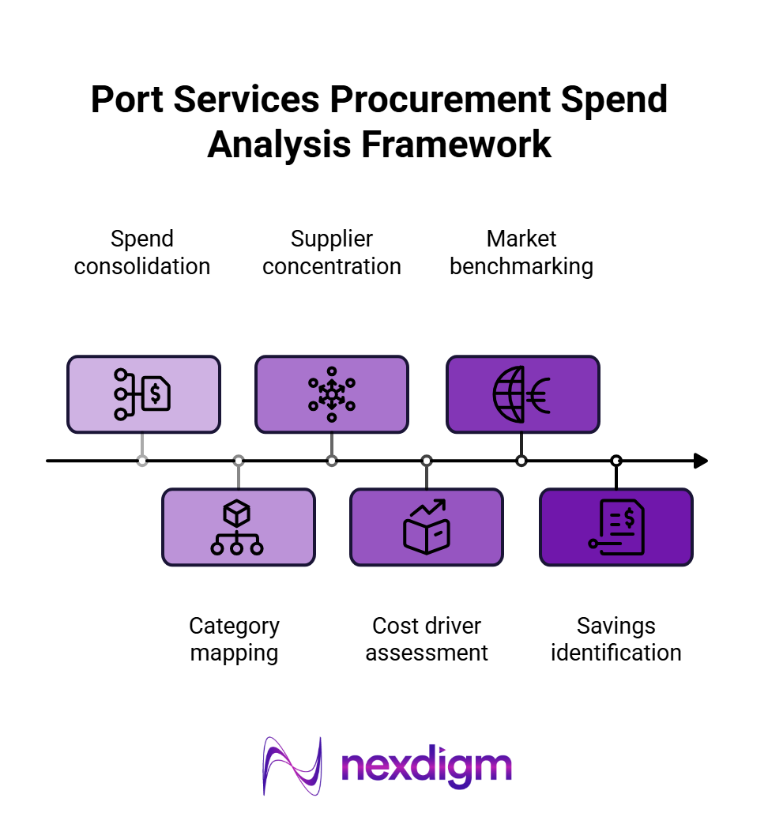
- Spend consolidation: Collect invoices, contracts and shipment records across ports, service providers and business units.
- Category mapping: Classify handling, terminal, storage, documentation, equipment and administrative expenses.
- Supplier concentration analysis: Identify major providers, expenditure dependencies and overlapping service arrangements.
- Cost driver assessment: Examine shipment volumes, cargo types, storage duration, dwell time and additional charges.
- Market benchmarking: Compare port service costs across locations using equivalent shipment and service requirements.
- Savings identification: Prioritise contract renegotiation, alternative port options, billing improvements and operational coordination.
Nexdigm can support organisations through port services market research, procurement spend analysis, supplier benchmarking and cost intelligence. These services help businesses establish expenditure visibility, evaluate provider competitiveness and identify opportunities to improve port-related procurement decisions.
Nexdigm’s Case Study: Identifying Port Services Cost Concentration
Nexdigm assessed port service expenditure across 5 ports and 12 service providers, analysing handling, terminal, storage and documentation charges. The study identified 4 major spending categories, detected a 15% variation in comparable service costs and prioritised 5 procurement improvement areas.
To take the next step, simply visit our Request a Consultation page and share your requirements with us.
Harsh Mittal
+91-8422857704