

POS payment systems are evolving as omnichannel commerce pushes merchants to adopt smarter, integrated, and customer-friendly payment technologies. Businesses now require POS solutions that support in-store, online, mobile, and contactless transactions while connecting inventory, sales, loyalty, and reporting functions.
Strong market entry strategy is essential for POS payment providers entering new markets, as it helps assess merchant demand, technology readiness, regulatory requirements, pricing models, and partner ecosystems. An effective POS payment system market entry approach enables providers to support merchant digital transformation, improve checkout experiences, and compete in the expanding retail technology landscape.
Recent estimates show the global POS market was valued at USD 38.56 billion in 2025 and is projected to reach USD 138.92 billion by 2034, growing at a CAGR of 15.3%. The POS software market was also estimated at USD 17.13 billion in 2025 and may reach USD 38.82 billion by 2033. These figures highlight why a POS payment system market entry strategy should focus on omnichannel readiness, merchant integration, and scalability.
Regulatory and Compliance Requirements for POS Payment Market Entry
Regulatory and compliance requirements for POS payment market entry involve assessing licensing rules, payment regulations, data privacy laws, transaction security standards, tax obligations, and reporting requirements before launching POS solutions.
- Payment Licensing Requirements: Reviews whether POS providers need licenses, approvals, registrations, or partnerships before offering payment acceptance services.
- Transaction Security Standards: Ensures POS systems follow security controls for card data protection, encryption, authentication, and safe transaction processing.
- Data Privacy Compliance: Assesses how customer, merchant, and transaction data are collected, stored, processed, shared, and protected.
- Tax and Reporting Obligations: Reviews applicable tax rules, invoicing requirements, transaction records, settlement reporting, and statutory documentation needs.
Nexdigm’s Entity Setup and Corporate Services for New POS Payment Markets
Nexdigm’s entity setup and corporate services for new POS payment markets helps providers establish legal entities, complete registrations, manage statutory documentation, and align with local corporate requirements. This support enables smoother market entry, regulatory readiness, banking setup, governance structuring, and operational launch for POS payment businesses expanding across new regions.
Nexdigm’s Technology Readiness Assessment for Scalable POS Payment Deployment
Nexdigm’s technology readiness assessment helps POS payment providers evaluate platform scalability, payment integrations, cybersecurity controls, system uptime, API readiness, data handling, and operational resilience before deploying across markets:
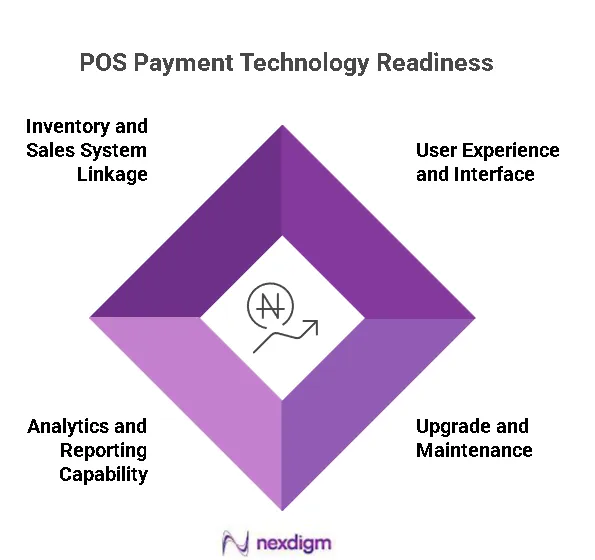
- Inventory and Sales System Linkage: Assesses integration with stock management, invoicing, CRM, ERP, and accounting systems used by merchants.
- User Experience and Interface Review: Evaluates cashier usability, dashboard clarity, error prompts, reporting screens, and ease of training for merchant staff.
- Analytics and Reporting Capability: Reviews sales dashboards, transaction trends, settlement reports, customer insights, and performance tracking for merchant decision-making.
- Upgrade and Maintenance Readiness: Assesses software update processes, remote troubleshooting, patch deployment, version control, and long-term platform support.
Nexdigm’s case:
Recently, Nexdigm helped a POS payment system provider assess technology readiness before expanding into three new markets. Nexdigm reviewed device compatibility, omnichannel functionality, merchant onboarding workflows, transaction speed, analytics capability, and maintenance readiness.
The assessment found compatibility with 85% of target merchant hardware, reduced onboarding time by 30%, and supported peak transaction processing of 18,000 transactions per hour. Nexdigm’s recommendations helped the company strengthen deployment readiness and plan a scalable POS rollout.
To take the next step, simply visit our Request a Consultation page and share your requirements with us.
Harsh Mittal
+91-8422857704