

Point-of-sale technology is becoming a larger part of retail operating infrastructure as businesses invest in connected checkout, payments, inventory visibility, and omnichannel capabilities. According to the National Retail Federation, 67% of retailers planned to increase technology investment in 2026, reflecting continued pressure to modernize retail operations.
Meanwhile, Juniper Research estimates that the global value of POS payments will exceed $11 trillion by 2026, highlighting the scale of transactions moving through retail payment infrastructure. As retailers expand or replace POS estates, comparing vendors on purchase price alone can create an incomplete picture.
POS procurement benchmarking retail sector analysis can help businesses compare hardware, software, transaction costs, implementation requirements, support models, and total cost of ownership to determine whether their POS investments remain commercially competitive.
Why POS Procurement Requires More Than a Price Comparison
POS systems combine hardware, software, payment processing, implementation, maintenance, integrations, and ongoing support. Two vendors offering similar-looking systems may therefore have significantly different total costs over the contract lifecycle. Retailers also need to consider functionality, scalability, uptime, cybersecurity, integration capabilities, and ease of deployment. A meaningful benchmark should account for these factors together, allowing procurement teams to distinguish between a lower upfront price and a genuinely stronger commercial proposition.
The Three Layers of POS Competitiveness
A useful POS comparison should connect technology capability with commercial economics and operating requirements.
- Technology Fit: Compare hardware, software features, integrations, security, scalability, and functionality to determine whether solutions meet current and future retail requirements.
- Commercial Position: Assess license fees, hardware costs, transaction charges, implementation fees, maintenance, and contract terms to understand the full financial commitment.
- Operating Economics: Examine support, uptime, deployment effort, training, upgrades, and lifecycle costs to determine the broader cost of operating each POS environment.
Together, these dimensions provide a clearer view of which POS proposition delivers competitive value rather than simply the lowest initial price.
How Experts at Nexdigm Assess POS Procurement Competitiveness
Experts at Nexdigm help retailers evaluate POS procurement through a combination of procurement analytics, supplier benchmarking, market intelligence, technology assessment, and commercial analysis. Our experts can look beyond vendor quotations to understand how different cost and capability elements contribute to the overall value proposition.
The assessment can compare vendors against the retailer’s specific requirements, helping distinguish between genuine feature advantages and unnecessary functionality, as well as between headline pricing and the actual cost of ownership.
This creates a more informed basis for vendor selection, negotiation, renewal, and POS modernization decisions.
The Need for POS Procurement Competitiveness
As POS systems become central to store operations, procurement teams need to ensure that technology investments deliver the right balance of:
- Control Technology Costs: Rising hardware, software, licensing, and transaction expenses can increase the total cost of running a retail POS estate over time.
- Protect Operational Value: Competitive procurement helps retailers secure the capabilities they need without paying for unnecessary features, excessive service costs, or inefficient technology configurations.
- Strengthen Long-Term Flexibility: Evaluating vendors on scalability, integration, support, and lifecycle economics can reduce dependency risks and support future store and technology expansion.
Maintaining procurement competitiveness therefore helps retailers control POS expenditure while ensuring the technology remains capable, scalable, and commercially sustainable.
Nexdigm’s Approach to Supporting POS Procurement Decisions
Nexdigm uses POS procurement benchmarking retail sector analysis to bring technology requirements, vendor capabilities, commercial terms, and lifecycle costs into one structured view. Our experts assess the procurement landscape through a practical sequence:
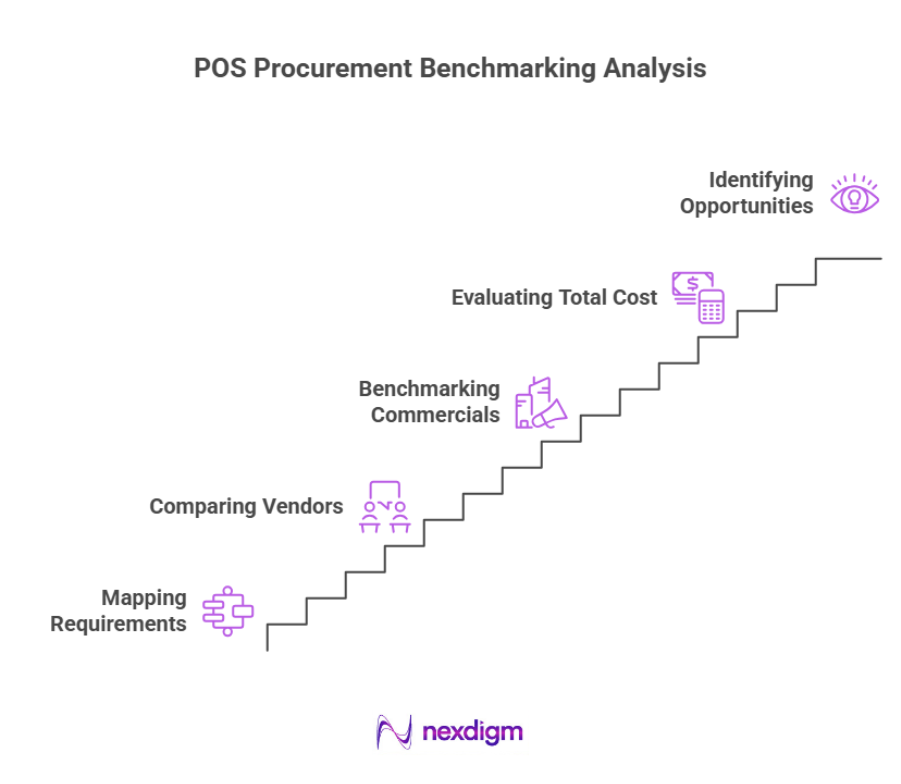
- Map Requirements: Defining store formats, transaction needs, functionality, integrations, scalability, and operational requirements.
- Compare Vendors: Assessing hardware, software, features, service capabilities, supplier coverage, and technology fit against identified requirements.
- Benchmark Commercials: Comparing pricing, licenses, transaction charges, implementation costs, support fees, and contract terms to identify meaningful gaps.
- Evaluate Total Cost: Considering maintenance, upgrades, replacement, integration, training, and other lifecycle costs to establish the broader economic position.
- Identify Opportunities: Prioritizing negotiation, specification optimization, vendor alternatives, or lifecycle improvements according to potential impact and feasibility.
This approach helps retailers move from vendor comparison to informed POS procurement decisions, with a clearer understanding of cost competitiveness, technology value, and long-term commercial implications.
Nexdigm’s Case
Nexdigm assessed POS procurement across multiple vendors and retail formats, identifying a 16% potential cost-improvement opportunity across hardware, software, and service components. The assessment also highlighted 11% of POS spend requiring commercial review and a 9% potential saving through specification and lifecycle optimization, helping the retailer prioritize vendor negotiations and technology decisions.
To take the next step, simply visit our Request a Consultation page and share your requirements with us.
Harsh Mittal
+91-8422857704