
Point-of-sale procurement combines several cost categories that vendors may price separately. Hardware, software subscriptions, payment processing, integrations, installation, training, and technical support can all affect the economics of a retail technology purchase.
A lower hardware quote does not necessarily mean a lower-cost system. Differences in software licensing, payment arrangements, integration requirements, and support coverage can materially change the total cost over the system’s operating life.
Separate the Cost Components
Retailers should divide POS expenditure into hardware, software, payments, implementation, integration, maintenance, and support. Hardware costs may include terminals, scanners, receipt printers, cash drawers, and payment devices. Software charges may be based on stores, terminals, users, transactions, or optional modules.
The cost model should also reflect deployment requirements. A retailer with an existing inventory platform may need limited integration work, while another may require product-data migration, custom interfaces, and additional testing across stores.
Compare Commercial Models
Vendors structure contracts differently. One may bundle hardware and software, while another charges separately for licences, support, and integrations. Payment-processing costs can also depend on the payment provider and contract terms, so they should not be treated as interchangeable with POS software fees.
For POS procurement cost benchmarking retail, the objective is to compare systems using the same store count, terminal requirements, transaction assumptions, support coverage, and evaluation period. Renewal clauses, hardware replacement, data extraction, and switching costs should be included because they affect the long-term commercial commitment.
Account for Technology Risk
Compatibility and support can influence costs beyond the initial purchase. A system that requires extensive customisation may be expensive to maintain, while unsupported hardware can create replacement requirements. Retailers should also assess security updates, access controls, incident response, data portability, and the supplier’s approach to software maintenance.
Where payment-card data is involved, the relevant payment security requirements should be considered in the vendor assessment. Retailers should establish which responsibilities sit with the POS provider, payment processor, and retailer rather than assuming that a vendor’s product alone ensures compliance.
POS Procurement Cost Benchmarking Framework
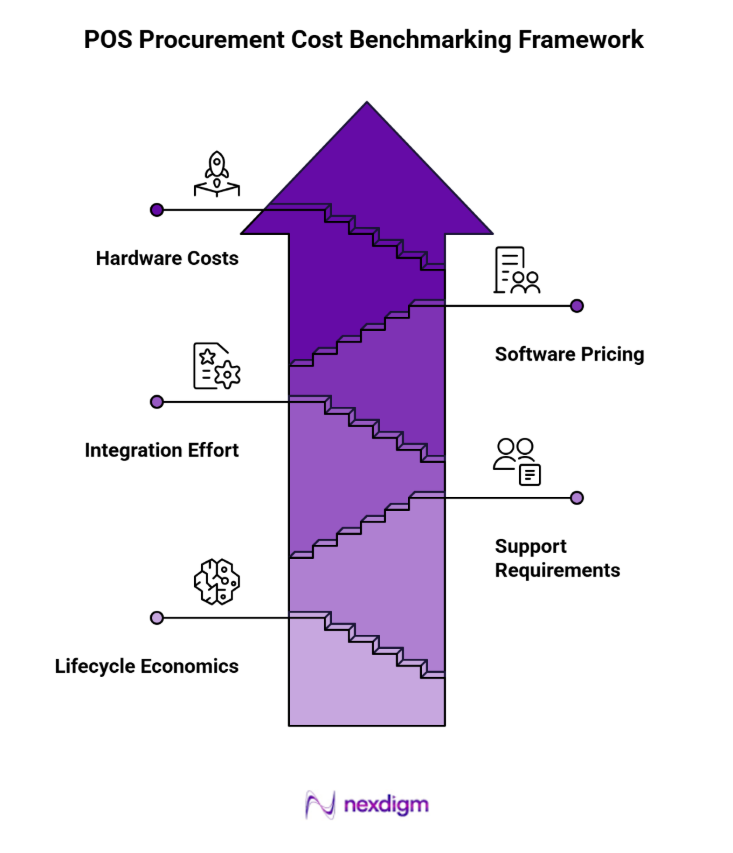
- Hardware Costs: Compare terminals, scanners, printers, payment devices, warranties, replacement policies, and installation charges against consistent equipment specifications.
- Software Pricing: Normalise subscription fees, licences, transaction-based charges, optional modules, upgrades, and renewal conditions using the same deployment assumptions.
- Integration Effort: Estimate data migration, interfaces, testing, customisation, training, and internal implementation resources required to connect the POS system with existing retail applications.
- Support Requirements: Compare service hours, response commitments, maintenance, security updates, replacement equipment, and escalation arrangements that influence ongoing operating costs.
- Lifecycle Economics: Calculate total ownership cost over a consistent period, including payment-related charges where relevant, contract changes, hardware refreshes, and exit or migration expenses.
Benchmark Before Contracting
Retailers should request itemised quotations and test shortlisted systems against real store workflows. A three-year or five-year cost model can expose differences that are hidden by introductory pricing, while a pilot can validate implementation assumptions before a wider rollout.
Nexdigm’s Case Study
A retailer comparing POS proposals for 40 stores found substantial differences in integration, hardware replacement, and support charges. A five-year cost comparison identified a configuration with a projected 11% lower total cost than the initial preferred option, subject to pilot results and final contract terms.
To take the next step, simply visit our Request a Consultation page and share your requirements with us.
Harsh Mittal
+91-8422857704