

Selecting a point-of-sale (POS) vendor is increasingly a decision about the wider retail technology ecosystem, not just checkout software. POS systems connect payment processing, inventory records, promotions, returns, customer data, and store reporting. A vendor that performs well at checkout may still create operational friction if its integrations are limited or product data cannot move reliably between systems.
The supplier market should therefore be assessed by capability, compatibility, commercial model, and long-term flexibility.
Examine the Vendor Landscape
POS suppliers generally compete through different operating models. Some provide an integrated platform covering software, hardware, payments, and support. Others specialise in software that connects with third-party payment providers and retail applications. The first model may simplify implementation, while the second can offer more flexibility but place greater responsibility on the retailer to manage integrations.
Market screening should establish which model fits the retailer’s store network, transaction requirements, existing technology, and expansion plans. Vendor presence in a target geography also matters because payment methods, fiscal requirements, language support, and service availability differ across markets.
Check Product and Data Compatibility
A POS system depends on accurate product identifiers, pricing, promotions, and inventory records. Compatibility should extend beyond whether a scanner can read a barcode. The system must correctly process product attributes, returns, discounts, and relevant transaction data.
GS1’s retail guidance on two-dimensional barcodes highlights an important technology transition: retailers need to assess whether scanners and POS software can process newer barcode formats alongside existing linear barcodes. The practical implication is that hardware and software readiness should be checked together, particularly when planning upgrades across multiple stores.
Compare the Commercial Models
POS quotations are difficult to compare when vendors charge differently for terminals, stores, transactions, users, integrations, or support. A lower subscription fee may be offset by payment-processing charges, implementation work, additional modules, or costly customisation.
For POS system supplier identification consulting retail, a useful comparison separates mandatory capabilities from optional features and models the full cost under the retailer’s expected operating conditions. Contract flexibility, data portability, payment-provider choice, and exit costs also affect the long-term economics.
POS Vendor Market Assessment Framework
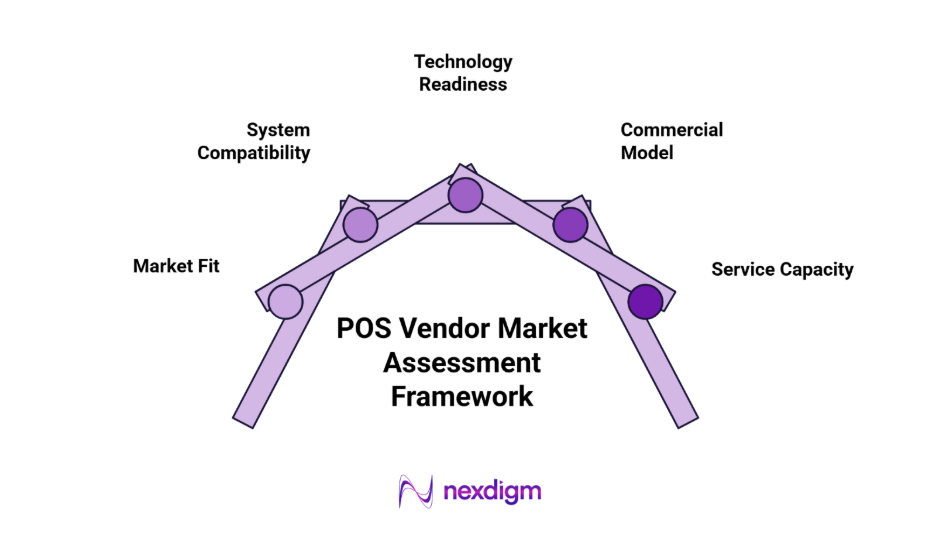
- Market Fit: Classify vendors by retail segment, geographic coverage, deployment model, supported payment methods, and experience with comparable store formats.
- System Compatibility: Verify integration with inventory, ecommerce, accounting, loyalty, payment, and reporting systems, including the cost of maintaining those connections.
- Technology Readiness: Assess hardware support, barcode processing, offline functionality, security controls, upgrade requirements, and the vendor’s roadmap for emerging retail workflows.
- Commercial Model: Compare licences, hardware, implementation, transaction fees, support, customisation, renewal conditions, and switching costs over a consistent ownership period.
- Service Capacity: Review implementation resources, local support, training, incident escalation, uptime commitments, and the supplier’s ability to support additional stores.
Select on Total Operating Value
The strongest shortlist combines product fit with credible service capacity and transparent economics. Retailers should test shortlisted systems against real store workflows, including refunds, stock corrections, promotions, and connectivity interruptions, before committing to a wider rollout.
Nexdigm’s Case Study
A retailer comparing POS providers for 35 stores found that quoted subscription prices concealed differences in integration and support charges. A three-year cost comparison changed the shortlist and identified a configuration with an estimated 12% lower total cost than the initial preferred option, subject to validation during implementation.
To take the next step, simply visit our Request a Consultation page and share your requirements with us.
Harsh Mittal
+91-8422857704