

Poultry competitor pricing analysis consulting helps producers compare pricing strategies across businesses competing on production scale, feed efficiency, processing capacity, distribution reach, and operational performance. Through comprehensive Pricing Analysis Services, companies can assess competitor prices, product formats, weight categories, channel margins, regional demand, input costs, promotional activity, and customer affordability.
These insights reveal pricing gaps, cost advantages, margin risks, and opportunities across fresh poultry, frozen products, processed meat, and value-added offerings. Effective pricing analysis supports portfolio positioning, price optimization, channel strategy, and revenue planning, enabling poultry businesses to strengthen competitiveness, protect profitability, improve market responsiveness, and achieve sustainable commercial growth.
An illustrative 10% improvement in poultry pricing accuracy can strengthen commercial performance. Pricing Analysis Services evaluate competitor prices, production efficiency, feed costs, regional demand, and channel margins, helping poultry businesses improve price realization, protect profitability, enhance competitiveness, and support sustainable growth.
Poultry Pricing Intelligence for Production-Led Growth
Poultry pricing intelligence combines production efficiency, market demand, competitor insights, and cost analysis to optimize pricing, improve profitability, strengthen competitiveness, and support sustainable commercial growth across poultry businesses. Some core steps of it are:
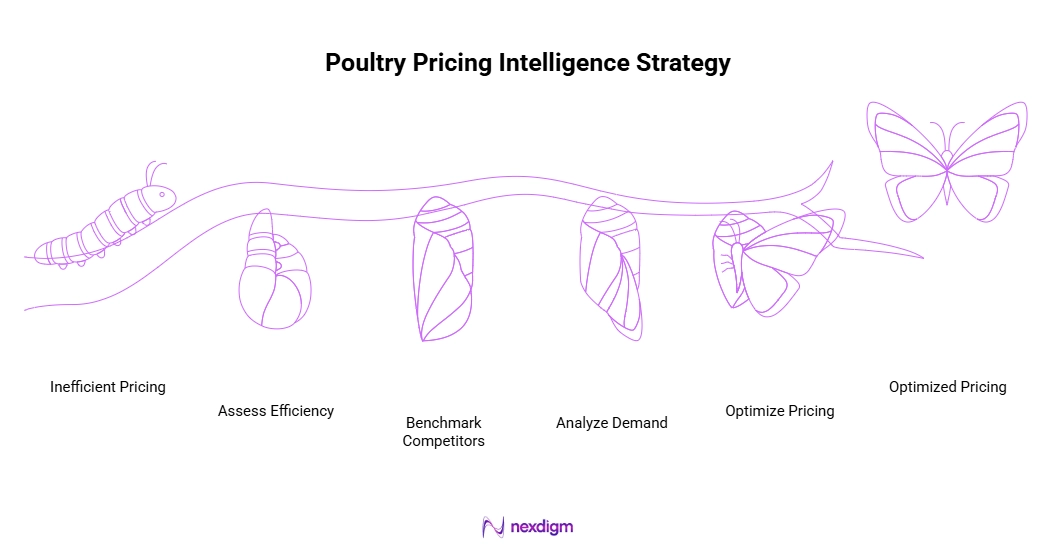
Step 1: Assess Production and Cost Efficiency
Evaluate feed costs, hatchery performance, processing expenses, labor, logistics, and operational efficiency to establish sustainable price floors while protecting profitability and commercial viability.
Step 2: Benchmark Competitor Pricing
Compare competitor prices, product categories, pack sizes, promotional strategies, and market positioning to identify pricing gaps, strengthen differentiation, and improve competitive responsiveness.
Step 3: Analyze Market Demand and Customer Segments
Assess regional demand, customer preferences, purchasing behavior, channel requirements, and price sensitivity to develop targeted pricing strategies that maximize adoption and revenue.
Step 4: Optimize Product and Channel Pricing
Align prices across fresh, frozen, processed, retail, wholesale, and foodservice channels to improve portfolio performance, channel consistency, and long-term margin realization.
Step 5: Monitor Performance and Refine Pricing
Track price realization, sales volumes, competitor movements, market trends, and profitability metrics to continuously refine pricing strategies and sustain commercial growth.
Nexdigm’s Pricing Analysis Services for Poultry Market Competitiveness
Nexdigm’s Pricing Analysis Services help poultry businesses improve market competitiveness through poultry competitor pricing analysis consulting, competitive price benchmarking, cost-based pricing analysis, pricing intelligence, market pricing strategy, and price optimization. By evaluating production efficiency, feed costs, competitor pricing, regional demand, product mix, and channel margins, Nexdigm enables data-driven pricing decisions that strengthen competitiveness, improve price realization, protect profitability, and support sustainable commercial growth.
Nexdigm’s Market-Led Framework for Poultry Price Benchmarking
Nexdigm’s market-led framework combines competitor pricing, production economics, regional demand, channel dynamics, and portfolio performance to establish reliable benchmarks, strengthen price realization, protect margins, and support sustainable poultry market growth. Data Driven steps followed by Nexdigm’s experts are:
Step 1: Define Benchmarking Scope
Identify poultry categories, competitors, regions, channels, pack formats, and customer segments to establish relevant comparison parameters and measurable pricing objectives.
Step 2: Collect Market Pricing Data
Gather competitor prices, promotions, discounts, product specifications, weight categories, and channel offers to build a reliable poultry pricing intelligence database.
Step 3: Compare Costs and Efficiency
Assess feed, processing, labor, logistics, production scale, and operational efficiency against competitors to identify cost advantages and sustainable pricing thresholds.
Step 4: Evaluate Market Positioning
Analyze customer value, product quality, brand perception, affordability, and regional demand to determine competitive positioning and differentiated price points across markets.
Step 5: Monitor and Refine Benchmarks
Track price realization, sales volumes, margins, competitor movements, and market changes to update benchmarks and guide continuous pricing improvements.
Nexdigm’s Case
Nexdigm helped a poultry producer benchmark pricing against leading competitors. The engagement improved price realization by 10%, increased operating margins by 8%, and enhanced market competitiveness, enabling stronger revenue growth and more resilient pricing decisions.
To take the next step, simply visit our Request a Consultation page and share your requirements with us.
Harsh Mittal
+91-8422857704