
India’s poultry industry has reached a scale where national production growth alone tells only part of the investment story. The country produces more than 10.5 million metric tonnes of poultry meat and approximately 149 billion eggs annually, yet farming economics remain sharply different across broilers, layers, and processed poultry.
For investors and integrated poultry companies, the question is increasingly geographical and operational: where can additional production capacity generate attractive returns after accounting for feed costs, mortality, farm infrastructure, processing access, and local demand?
Broilers Offer Speed, Layers Offer Recurring Cash Flow
Broiler and layer businesses operate on fundamentally different capital cycles.
A broiler reaches approximately 2.0–2.4 kg within a 35–40-day production cycle. Capital turns rapidly, but profitability depends heavily on feed conversion, mortality, chick costs, and volatile live-bird prices. An FCR of 1.45–1.65 means relatively small changes in feed efficiency can materially affect cost per kilogram of live weight.
Layer farming requires considerably more patience. Producers incur an approximately 18-week rearing period before entering a 72–80-week laying cycle. The resulting daily egg cash flow is more predictable, but prolonged periods of elevated feed prices can compress margins when egg realizations remain constrained.
The choice between the two is therefore less about market size and more about capital rotation, risk exposure, and operating capability.
Feed Costs Can Change the Farm-Level Equation
Feed represents 60% to 75% of total poultry production costs, making raw ingredient pricing central to farm viability.
- Primary ingredients: Maize supplies 55% to 65% of dietary energy, while soybean meal delivers the bulk of protein. Price spikes in either directly inflate operating costs.
- Sourcing economics: High consumer demand cannot compensate for long-distance feed transport costs. Operating near grain supply zones provides a built-in cost advantage, even in developing poultry markets.
Evaluating farm viability must therefore incorporate feed sourcing logistics alongside consumer demand.
Climate Can Separate a Viable Farm From an Unviable One
Temperature is another major variable.
Open-sided poultry sheds can experience mortality rates of 10%–12% during severe summer conditions, compared with less than 3.5% in modern environmentally controlled facilities.
That difference changes the investment equation. Regions with high heat exposure may require tunnel ventilation, cooling systems, insulation, and stronger power infrastructure. The additional capital can be justified where improved survivability and FCR offset the investment, but not every farm or production segment can absorb the cost.
Climate suitability should therefore be treated as an economic variable rather than simply an agricultural one.
The Next Opportunity May Sit Outside Established Poultry Hubs
Commercial production is concentrated around established clusters such as Palladam and Coimbatore in Tamil Nadu, Hyderabad and Mahbubnagar in Telangana, and Pune-Nashik in Maharashtra. Layer production has strong concentrations across Haryana and Punjab.
Meanwhile, Eastern Uttar Pradesh, Bihar, and West Bengal continue to present supply deficits despite large consumer populations.
These emerging markets create a different proposition. They can offer proximity to underserved demand and, in some locations, access to surplus maize. However, weaker contract-farming penetration, processing infrastructure, veterinary services, and organized distribution can increase execution risk.
The opportunity is therefore not simply about entering a state. It is about identifying individual clusters where demand growth and operating infrastructure are developing together.
Processing Can Change the Revenue Model
Approximately 90% of retail broiler sales continue to move through live wet markets, while dressed, chilled, and frozen poultry represent a much smaller share.
That leaves a substantial value-chain question for producers.
Processed poultry can provide access to organized retail, QSRs, HoReCa, and institutional buyers, where contract pricing and standardized specifications can reduce exposure to daily live-bird price movements.
However, processing requires investment in slaughtering, cold storage, reefer logistics, quality systems, and market development. The right opportunity therefore depends on whether sufficient demand density exists to support those assets.
A poultry farming market opportunity study needs to combine farm economics with geography. Feed availability, mortality risk, contract farming penetration, processing infrastructure, and consumption demand can produce very different economics within the same state.
Nexdigm’s Regional Production-to-Demand Cluster Framework
Nexdigm evaluates poultry expansion opportunities through five decision layers:
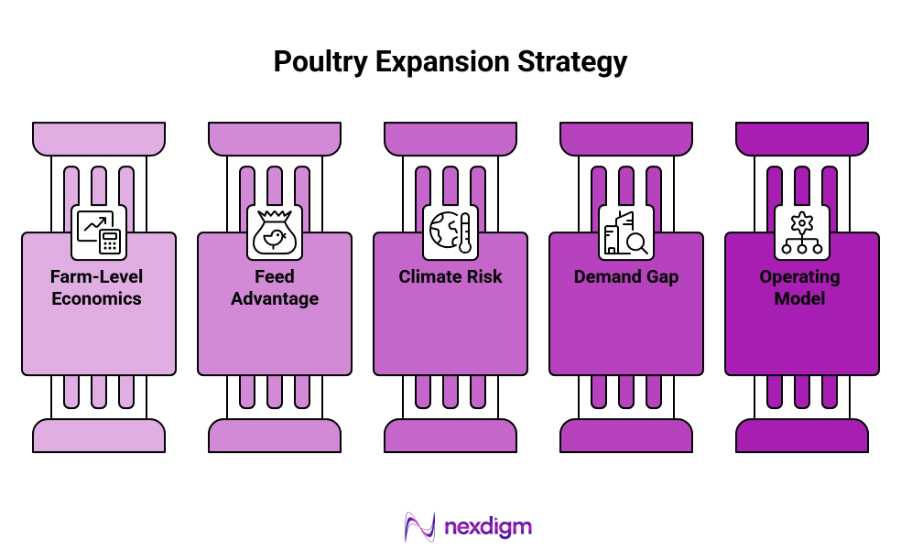
- Measure the Farm-Level Economics: Model FCR, mortality, feed costs, chick costs, farm-gate realization, capital expenditure, and production cycles to establish viable unit economics for broiler and layer operations.
- Map the Feed Advantage: Overlay maize, soybean meal, feed-mill locations, freight costs, and ingredient availability to identify clusters with structurally lower feed procurement exposure.
- Price the Climate Risk: Evaluate temperature patterns, housing requirements, power availability, mortality exposure, and environmental-control investment to determine the cost of operating in each location.
- Locate the Demand Gap: Map poultry consumption, institutional demand, processing capacity, urban markets, and existing production density to identify underserved clusters.
- Test the Operating Model: Compare independent farming, contract farming, integrated production, and processed-poultry models based on capital requirements, supply security, market access, and risk allocation.
Case Study: Nexdigm’s Contract Farming Restructuring
An institutional livestock operator managing an open-sided broiler contract network in Central India was experiencing negative operating EBITDA, with summer flock mortality reaching 11.4% and FCR deteriorating to 1.74.
Nexdigm restructured the operating footprint around a 150 km radius of the company’s feed mill and converted 60 contract farms to semi-automated, tunnel-ventilated environmentally controlled sheds through an equipment lease-financing programme.
Across two production cycles, average mortality fell to 3.2%, FCR improved to 1.49, and production costs declined by ₹8.40 per kg of live weight, improving resilience to regional live-bird price volatility.
To take the next step, simply visit our Request a Consultation page and share your requirements with us.
Harsh Mittal
+91-8422857704