

Poultry demand alone does not make a new market commercially attractive. For an integrated poultry business, feed can account for 65%–70% of live-bird production cost, making the distance between feed ingredients and farms a direct determinant of production economics.
Expansion therefore requires a combined assessment of demand, feed procurement, farm productivity, biosecurity, processing, and distribution.
Feed Economics Can Override Demand Growth
The source estimates Indian broiler meat consumption growth at 6%–8% annually and table-egg demand growth at 5%–7%. Yet feed economics can quickly change the attractiveness of a region.
Broiler operations typically target an FCR of 1.50–1.65, while feed formulations rely heavily on corn and soybean meal. The source identifies corn at approximately 55%–60% of formulation and soybean meal at 25%–30%.
This makes regional feed availability critical. Grain-deficit markets such as Kerala and parts of the Northeast can incur additional ingredient freight of ₹1,500–₹2,500 per tonne, translating into an estimated ₹3.5–₹5.0 per kg increase in live-bird production cost compared with surplus regions such as Telangana, Karnataka, and Madhya Pradesh.
Farm Density Creates a Second Risk Layer
Poultry expansion also requires attention to the geographic concentration of farms. High-density poultry corridors can improve access to suppliers, labour, processing, and distribution, but they can simultaneously increase disease transmission risk.
The source highlights Avian Influenza and Newcastle Disease as key concerns in dense poultry clusters. Severe outbreaks can result in substantial mortality and movement restrictions, creating losses that cannot be captured by a simple demand forecast.
Environmentally controlled tunnel-ventilated housing can reduce some operating risks. The source estimates investment at ₹350–₹450 per square foot and indicates potential mortality reduction from 7%–9% in open-sided sheds to below 3.5%, alongside an 8–12-point improvement in FCR during summer months.
Distribution Determines What Kind of Poultry Business Is Being Built
India’s poultry retail market remains heavily oriented toward live birds, with the source estimating 90%–92% of retail sales through live-bird wet markets and 8%–10% through dressed or frozen channels.
That structure creates two different expansion models. Live-bird distribution requires high responsiveness to spot prices and offers limited inventory buffering. Processed poultry requires additional slaughtering, chilling, freezing, and distribution infrastructure, but can provide greater access to modern retail, food service, and quick-commerce channels.
A market-entry plan therefore needs to decide whether processing is part of the initial model or a later stage of expansion.
Nexdigm’s Poultry Market Entry Framework
Nexdigm can structure poultry market entry strategy services around five analytical dimensions:
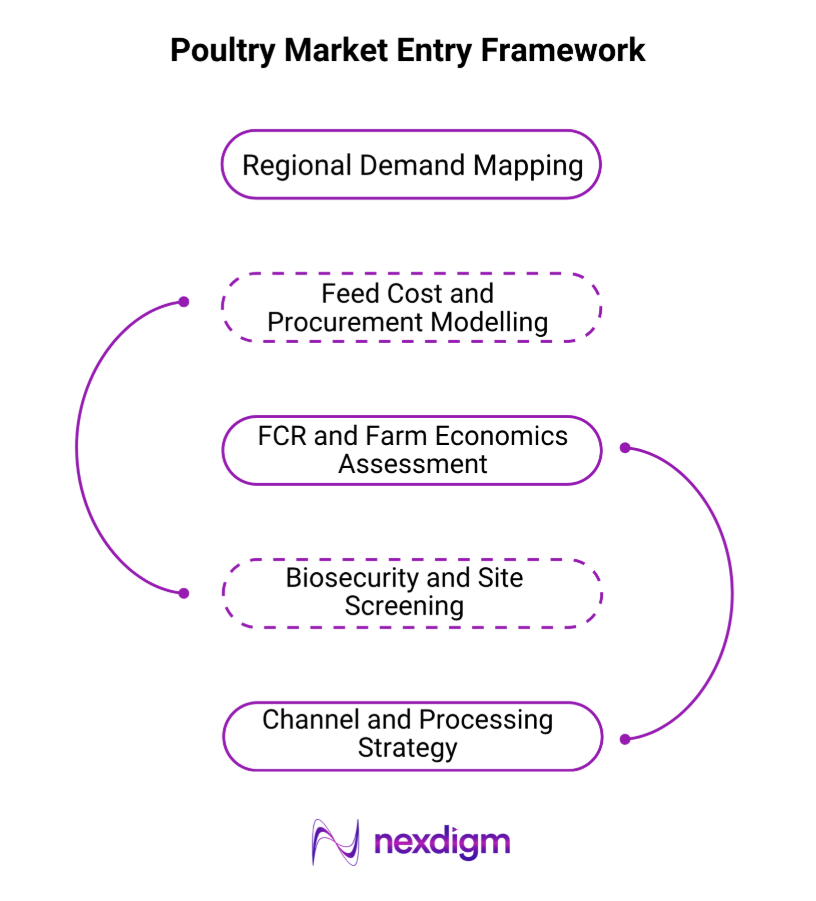
- Regional Demand Mapping: Broiler and egg consumption, urban demand centres, institutional buyers, food-service demand, retail formats, and competitive intensity are assessed to identify commercially relevant markets.
- Feed Cost and Procurement Modelling: Maize, soybean meal, amino acids, alternative feed ingredients, freight, supplier concentration, and seasonal price movements are modelled to establish the landed feed-cost baseline for each target region.
- FCR and Farm Economics Assessment: Feed conversion, mortality, housing systems, flock cycles, farm density, labour, utilities, and production costs are evaluated to determine the operating economics required for competitive live-bird production.
- Biosecurity and Site Screening: Disease exposure, surrounding farm density, water availability, access roads, buffer requirements, veterinary infrastructure, and environmental controls are assessed before selecting production locations.
- Channel and Processing Strategy: Live-bird wholesale, chilled, frozen, food service, modern trade, and quick-commerce channels are compared against processing investment, cold-chain requirements, margin potential, and distribution reach.
Nexdigm Case Study: Poultry Enterprise Risk Assessment
Nexdigm supported a leading food-processing and poultry-farming enterprise operating across 450 locations in India. Its assessment covered 2,500 nodes and 16 servers, identifying 17 critical, 9 high, 9 medium, and 29 low-priority vulnerabilities, alongside 13 informational findings, enabling enterprise-wide risk mitigation.
To take the next step, simply visit our Request a Consultation page and share your requirements with us.
Harsh Mittal
+91-8422857704