
Poultry procurement decisions carry risks that extend beyond product pricing and delivery schedules. Feed manufacturers, poultry integrators, processors, retailers and food businesses depend on suppliers operating across several stages of the value chain. These may include breeding farms, hatcheries, feed producers, veterinary input suppliers, live-bird aggregators, processing facilities and cold-chain providers.
Each supplier introduces a different set of operational and compliance requirements. Weak biosecurity at a breeding facility can affect flock health, while inconsistent feed quality may influence animal performance. Inadequate sanitation at a processing facility can create food safety exposure, and poor cold-chain management can compromise product quality before it reaches the buyer.
The scale of the Indian poultry industry makes these concerns commercially significant. In 2024–25, India produced approximately 149.11 billion eggs and 5.18 million tonnes of poultry meat. As production and distribution networks expand, organisations need stronger methods for evaluating supplier practices and verifying compliance across the supply chain.
Poultry supplier compliance research consulting helps organisations assess supplier capabilities against relevant biosecurity, food safety, quality and regulatory requirements. It provides a structured basis for supplier selection, risk monitoring and procurement decisions.
Why Poultry Supplier Compliance Is Difficult to Evaluate
Biosecurity practices vary across production facilities
Biosecurity is essential to controlling the introduction and spread of infectious diseases within poultry operations. However, supplier practices can differ significantly depending on facility design, management systems, staff training and veterinary oversight.
Potential weaknesses include inadequate visitor controls, inconsistent sanitation, poor separation of production areas, insufficient pest management and weak procedures for handling sick or dead birds.
These gaps are not always visible during routine commercial interactions. A supplier may provide competitive prices and maintain adequate production capacity while operating with inadequate disease prevention controls.
For buyers sourcing from multiple farms or aggregators, the challenge is to establish whether biosecurity requirements are applied consistently across the entire supplier network.
Feed quality creates downstream performance risks
Feed suppliers influence poultry health, growth and production economics. Variations in ingredient quality, nutrient composition, contamination controls and storage practices can affect the reliability of feed procurement.
The risks include inconsistent formulation, inadequate raw material traceability, poor storage conditions and contamination from unsuitable ingredients. Buyers may also face difficulty verifying whether feed specifications are maintained consistently across production batches.
Supplier evaluation must therefore extend beyond product specifications to include sourcing practices, testing procedures, manufacturing controls and documentation.
Food safety requirements extend across processing and distribution
Poultry processors and distributors must manage hygiene, sanitation, temperature control, packaging and traceability. These requirements become more complex when products move through several facilities or intermediaries.
Potential weaknesses include inadequate cleaning procedures, cross-contamination risks, poor temperature monitoring and incomplete batch documentation.
Cold-chain failures can be particularly difficult to identify when procurement teams rely only on delivery confirmation. A product may arrive within the agreed delivery window but still have experienced unsuitable storage or transportation conditions.
Documentation does not always reflect operational compliance
Supplier certificates and audit reports provide useful information, but they do not necessarily establish that controls are implemented consistently.
Documents may be outdated, limited to a specific facility or insufficiently detailed to demonstrate compliance across all operations. Buyers also need to verify whether certifications apply to the products, processes and locations included in the procurement arrangement.
A supplier’s compliance status should therefore be assessed through documented evidence and operational verification rather than certificate collection alone.
What Buyers Should Examine During Supplier Evaluation
Poultry supplier assessment should cover the full chain of activities relevant to the purchased product or service. Requirements for a feed manufacturer will differ from those for a hatchery, farm, processor or cold-chain provider.
Organisations should establish clear evaluation criteria covering:
- Biosecurity protocols, veterinary oversight and disease prevention practices.
- Feed ingredient sourcing, formulation controls and product testing.
- Processing hygiene, sanitation and food safety management.
- Storage, transportation and temperature monitoring.
- Batch traceability, supplier documentation and corrective-action records.
- Applicable licences, registrations, certifications and regulatory obligations.
The assessment should also distinguish between critical compliance failures and improvement opportunities. A missing document may require clarification, while a serious biosecurity or food safety weakness may justify immediate sourcing restrictions.
How Nexdigm Supports Poultry Supplier Compliance Research
Nexdigm supports organisations through supplier intelligence, market research, compliance assessment and procurement research. Its approach can help buyers map poultry supplier networks, evaluate supplier capabilities, identify potential compliance gaps and compare sourcing options.
Research can also support supplier segmentation, enabling procurement teams to distinguish between strategic suppliers, qualified alternatives and vendors requiring additional verification.
This provides a more structured basis for supplier onboarding, periodic reviews and procurement risk management.
Poultry Supplier Compliance Evaluation Framework
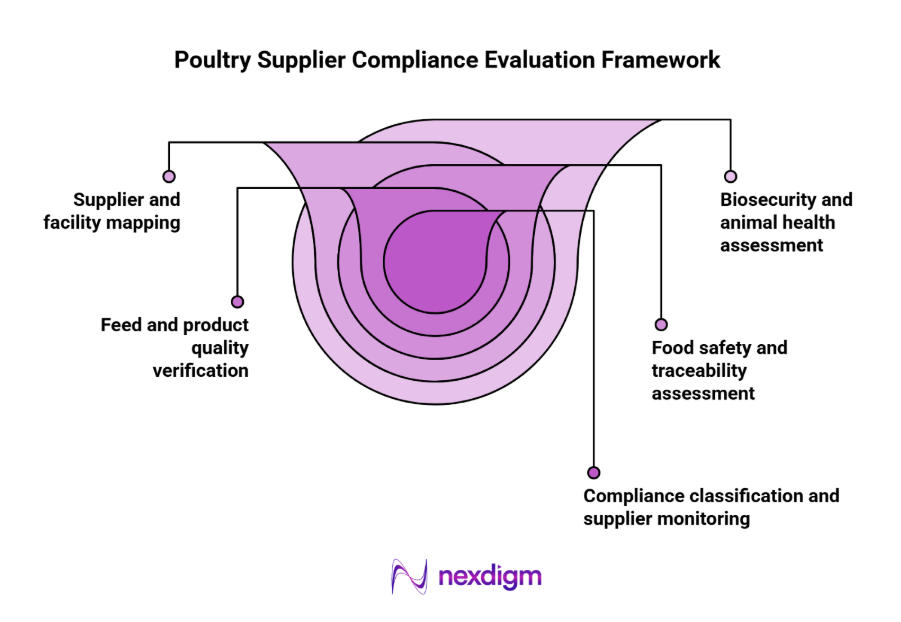
- Supplier and facility mapping
Identify relevant farms, hatcheries, feed manufacturers, processors, aggregators and logistics providers. Record the facilities, products and operational activities covered by each supplier relationship. - Biosecurity and animal health assessment
Examine disease prevention procedures, sanitation, visitor controls, veterinary supervision, vaccination practices and emergency response arrangements. Assess whether controls are consistently implemented across relevant facilities. - Feed and product quality verification
Review product specifications, ingredient sourcing, batch testing, contamination controls and quality assurance processes. Evaluate whether suppliers maintain consistent standards across production cycles. - Food safety and traceability assessment
Evaluate hygiene management, processing controls, temperature monitoring, packaging, storage and batch-level traceability. Verify that documentation covers the actual products and facilities being procured. - Compliance classification and supplier monitoring
Classify suppliers according to compliance status, risk severity and corrective-action requirements. Establish review schedules and escalation procedures for critical issues, recurring non-conformities and changes in supplier operations.
Nexdigm’s Case Study: Assessing Poultry Supplier Compliance
Nexdigm evaluated 21 poultry suppliers across 4 supplier categories and 3 operating regions. The assessment identified 6 suppliers requiring enhanced verification and established a compliance review structure covering biosecurity, feed quality, processing hygiene and traceability.
To take the next step, simply visit our Request a Consultation page and share your requirements with us.
Harsh Mittal
+91-8422857704