
Poultry businesses operate within a supply chain where the reliability of one supplier can affect production schedules, animal health, product quality and operating margins. Feed, day-old chicks, breeding stock, veterinary products, vaccines, processing inputs and packaging materials all contribute to the economics of poultry production. Yet these categories are often sourced through different vendors, with varying standards and levels of supply reliability.
For integrated poultry companies, feed manufacturers, processors and large commercial farms, supplier selection is not simply about finding the lowest quotation. A supplier must meet volume requirements, maintain consistent quality, comply with applicable regulations and deliver products across the required locations. Weakness in any one of these areas can create costs that are difficult to recover later.
A Growing Poultry Market Is Increasing Supplier Pressure
India’s poultry industry has expanded considerably over the past decade. Egg production increased from 78.48 billion eggs in 2014–15 to 149.11 billion in 2024–25. Poultry meat production also increased, reaching approximately 5.18 million tonnes in 2024–25, compared with 5.02 million tonnes in the previous year.
This growth creates demand across the entire poultry ecosystem. Feed manufacturers need dependable access to maize, soybean meal, additives and premixes. Commercial farms require consistent supplies of chicks, vaccines and veterinary products. Processors need reliable packaging, equipment and processing inputs.
However, a growing market does not mean every supplier has the capacity or infrastructure to serve larger customers. Smaller regional vendors may offer competitive pricing but struggle with volume commitments, while larger suppliers may have broader distribution but less flexibility in customised requirements.
Feed Quality and Ingredient Availability Affect Production Economics
Feed is one of the most significant operating expenses in poultry production. Its composition influences growth rates, feed conversion ratios, bird health and production consistency. Suppliers that cannot maintain nutritional specifications across batches can create performance differences even when purchase prices remain unchanged.
Ingredient sourcing introduces additional uncertainty. Maize, soybean meal, oilseed cakes, amino acids, vitamins and minerals are exposed to agricultural seasonality, competing demand and price fluctuations. A feed supplier may have strong manufacturing capacity but remain vulnerable if its ingredient procurement depends on a narrow supplier base.
For poultry businesses, the relevant question is whether a feed vendor can maintain consistent formulation and supply during periods of market volatility.
Supplier Quality and Compliance Are Not Interchangeable
Poultry procurement involves products with different regulatory and technical requirements. Feed ingredients, veterinary medicines, vaccines, breeding stock and processing materials cannot be evaluated through one generic quality checklist.
Documentation, manufacturing controls, product traceability and applicable approvals need to be verified at the relevant product and facility level. For animal health products, storage and transportation conditions are especially important. A product may meet manufacturing requirements but lose effectiveness if distribution conditions are inadequate.
The same applies to chicks and breeding stock. Buyers should assess source quality, health status, vaccination history, mortality records and the supplier’s ability to maintain consistent delivery schedules.
Distribution Gaps Can Disrupt Otherwise Reliable Supply
A supplier’s production capacity does not automatically translate into dependable delivery. Poultry operations may be located across multiple districts or states, requiring vendors to maintain regional warehouses, transport arrangements and local service support.
Delivery delays can create operational pressure. Feed shortages can disrupt feeding schedules, while delayed chick deliveries can affect farm utilisation and production planning. Veterinary and vaccine availability may also become critical during disease outbreaks.
Buyers should therefore distinguish between suppliers with a strong national presence and those with demonstrated coverage in the actual operating markets.
How Poultry Businesses Should Identify and Evaluate Suppliers
A structured poultry supplier identification and evaluation exercise should begin by separating suppliers according to product category and operational importance. Feed manufacturers, hatcheries, veterinary product companies, equipment suppliers and processing vendors require different qualification criteria.
The evaluation should compare production capacity, product specifications, quality assurance, regulatory documentation, geographic coverage and delivery performance. Buyers should also examine the supplier’s upstream dependencies, particularly where critical feed ingredients or specialised products are involved.
Commercial assessment should include delivered price, credit terms, minimum order quantities, seasonal availability and service commitments. A supplier offering a lower quotation may not provide better value if it requires larger inventory buffers or has a weak distribution network.
Nexdigm supports poultry and agribusiness organisations through supplier identification, market mapping, vendor benchmarking and commercial research. Its work can help buyers understand the supplier landscape, compare capabilities and identify qualified sourcing alternatives.
Poultry Supplier Qualification Framework
A practical evaluation should examine five dimensions:
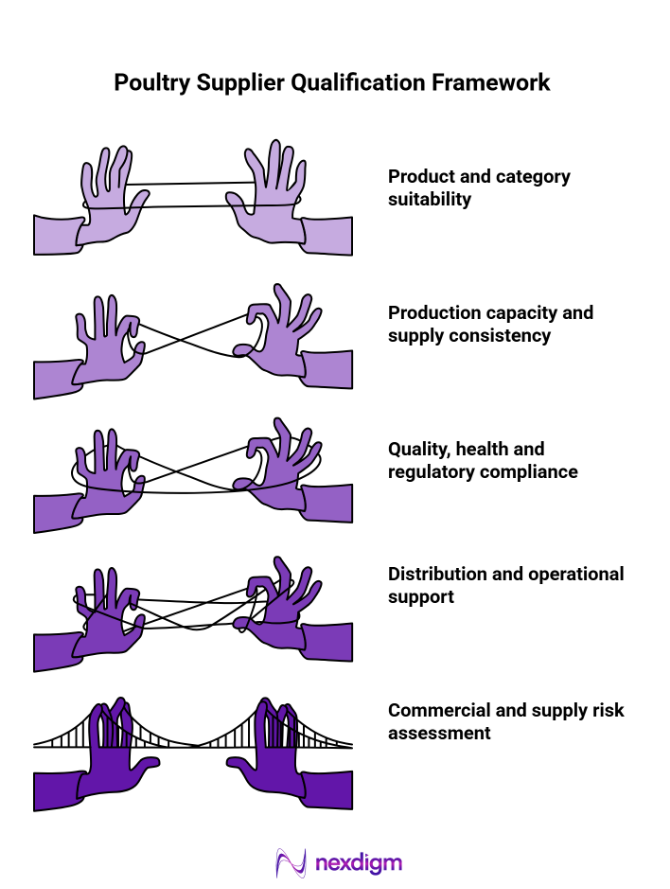
- Product and category suitability
Identify the supplier’s role across feed, feed ingredients, chicks, breeding stock, veterinary products, vaccines, equipment and processing inputs. Match the product portfolio to the buyer’s production model and technical requirements. - Production capacity and supply consistency
Review installed capacity, actual output, inventory availability, seasonal production constraints and the ability to fulfil recurring volume commitments. Examine whether the supplier can support expansion across additional locations. - Quality, health and regulatory compliance
Verify product specifications, testing protocols, traceability, applicable registrations, health documentation and facility-level quality controls. For temperature-sensitive products, assess storage and transportation arrangements. - Distribution and operational support
Evaluate warehouse locations, delivery coverage, transport capability, lead times, emergency supply arrangements and technical support. Consider whether the supplier can maintain service levels across all operating locations. - Commercial and supply risk assessment
Compare delivered costs, payment terms, minimum order quantities, contract flexibility and price revision mechanisms. Identify upstream dependencies, alternative suppliers and the consequences of a supply interruption.
Nexdigm’s Case Study: Evaluating Poultry Supply Partners
Nexdigm assessed 39 poultry suppliers across 5 input categories, comparing production capacity, quality controls, regulatory readiness and regional distribution. The study shortlisted 10 suppliers for further qualification and identified 4 categories with limited regional sourcing alternatives.
To take the next step, simply visit our Request a Consultation page and share your requirements with us.
Harsh Mittal
+91-8422857704