

The global automotive industry is undergoing one of its most significant transformations as powertrain technologies evolve from traditional internal combustion engines (ICEs) toward hybrid and fully electric vehicle (EV) platforms. While much of the discussion focuses on vehicle manufacturers and electrification goals, a critical shift is occurring within the component ecosystem.
A detailed Powertrain component market opportunity analysis reveals that demand is not simply moving from one technology to another. Instead, value is being redistributed across new component categories, advanced electronics, power management systems, and integrated technologies. For suppliers, manufacturers, investors, and OEMs, understanding these shifts is essential for capturing future growth opportunities.
From a Nexdigm perspective, the transition should not be viewed as the decline of one market and the rise of another. Rather, it represents a restructuring of demand patterns across the entire automotive supply chain.
Powertrain Ecosystem and its Growing Importance
The powertrain ecosystem comprises all systems and components responsible for generating, managing, and delivering power to a vehicle. As the automotive industry transitions from traditional ICE vehicles to hybrid and electric platforms, each powertrain ecosystem requires a distinct mix of components, technologies, and supplier capabilities. Understanding these differences is essential for identifying where component demand is growing and where future market opportunities are likely to emerge. The evolution of these ecosystems is reshaping supplier priorities, investment decisions, and value creation across the automotive value chain.
The Three Powertrain Ecosystems
Today’s automotive market is no longer dominated by a single propulsion technology. Instead, three parallel ecosystems are shaping component demand:
- Internal Combustion Engine (ICE) Vehicles: Traditional vehicles continue to command significant market volume, especially in developing economies and commercial transportation segments.
- Hybrid Vehicles: Hybrids serve as a bridge between conventional and fully electric mobility, combining combustion engines with electric propulsion systems.
- Electric Vehicles (EVs): Battery-powered vehicles are driving demand for entirely new component architectures and technology platforms.
Each category creates distinct opportunities and challenges for suppliers.
ICE Components: Evolution Rather Than Elimination
Despite the acceleration of electrification, ICE vehicles remain an important part of the automotive landscape.
Demand continues for:
- Engine components
- Fuel injection systems
- Exhaust systems
- Turbochargers
- Transmission assemblies
- Thermal management solutions
However, growth rates are gradually slowing in many regions.
What Is Changing?
OEMs are increasingly focused on:
- Improving fuel efficiency
- Reducing emissions
- Optimizing engine performance
- Lowering production costs
As a result, suppliers must deliver higher-value solutions rather than relying on volume growth alone. As OEM priorities continue to evolve, component suppliers must adapt to changing technology requirements and purchasing criteria. This shift is fundamentally reshaping demand across the powertrain value chain.
Nexdigm Perspective: Managing the ICE Transition
At Nexdigm, industry assessments indicate that ICE-related businesses should focus on strategic repositioning rather than immediate diversification. Key priorities include:
- Product Modernization: Developing components that support stricter emissions standards and improved fuel economy.
- Operational Efficiency: Strengthening competitiveness through manufacturing excellence and cost optimization.
- Market Diversification: Exploring growth opportunities across multiple regions and vehicle categories.
- Transition Planning: Gradually expanding into electrified component portfolios while maintaining ICE revenue streams.
A forward-looking Powertrain component market opportunity analysis shows that ICE components will remain relevant, but future growth opportunities will increasingly require adaptation.
Hybrid Platforms: Creating Demand Across Both Worlds
Hybrid vehicles occupy a unique position within the automotive market. Unlike conventional vehicles or EVs, hybrids require a combination of mechanical and electrical systems. As a result, they generate demand for:
- Internal combustion engine components
- Electric motors
- Power control units
- Battery systems
- Inverters
- Energy management solutions
This dual architecture creates a broader supplier opportunity set.
Why Are Hybrids Important?
Many consumers continue to seek fuel efficiency benefits without depending entirely on charging infrastructure. This makes hybrids particularly attractive in markets where EV adoption remains gradual.
Nexdigm Perspective: Hybrids Represent a Strategic Growth Opportunity
From a Nexdigm standpoint, hybrids should not be viewed solely as a transitional technology. They also represent:
Portfolio Expansion Opportunities
Suppliers can leverage existing ICE capabilities while entering electrification-related segments.
Lower Transition Risk
Hybrid growth enables companies to diversify without abandoning established businesses.
Market Accessibility
Hybrids remain attractive across a wide range of geographies and consumer demographics.
Technology Learning Platforms
Organizations gain experience with electric mobility systems before large-scale EV adoption.
This makes hybrid platforms an increasingly important focus area within any Powertrain component market opportunity analysis.
EV Platforms: The New Demand Engine
The most significant shift in component demand is occurring within fully electric vehicles. Traditional engine systems are being replaced by electrified technologies. Growing component categories include:
- Electric motors
- Battery packs
- Battery management systems
- Power electronics
- High-voltage wiring
- Inverters
- Charging systems
- Thermal management solutions
As EV production scales, demand for these technologies is expected to increase significantly.
Nexdigm Perspective: Value Is Migrating Toward Electrification Technologies
At Nexdigm, market evaluations indicate that future component value creation will increasingly come from technology-intensive systems. Organizations should focus on:
- Electrification Readiness: Assess product portfolios against future EV demand requirements.
- R&D Investment: Innovation capabilities will become a major competitive differentiator.
- Manufacturing Transformation: Production processes must evolve to support electrified component requirements.
- Strategic Partnerships: Collaboration with OEMs, battery manufacturers, and technology providers can accelerate market participation.
Companies that proactively align with electrification trends are likely to capture growth opportunities. These trends highlight a broader transformation underway across the automotive value chain, making it important to understand how powertrain evolution is reshaping component demand.
How Is the Powertrain Transition Reshaping Component Demand?
The answer lies in four major shifts:
- Declining demand for several traditional ICE-specific components
- Continued growth in hybrid powertrain systems
- Rapid expansion of EV-focused component categories
- Increasing demand for integrated and software-enabled solutions
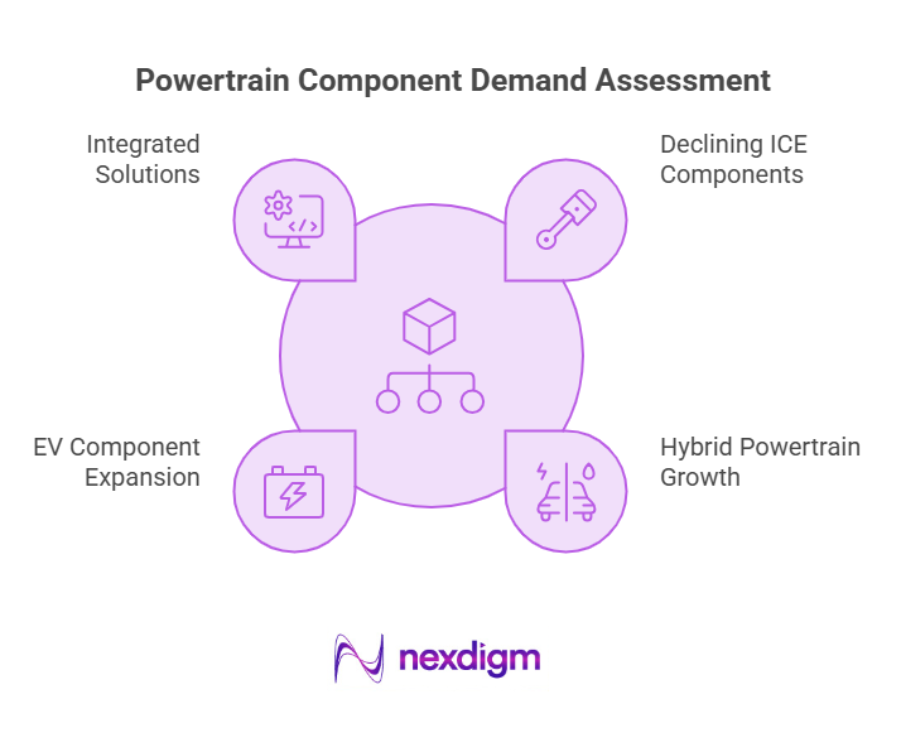
While ICE platforms will continue to generate significant demand in many markets, future value growth is increasingly concentrated in electrification-related technologies. Therefore, Nexdigm uses its Powertrain component market opportunity analysis to suggest that suppliers must adapt their product portfolios to remain competitive in an evolving mobility environment.
Where Are the Biggest Opportunities Emerging?
A strategic Powertrain component market opportunity analysis highlights several high-growth segments:
- Electric Motors and E-Axles: Demand is expanding alongside EV production growth.
- Power Electronics: Inverters, converters, and control modules are becoming critical vehicle systems.
- Battery-Related Components: Thermal management, battery housing, and management systems continue gaining importance.
- Hybrid Powertrain Assemblies: Growth remains strong in markets undergoing gradual electrification.
- Advanced Thermal Management: Both hybrids and EVs require sophisticated temperature control technologies.
This engagement demonstrates how a structured evaluation approach can help businesses identify high-potential opportunities while navigating technological and market uncertainties. To support such decision-making, Nexdigm applies a comprehensive framework that assesses powertrain component opportunities across key strategic dimensions.
The Nexdigm Framework for Evaluating Powertrain Component Opportunities
As powertrain technologies evolve, suppliers must assess opportunities beyond current demand trends and focus on long-term market viability. To help organizations prioritize investments and identify sustainable growth areas, Nexdigm recommends evaluating opportunities across these strategic dimensions:
- Demand Sustainability: Assesses whether component demand is expected to remain strong over the long term by analyzing industry trends, regulatory shifts, vehicle production forecasts, and customer adoption patterns.
- Technology Alignment: Evaluates how well a component portfolio aligns with emerging technologies, including electrification, hybridization, advanced materials, connectivity, and evolving powertrain architectures.
- Competitive Positioning: Examines an organization’s ability to differentiate through innovation, quality, cost competitiveness, manufacturing capabilities, customer relationships, and market presence relative to competitors.
This framework helps organizations align long-term investment strategies with industry transformation trends.
Nexdigm’s Case
Nexdigm recently assisted an automotive player in assessing powertrain shifts as India’s EV sales reached 2.66 million units in FY26, up 29.7% YoY. The study evaluated ICE, hybrid, and EV component opportunities, identifying emerging value pools and growth opportunities.
To take the next step, simply visit our Request a Consultation page and share your requirements with us.
Harsh Mittal
+91-8422857704