
Precision agriculture adoption is progressing, although technology use varies across farming markets and operational scales. The USDA’s August 2025 report found that 22% of US farms used precision agriculture practices, compared with 27% in 2023. However, 85% of farms had internet access, and 50% purchased agricultural inputs online in 2025.
The OECD’s 2026 research found that 56% of surveyed German farms used GPS-guided machinery, while 20.1% used variable-rate fertilizer application. These differences highlight how equipment adoption depends on farm requirements, digital readiness, and investment priorities.
Through precision agriculture equipment sourcing research, agricultural businesses can relevant suppliers, compare equipment capabilities, and assess sourcing options across performance, integration, and cost.
Why Precision Equipment Selection Depends on Farm Economics
Precision agriculture investments involve more than purchasing advanced machinery. GPS guidance, yield monitors, sensors, drones, and variable-rate application systems serve different purposes and carry different investment requirements. Their commercial value depends on farm acreage, crop patterns, equipment utilization, connectivity, and the ability to translate collected data into operational decisions. A suitable sourcing strategy must therefore consider both technical performance and the economics of adoption.
Commercial Considerations Before Investing in Precision Equipment
Before approaching suppliers, farms need to establish what the investment should deliver. Three considerations can guide this assessment:
- Expected Operational Benefits: Identify opportunities to improve field accuracy, monitor crop conditions, optimize input application, and reduce operational inefficiencies.
- Technology Compatibility: Determine whether equipment integrates with existing tractors, implements, farm management software, sensors, and data platforms.
- Investment and Ownership Costs: Evaluate purchase prices, installation expenses, software subscriptions, maintenance requirements, and expected equipment utilization.
These considerations help establish a practical basis for comparing equipment and identifying suppliers.
Nexdigm’s Research Begins with the Equipment Sourcing Landscape
Our expertise helps agricultural businesses understand the supplier ecosystem behind precision farming technologies. Our experts identify manufacturers, equipment providers, software companies, and specialized technology vendors across relevant markets. We examine product portfolios, technical capabilities, market presence, distribution arrangements, and commercial positioning. This creates a structured view of available sourcing options and helps organizations identify providers relevant to their intended applications.
How Nexdigm’s Experts Identify the Technologies That Match Farming Operations
Precision agriculture covers several equipment categories, each addressing different operational requirements. Our precision agriculture equipment sourcing research can help businesses explore suppliers across these technology areas:
- GPS and Guidance Systems: Identify providers of GNSS receivers, auto-steering equipment, positioning systems, and guidance displays for accurate field operations.
- Sensors and Monitoring Equipment: Map suppliers of soil sensors, crop monitoring devices, weather stations, and yield measurement technologies.
- Drones and Remote Sensing Solutions: Examine providers of agricultural UAVs, imaging equipment, mapping technologies, and crop assessment solutions.
- Variable-Rate Application Equipment: Identify manufacturers of controllers, application systems, and precision implements that support targeted seeding, fertilization, and spraying.
This technology-led assessment helps organizations understand the available equipment choices before moving into detailed supplier comparisons.
Assessing Supplier Capabilities Beyond Technology Offerings with Nexdigm
Identifying relevant equipment providers is only the starting point. Our research services can help agricultural businesses assess suppliers across these important dimensions:
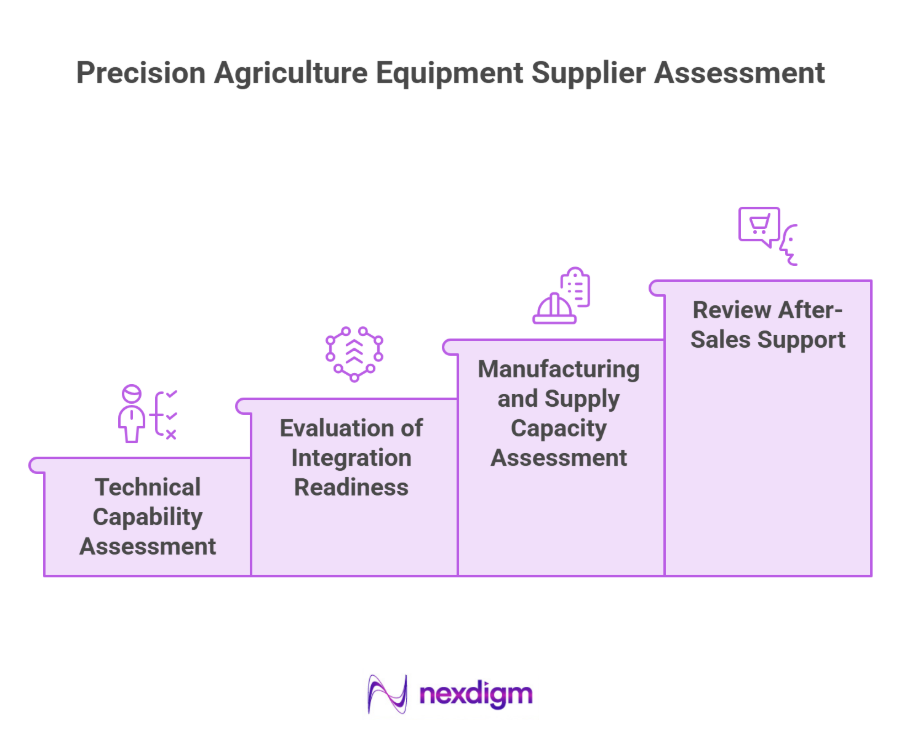
- Technical Capabilities: Examine equipment specifications, accuracy, automation features, and suitability for different farming applications.
- Integration Readiness: Evaluate compatibility with existing machinery, farm management platforms, connectivity systems, and data infrastructure.
- Manufacturing and Supply Capacity: Assess production capabilities, product availability, distribution networks, and ability to support procurement requirements.
- After-Sales Support: Review warranty provisions, maintenance services, spare-parts availability, and regional technical assistance.
This assessment helps organizations distinguish suppliers with relevant product offerings from those better positioned to support their operational requirements.
Translating Nexdigm’s Supplier Intelligence into Equipment Sourcing Priorities
Our expert-led research consolidates supplier profiles, technology assessments, integration considerations, and commercial findings into structured research outputs. This helps businesses compare providers, identify capability gaps, and prioritize suppliers based on equipment requirements, market presence, and support capabilities. These insights give procurement teams a clearer basis for shortlisting manufacturers and planning further technical and commercial evaluations.
Nexdigm’s Case
An agricultural enterprise sought precision equipment suppliers across GPS guidance, soil monitoring, and variable-rate application. Nexdigm assessed 21 providers across technology, integration, supply capacity, and service support. The analysis found that 33% had interoperability limitations, while 28% lacked adequate regional service coverage. The enterprise used these findings to prioritize suppliers for further evaluation.
To take the next step, simply visit our Request a Consultation page and share your requirements with us.
Harsh Mittal
+91-8422857704