

Precision engineering demand is strengthening across industries where tighter tolerances, complex components, and reliable performance are increasingly critical. The global precision machining market is estimated at $134.25 billion in 2026, with Asia Pacific accounting for 43.9% of the 2025 market.
Semiconductor manufacturing is also driving high-precision requirements, with global semiconductor equipment sales forecast to reach a record $165.9 billion in 2026, up 23.2% year over year.
Aerospace remains another major demand center, with the global commercial aircraft backlog exceeding 17,000 aircraft in July 2026. These trends are increasing demand for high-tolerance components across aerospace, electronics, automotive, medical, and industrial applications.
What Precision Engineering Customers Value Most
As precision requirements rise, customers are evaluating suppliers on more than dimensional accuracy. Consistency, responsiveness, capacity, and commercial competitiveness increasingly influence sourcing decisions.
- Consistent Quality: Customers prioritize suppliers capable of maintaining tight tolerances and repeatable quality across production volumes, minimizing defects and performance variability.
- Capacity & Reliability: Buyers increasingly value suppliers with sufficient capacity, dependable delivery schedules, and flexibility to accommodate changing production requirements.
- Technical & Commercial Value: Engineering expertise, certifications, competitive pricing, and problem-solving capabilities increasingly determine supplier selection for demanding applications.
Suppliers that combine precision, reliability, technical capability, and commercial value are better positioned to capture growing demand across high-tolerance applications.
Understanding the High-Growth Areas in Precision Engineering
Demand is becoming more concentrated in applications where performance, accuracy, and reliability directly affect product outcomes. Semiconductor equipment, aerospace components, medical devices, electric vehicles, and advanced industrial machinery are creating opportunities for suppliers with specialized capabilities. These markets increasingly favor manufacturers that can combine high tolerances, scalable production, certification, and consistent quality.
Nexdigm’s Intelligence for Precision Engineering Growth
Precision engineering opportunities vary significantly by application, customer requirements, geography, and supplier capability. Nexdigm helps manufacturers connect these factors to identify where demand is growing, which requirements matter most, and where competitive opportunities exist, by focusing on these key areas:
- Demand Hotspot Identification: Identify industries, applications, and customer segments generating stronger demand for high-tolerance components.
- Capability-to-Market Matching: Compare manufacturing capabilities with application requirements to identify markets where suppliers can compete effectively.
- Customer Requirement Intelligence: Assess purchasing priorities such as tolerance, quality, certifications, delivery, customization, and cost to understand supplier-selection criteria.
- Competitive Opportunity Mapping: Evaluate competitor capabilities, positioning, geographic presence, and specialization to identify market gaps and differentiation opportunities.
The resulting intelligence helps precision engineering businesses focus commercial efforts on the applications and markets where their capabilities have the strongest potential to create growth.
Nexdigm’s Precision Engineering Market Opportunity Analysis
Nexdigm’s Precision engineering market opportunity analysis helps manufacturers evaluate where high-tolerance engineering capabilities can translate into commercially attractive growth. The opportunity analysis comprises of the following steps:
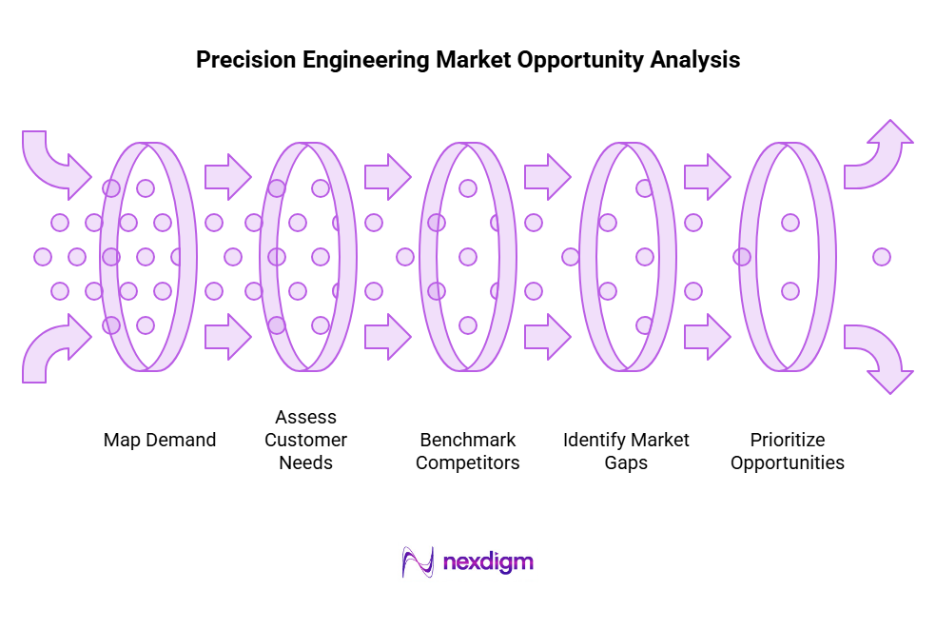
- Map Demand: Identify high-growth industries, applications, customer segments, and geographic markets that require precision-engineered components, helping manufacturers align capabilities with demand drivers and prioritize attractive expansion opportunities.
- Assess Customer Needs: Evaluate tolerance requirements, quality expectations, certifications, customization needs, delivery timelines, production capacity, and cost considerations to better understand purchasing criteria across target applications.
- Benchmark Competitors: Analyze competitor capabilities, manufacturing technologies, production capacity, specialization areas, pricing strategies, and geographic reach to identify competitive strengths, weaknesses, and market positioning opportunities.
- Identify Market Gaps: Highlight underserved applications, unmet customer requirements, capability shortages, and emerging industries need to uncover opportunities for differentiation, innovation, and long-term value creation.
- Prioritize Opportunities: Rank target markets and applications based on demand potential, competitive intensity, capability alignment, investment requirements, and commercial attractiveness to support focused growth strategies.
This enables precision engineering businesses to focus resources on high-potential markets and applications where their capabilities can support sustainable revenue growth and competitive differentiation.
Nexdigm’s Opportunity Analysis in Supporting Sustainable Revenue Growth
Nexdigm’s analysis helps precision engineering businesses identify where market demand, customer requirements, and internal capabilities intersect. This enables companies to focus resources on opportunities such as:
- Prioritized Growth Markets: Identify industries, applications, and customer segments with sustained demand for precision-engineered components.
- Higher-Value Opportunities: Target applications where technical complexity, quality requirements, and specialized capabilities support stronger commercial potential.
- Customer-Led Expansion: Align capabilities with evolving customer needs to strengthen relationships and create opportunities for recurring business.
- Strategic Capability Development: Guide investments in technology, capacity, certifications, and expertise based on validated market opportunities.
By connecting market intelligence with commercial priorities, Nexdigm helps manufacturers build focused growth strategies that support recurring demand, stronger customer positioning, and sustainable revenue expansion.
Nexdigm’s Case
Nexdigm supported a precision engineering manufacturer in identifying high-growth applications and customer segments. The analysis narrowed 40+ opportunities to 6 priority markets, identified 12 potential customer segments, and highlighted capability gaps requiring targeted investment. These insights helped the manufacturer focus business development efforts and build a stronger pipeline for sustainable revenue growth.
To take the next step, simply visit our Request a Consultation page and share your requirements with us.
Harsh Mittal
+91-8422857704