
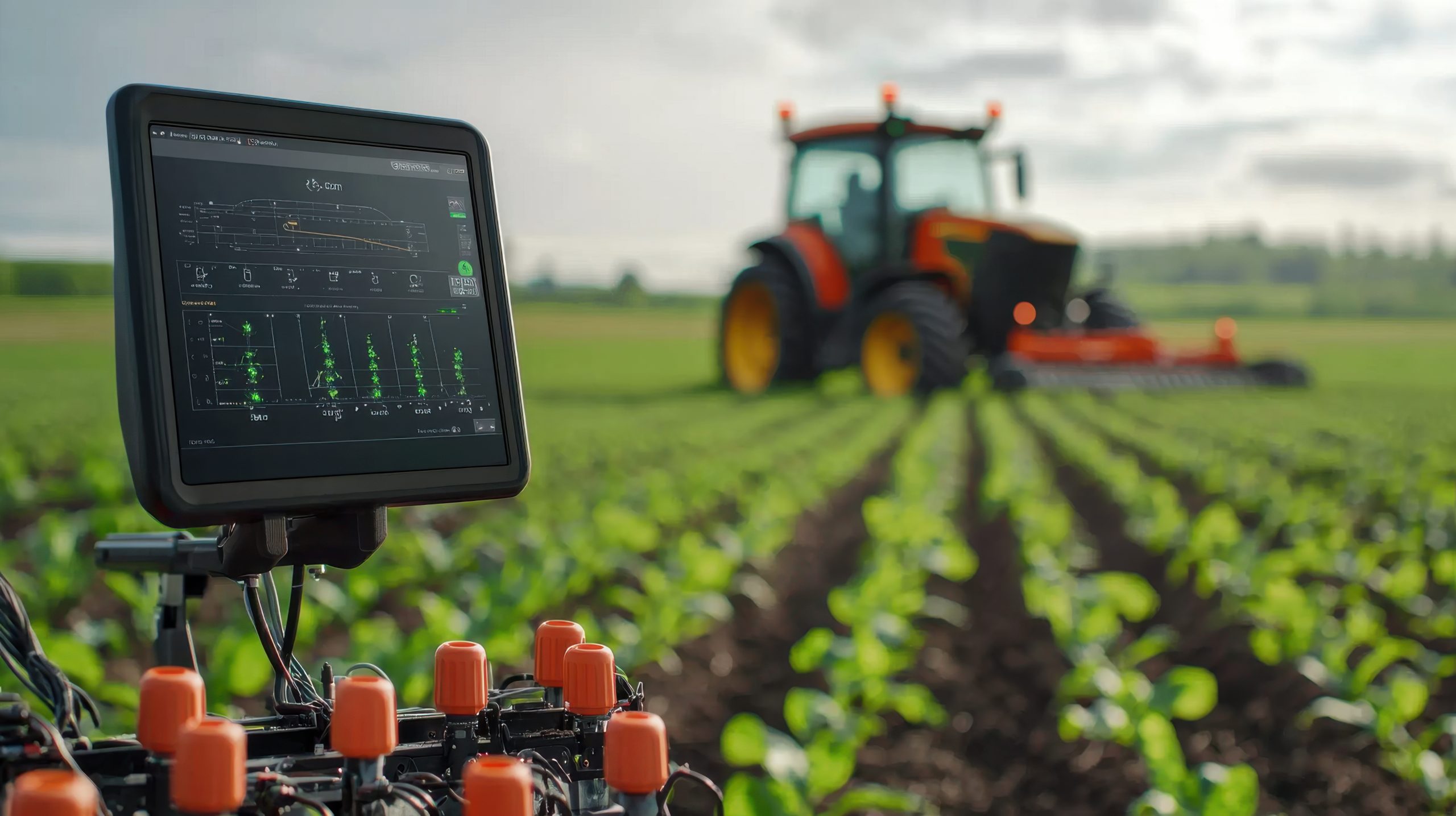
Precision agriculture is often discussed as a technology adoption story. For farmers, equipment manufacturers, and investors, it is really a utilisation and payback story. A machine can deliver impressive technical performance and still struggle commercially if it sits idle for most of the year or requires an individual farmer to finance an asset serving only a small acreage.
India’s smallholder structure makes this distinction particularly important. Equipment economics increasingly favour shared access through Custom Hiring Centres, Farmer Producer Organizations, rural entrepreneurs, and pay-per-acre service models. The question is therefore not which technology is most advanced, but which equipment can create measurable value at a viable cost per acre.
Start With the Field Outcome, Not the Hardware
Different technologies generate value through different mechanisms. Agricultural spraying drones can reduce water consumption through low-volume application, while precision planters improve seed placement and crop geometry. Laser land levellers can reduce irrigation and fuel requirements, while sensor-led fertigation can lower fertilizer and power consumption in high-value horticulture.
The research indicates:
- Ten-litre agricultural spraying drones typically cost ₹4.5–₹6.5 lakh, with commercial service fees of approximately ₹350–₹500 per acre.
- Drone spraying can reduce water consumption by around 85% to 90% and chemical volume by roughly 20% to 30%.
- Laser land levellers can reduce irrigation application time by 20% to 25%.
- Precision planters can reduce seed requirements by 15% to 20% and support an 8% to 12% yield improvement in suitable crops.
- Variable-rate fertigation and sensor systems can generate 18% to 24% fertilizer savings and 20% to 30% power savings in commercial horticulture.
The commercial value of these technologies depends on whether the resulting savings or yield gains are large enough to justify the cost of access.
The Real Constraint Is Utilisation
Individual ownership is difficult when equipment is serving a small landholding. A drone costing several lakh rupees cannot rely on one farmer’s acreage for sufficient annual utilisation. The economics become more attractive when demand is aggregated across villages and cropping seasons.
For an equipment provider, the critical variables are therefore the number of serviceable acres, geographic concentration, cropping calendar, annual machine-hours, service pricing, and maintenance requirements.
For example, commercial drone operations may require approximately 1,200–1,500 flight acres annually to reach break-even under the economics outlined in the research. That changes the business model from simply selling hardware to building a service network capable of keeping the asset productive.
Shared Access Is Changing the Equipment Business
Three delivery structures can improve equipment utilisation.
- Custom Hiring Centres allow multiple farmers to access machinery without taking on full ownership costs.
- Pay-per-acre contracting shifts the transaction from equipment ownership to a defined field service.
- FPO-led models can aggregate demand while keeping equipment access closer to producer communities.
The commercial implications differ for every participant.
Manufacturers need sufficient equipment utilisation and after-sales infrastructure. Rural entrepreneurs need concentrated demand. Financiers need predictable cash flows. Farmers need measurable savings or yield benefits at a service price they can absorb.
This means market potential cannot be determined by equipment sales alone.
Measuring the Opportunity Requires More Than a Mechanisation Rate
A precision farming equipment market study needs to establish where the economics support adoption. Nexdigm can evaluate crop calendars, acreage concentration, labour availability, tractor and implement compatibility, machine utilisation, service pricing, maintenance requirements, and farmer-level savings.
The assessment can determine:
- Which equipment categories can support viable pay-per-acre models.
- Which agricultural clusters provide sufficient annual utilisation.
- Where CHC or FPO models can reduce ownership barriers.
- How savings in water, chemicals, fuel, labour, or seed affect farmer ROI.
- What local service infrastructure is required for scale.
This turns a technology market assessment into a commercial deployment plan.
Nexdigm’s Framework for Precision Agriculture Economics
Nexdigm can assess the market through five connected dimensions:
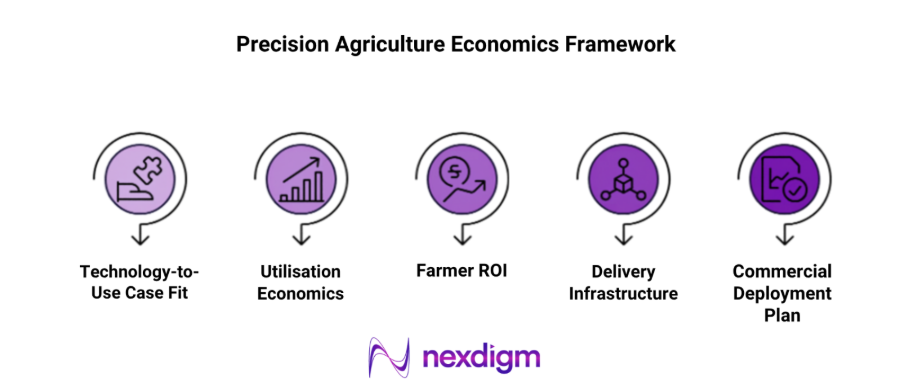
- Technology-to-Use-Case Fit: Matches equipment categories to specific crops, farm sizes, field operations, and local agronomy, preventing niche technologies from being treated as universal solutions.
- Utilisation Economics: Models serviceable acreage, cropping cycles, operational days, machine-hours, downtime, and service pricing to determine asset revenue viability.
- Farmer ROI: Quantifies net impact on inputs (water, chemicals, seed, diesel, labour) and yield/quality against equipment ownership or service costs to establish economic viability.
- Delivery Infrastructure: Evaluates CHC density, FPO engagement, operator and mechanic availability, charging/battery infrastructure, spare-parts supply, and financing options for reliable deployment.
- Commercial Deployment Plan: Synthesizes these layers to map viable demand clusters and define the service or ownership model required to sustain long-term equipment utilisation.
Nexdigm Case Study: Scaling Equipment Through Shared Access
A regional operational mechanisation assessment audited 45 Custom Hiring Centre hubs serving average landholdings of 1.2 hectares. The intervention established centralised maintenance networks and equipment access across the cluster.
The reported outcomes included a 22% reduction in cultivation costs, a 30% reduction in active pesticide volume through calibrated ULV drone spraying, and an 18% increase in soybean yield associated with pneumatic stand placement.
The case illustrates why the commercial opportunity for precision equipment can depend as much on the delivery model and utilisation architecture as on the equipment itself.
To take the next step, simply visit our Request a Consultation page and share your requirements with us.
Harsh Mittal
+91-8422857704