

Precision equipment strategies are helping technology providers capture growth across smart farming markets by improving accuracy, resource use, and productivity in agricultural operations. Tools such as GPS-guided equipment, sensors, variable-rate applicators, drones, and data platforms enable farmers to monitor fields, reduce input waste, and make better operational decisions.
For technology providers, a clear market entry strategy is essential to assess regional demand, farmer adoption readiness, equipment compatibility, pricing models, and distribution partnerships. A focused Precision farming equipment market entry approach helps identify scalable opportunities, align solutions with local farming needs, and build a strong position in the expanding smart agriculture market.
Recent estimates show that the global precision farming market was valued at USD 15.1 billion in 2025 and is projected to reach USD 38.8 billion by 2033, growing at 12.7% CAGR. North America accounted for 36.1% of market revenue in 2025. These figures support Precision farming equipment market entry planning by highlighting rising demand for GPS-enabled equipment, sensors, analytics, and automation across smart farming markets.
Evaluating Demand Across Smart Farming and Precision Agriculture Markets
This involves analyzing farm size, crop patterns, mechanization levels, technology adoption, labor challenges, and productivity goals to identify demand for precision farming equipment across target markets.
-
Farm Size Assessment
Evaluate landholding patterns and large farming clusters to identify scalable demand for precision farming equipment.
-
Crop Pattern Review
Analyze crop types, seasonal cycles, and input intensity to assess suitability for precision agriculture technologies.
-
Technology Adoption Mapping
Review current use of GPS tools, sensors, drones, analytics, and automation across target farming regions.
-
Mechanization Level Analysis
Assess existing equipment penetration and modernization needs to estimate demand for advanced precision farming solutions.
Nexdigm Competitive Benchmarking for Smart Farming Market Entrants
Nexdigm can help smart farming market entrants benchmark competitors across product features, pricing models, technology capabilities, distribution reach, service networks, and customer positioning. This supports market entry strategy by identifying differentiation opportunities, adoption barriers, regional gaps, and practical growth levers for precision farming equipment providers.
Nexdigm Customer Segmentation for Precision Farming Technology Adoption
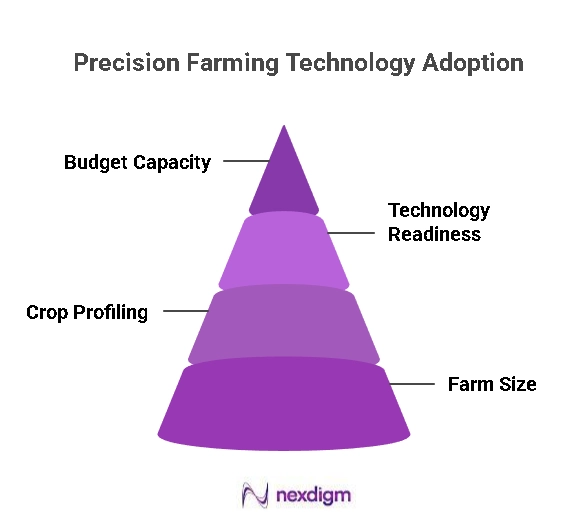
Nexdigm can segment farms, cooperatives, contractors, and agribusinesses by size, crop type, budget, technology readiness, productivity needs, and adoption potential for precision farming solutions:
-
Farm Size Segmentation
Classify small, medium, and large farms to identify scalable users for precision farming technology adoption.
-
Crop-Based Profiling
Assess crop types, input intensity, and seasonal cycles to match precision tools with specific farming requirements.
-
Technology Readiness Mapping
Evaluate digital awareness, equipment usage, connectivity access, and openness to GPS, sensors, drones, and analytics.
-
Budget Capacity Assessment
Analyze investment ability, financing needs, payback expectations, and affordability for precision farming equipment.
Nexdigm’s case:
Nexdigm helped a precision farming technology provider segment customers across smart farming markets. The analysis identified large farms representing 40% of near-term adoption potential, cooperatives with 25% channel expansion opportunity, and contractors seeking 20–30% productivity gains through GPS-enabled tools and sensors. These insights helped the company prioritize high-value customer groups, refine product positioning, and develop a focused market entry strategy.
To take the next step, simply visit our Request a Consultation page and share your requirements with us.
Harsh Mittal
+91-8422857704