
Price laddering analysis is a strategic pricing analysis technique that helps businesses evaluate product tiers and identify opportunities to increase revenue through well-planned upgrades. By examining the pricing gaps between entry-level, mid-range, and premium offerings, companies can uncover an upsell potential while maintaining strong customer value.
Effective price laddering analysis ensures that each product tier offers meaningful benefits that encourage customers to move to higher-priced options. As part of a comprehensive pricing analysis, this approach supports better pricing decisions, improves customer segmentation, enhances profitability, and creates a structured path for sustainable revenue growth.
Research shows that even a 1% improvement in price can significantly increase operating profit, making structured pricing decisions highly valuable. Businesses using pricing analysis often review tier gaps, customer willingness to pay, and conversion behavior to identify revenue leakage.
A well-designed price laddering analysis can reveal 10% to 15% upsell potential by encouraging customers to shift from basic to higher-value tiers while preserving affordability and perceived value.
Understanding the Role of Price Laddering Analysis in Pricing Strategy
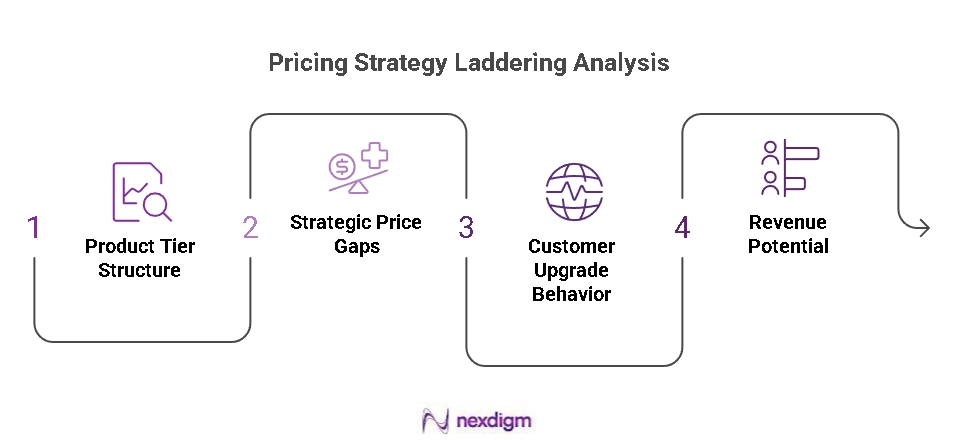
Price laddering analysis plays a vital role in pricing strategy by evaluating product tiers, identifying optimal price gaps, encouraging customer upgrades, maximizing revenue opportunities, improving profitability, and supporting data-driven pricing decisions:
-
Evaluating Product Tier Structure
Price laddering analysis reviews basic, mid-range, and premium tiers to ensure each level offers clear value differences.
-
Identifying Strategic Price Gaps
It helps measure whether price differences between tiers are attractive enough to encourage profitable customer upgrades.
-
Understanding Customer Upgrade Behavior
Pricing analysis shows how customers move between tiers based on affordability, features, benefits, and perceived value.
-
Maximizing Upsell Revenue Potential
Businesses can identify 10% to 15% upsell opportunities by positioning higher-tier products more effectively.
Nexdigm’s Advisory Support for Scalable Revenue Growth
Nexdigm’s advisory support for scalable revenue growth helps businesses strengthen pricing strategies, optimize product tiers, and identify upsell opportunities. Through pricing analysis, market benchmarking, and customer insights, Nexdigm enables organizations to improve profitability, enhance value perception, and create structured pricing models that support sustainable growth across products, channels, and markets.
Nexdigm’s Pricing Analysis Approach for Product Tier Optimization
Nexdigm’s pricing analysis approach helps businesses evaluate product tiers, assess price gaps, identify upsell potential, improve customer value perception, and build optimized pricing structures for sustainable revenue growth.
-
Product Tier Evaluation
Nexdigm reviews product tiers to identify pricing gaps, value differences, and opportunities for stronger customer upgrade paths.
-
Customer Value Assessment
Nexdigm analyzes customer needs, perceived value, and willingness to pay across different product and service tiers.
-
Competitive Price Benchmarking
Nexdigm compares market pricing to assess competitiveness, premium positioning, and potential areas for price optimization.
-
Upsell Opportunity Identification
Nexdigm identifies 10% to 15% upsell potential by aligning tier pricing with customer value and demand.
Nexdigm’s case:
Nexdigm helped a mid-sized consumer products company optimize its product tier pricing through price laddering analysis. By reviewing entry, mid, and premium tier gaps, Nexdigm identified a 12% upsell opportunity, improved premium-tier adoption by 18%, and supported a 9% revenue increase within two quarters through data-driven pricing analysis.
To take the next step, simply visit our Request a Consultation page and share your requirements with us.
Harsh Mittal
+91-8422857704