

Businesses are surrounded by data. From industry reports and analyst studies to government statistics and online databases, information is easier to access than before. But when it comes to answering critical business questions, such as why customers are changing preferences, what influences buying decisions, or identifying emerging opportunities, published data is not enough.
The most valuable insights frequently come directly by connecting with people. Speaking with customers, prospects, industry experts, and key stakeholders, organizations can uncover perspectives that reports alone cannot provide. This is why primary research remains an essential tool for businesses looking to fill information gaps, validate assumptions, and make strategic decisions for long-term growth.
Why Published Data Is Not Enough
Secondary research is often the starting point for understanding the market. It helps businesses gain a broad understanding of an industry and identify key trends shaping the market. However, most published information is designed for a wide audience and may not address an organization’s specific objectives. As markets evolve, businesses often find that available data too generic, outdated, or unable to explain the nuances behind customer behavior. This is where Primary Research comes into light. It helps in answering questions such as:
- Why are customers switching brands?,
- What drives purchasing decisions?,
- How will a new solution be perceived by the market?
How Primary Research Brings Market into Focus
Primary research involves collecting information directly from the people who matter most to the business. Organizations have the opportunity to hear directly from customers, prospects, partners, industry experts, or key decision-makers. This direct engagement allows businesses to capture insights that are relevant to their specific objectives, reflect current market realties, rich in context, and actionable for strategic business decisions. Whether through interviews, surveys, focus groups, or stakeholder discussions, primary research provides a clear view of the market from the perspective of those actively participating in it.
Understanding The “Why” Behind Business Decisions
One of the biggest advantages of primary research is its ability to reveal the reasons behind customer actions. Secondary data may indicate competitive insights and market share. However, understanding why customers are choosing that competitor often requires direct conversations with buyers. Primary research helps businesses identify:
- Customer priorities and preferences: Understand evolving customer needs, expectations, and emerging trends that influence purchasing behavior.
- Strengths and weaknesses of competitors: Gain insights into how competitors are perceived, including the factors that customers value and the gaps they identify.
- Purchase decision drivers: Identify the key factors that influence buying decisions, such as price, quality, service, innovation, trust, or ease of implementation.
- Pain points: Identify challenges and the unmet needs that customers face throughout their buying journey.
- Expectations for future products and services: Understand changing customer requirements and the features or experiences they expect from future offerings.
These insights enable organizations to move beyond surface-level observations and understand the factors genuinely influencing the market.
Primary Research and its Importance in B2B Markets
In B2B markets, purchasing decisions are done by collaboration of multiple teams. Multiple stakeholders often participate in the evaluation and approval process, each with different priorities and concerns. Understanding these perspectives requires more than market reports and statistics. A B2B market research company can help organizations engage directly with decision-makers, technical evaluators, teams, channel partners, and end users to understand:
- How buying decisions are made
- What challenges customers face
- How stakeholder priorities differ
- What factors drive long-term business relationships
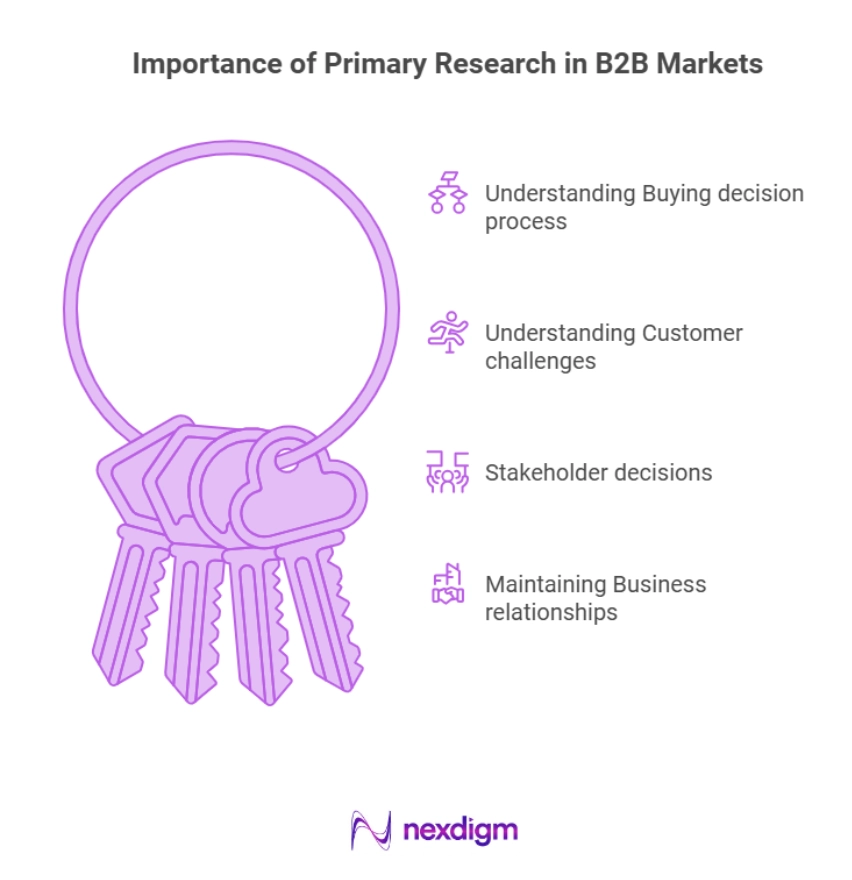
These insights provide an insight into the buying journey and help businesses develop stronger market strategies.
How Nexdigm Uses Primary Research to Deliver Deeper Insights
Nexdigm helps with business decisions driven by a combination of market intelligence and direct stakeholder insights. While secondary research provides an important foundation, primary research adds the depth and context needed to answer business-critical questions. Through tailored primary research programs, Nexdigm helps organizations:
- Connect directly with customers and stakeholders: Collect feedback from key audiences to understand perceptions, expectations, experiences, and evolving business needs.
- Validate strategic assumptions: Test business hypotheses, assess market readiness, and ensure strategic decisions are goverened by real-world insights.
- Explore new market opportunities: Identify untouched customer segments, emerging trends, and growth areas that may not be visible through published data alone.
- Assess brand perception and customer satisfaction: Understand how customers view the brand, measure satisfaction levels, and identify areas for improvement.
- Understand evolving buyer expectations: Track changing customer preferences, purchasing behaviors, and decision-making factors across different markets and industries.
- Generate actionable insights for growth: Convert research findings into practical insights and recommendations that support product development, market expansion, and business growth strategies.
As a trusted B2B market research company, Nexdigm combines analytical insights with primary research abilities to help organizations gain clarity in increasingly complex markets.
Nexdigm’s Case
Nexdigm assisted a global industrial client address critical market-data gaps through primary interviews with customers, distributors, and technical experts across four countries. The insights validated unmet needs, refined pricing assumptions, improved forecast accuracy by 29%, reduced market-entry risk by 24%, and accelerated investment approval by six weeks.
To take the next step, simply visit our Request a Consultation page and share your requirements with us.
Harsh Mittal
+91-8422857704