

National hospital-bed ratios can conceal substantial differences between individual cities and catchment areas. A market may have adequate overall capacity while remaining underserved in oncology, cardiac care, orthopedics, or other high-value specialties.
For private hospital operators, the investment opportunity therefore depends on identifying where patient demand, specialist capacity, and provider economics are most closely aligned.
India’s private healthcare sector is already responding to this gap.
Private providers account for approximately 59–60% of available hospital beds.
Nexdigm’s analysis of 18 large hospital chains expects more than 34,000 additional beds between FY2026 and FY2030, representing a 48–50% increase over their existing capacity.
The associated investment is expected to exceed ₹40,000 crore.
Demand Is Supporting Capacity Expansion
The investment pipeline is being supported by strong utilization and improving hospital economics.
ICRA reported 63.5% occupancy in FY2026 among its sample of hospital companies, alongside a 9.2% increase in average revenue per occupied bed per day (ARPOB).
It expects revenue growth of 13–15% in FY2027, with operating margins remaining around 22–24%.
CRISIL’s analysis points in the same direction. It expects private hospital revenue to grow 14–15% in fiscal 2027, with patient volumes and bed occupancy remaining strong despite continued capacity additions.
Its analysis of 98 private hospitals also found that complex, high-value specialties such as cardiology, oncology, neurology, gastroenterology, and orthopedics accounted for approximately 62% of the case mix in fiscal 2025, up from around 59% before the pandemic.
Tier II and III Cities Are Becoming Important Expansion Markets
The opportunity is increasingly extending beyond India’s largest metropolitan areas. ICRA estimates that around 38–40% of the more than 34,000 planned beds will be added in Tier II and Tier III cities.
Northern India is expected to account for approximately 46% of planned additions, followed by Southern India at around 30%.
These markets can offer a different growth proposition from established metros. Limited access to advanced specialties can create referral outflows to larger cities, while rising incomes, insurance coverage, and growing healthcare awareness can support local demand.
However, lower hospital density alone does not establish an investment case. A new facility also needs sufficient population within its catchment, specialist availability, appropriate payer mix, and enough procedure volume to reach sustainable occupancy.
Specialty Capacity Can Matter More Than Bed Count
The next layer of analysis is the composition of existing capacity.
A city with 5,000 hospital beds may still have a shortage of cardiac catheterization capacity, oncology services, advanced orthopedics, or intensive care.
On the flip side, a market with fewer total beds may already have strong specialist coverage and limited room for another general hospital.
Private operators are increasingly responding through specialty-led expansion. CRISIL expects the sector’s continued focus on high-end specialties to support ARPOB growth, while ICRA identifies improved case mix and sustained demand as important drivers of hospital profitability.
This makes service-line capacity a critical component of investment screening.
The Best Market Is Where Demand Can Convert Into Returns
Demand alone does not make a hospital investment attractive. Investors need to determine whether the available patient pool can generate sufficient volumes at sustainable pricing.
The key variables include:
- Catchment demand: Population, disease burden, procedure volumes, and growth.
- Existing capacity: Beds, specialties, occupancy, and competitor infrastructure.
- Patient leakage: Referrals leaving the market for higher-level care elsewhere.
- Payer mix: Insurance, government schemes, corporate coverage, and self-pay.
- Hospital economics: ARPOB, operating margins, staffing costs, and capital requirements.
- Competitive intensity: Existing chains, independent hospitals, planned projects, and specialty concentration.
The strongest opportunities emerge where several of these indicators align rather than from capacity scarcity alone.
Nexdigm’s Private Hospital Investment Framework
A Private hospital market opportunity analysis should identify where additional capacity can generate sustainable demand and attractive returns.
Nexdigm assesses potential markets through six clear filters:
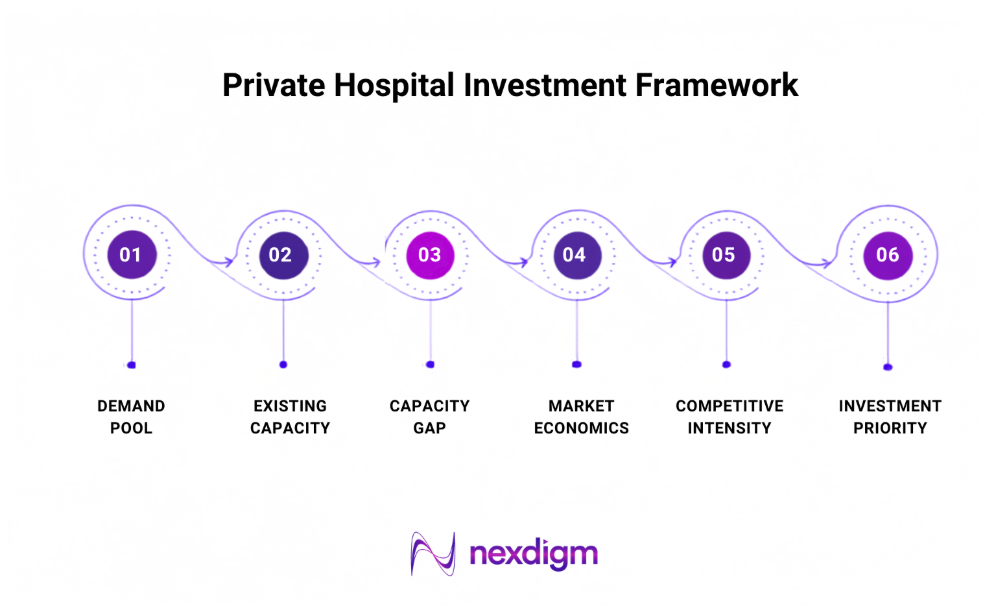
- Demand Pool: Population, disease burden, procedure volumes, and healthcare utilization.
- Existing Capacity: Beds, specialties, occupancy, infrastructure, and competitor presence.
- Capacity Gap: Unmet demand, referral outflows, waiting times, and underserved specialties.
- Market Economics: ARPOB, payer mix, pricing, operating costs, and investment requirements.
- Competitive Intensity: Hospital chains, independent providers, planned capacity, and specialty concentration.
- Investment Priority: Rank cities and service lines by demand, capacity gap, financial attractiveness, and execution feasibility.
How Nexdigm Identifies the Strongest Hospital Expansion Markets
A hospital operator screened 40 cities across five regions, representing more than 110 million people. Initial screening identified 18 cities with significant capacity gaps.
After evaluating occupancy, payer mix, specialty demand, competition, and investment economics, Nexdigm prioritized 7 markets, representing an estimated USD 1.1 billion addressable opportunity for new and expanded private hospital capacity.
To take the next step, simply visit our Request a Consultation page and share your requirements with us.
Harsh Mittal
+91-8422857704
[email protected]