

India’s private school landscape represents a substantial and increasingly diverse education market. UDISE+ 2024-25 reports 1.47 million schools and 246.9 million student enrollments from pre-primary to higher secondary. Private unaided recognized schools account for 339,583 schools and 95.9 million enrollments, representing nearly 39% of total enrollment at these levels.
These numbers indicate significant scale, but scale alone does not determine where the next viable school opportunity lies. Differences in household income, student demographics, parent expectations, curriculum preferences, school fees, existing capacity, and competitive intensity can create very different outcomes across individual catchments.
For education groups, school operators, and investors, a structured Private school market opportunity analysis can help determine where addressable demand exists, which parent segments remain underserved, what proposition fits the market, and whether the resulting enrollment potential can support sustainable campus economics.
What Parents Expect from the Next Generation of Schools
School selection increasingly involves several considerations beyond academic performance. Families may evaluate curriculum, teaching quality, safety, infrastructure, extracurricular opportunities, technology, proximity, transportation, student outcomes, and perceived value relative to fees.
These expectations can vary significantly by location and household segment. A premium proposition may find stronger acceptance in one catchment, while another may have greater potential for an affordable or differentiated school model. Understanding these variations is therefore important when defining the positioning of a new campus.
When Demand Has to Translate into Campus Economics
A large student population does not necessarily mean that additional school capacity is required. Existing schools may already have sufficient seats, competitors may have strong brand positions, or prevailing fees may limit the addressable market for a proposed institution.
The assessment can therefore answer practical questions such as: How large is the addressable student pool? What proportion can realistically be captured? At what fee level? Which competitors would the campus face? What capacity should be developed? And what enrollment trajectory would be required to support the investment?
Nexdigm’s Approach to Private School Market Opportunity Analysis
Nexdigm combines education-sector research, market intelligence, competitive benchmarking, demand assessment, location analysis, and strategic advisory to evaluate private school opportunities. Its Private school market opportunity analysis links parent expectations to market realities and then to campus-level economics. The analysis can cover:
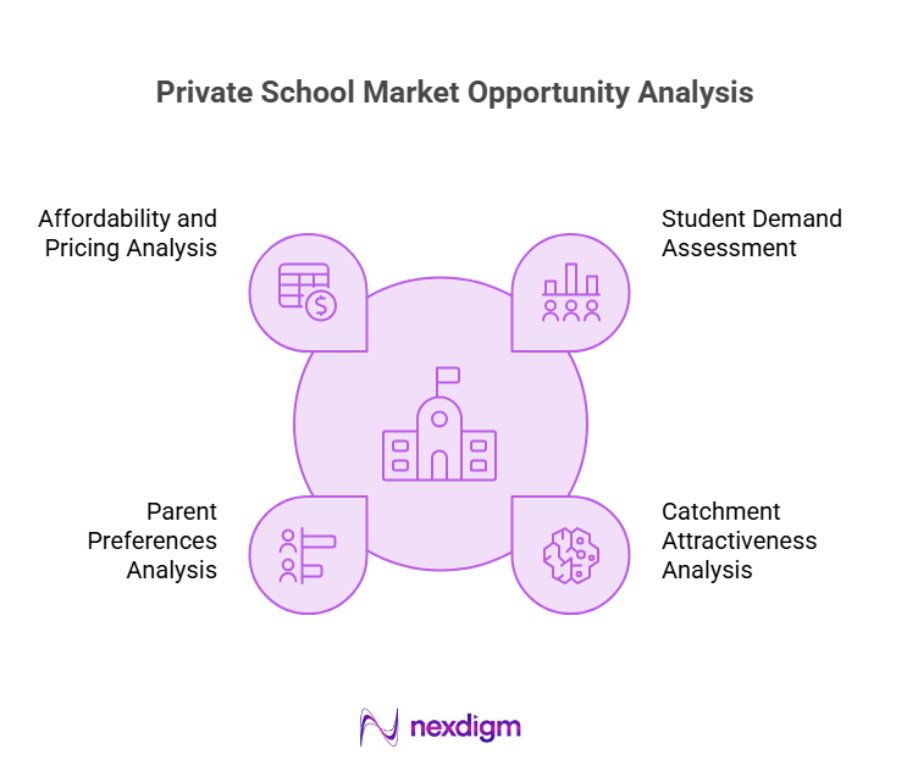
- Student Demand: Assess school-age populations, enrollment trends, demographic composition, migration, household formation, and projected student-pool growth to estimate the underlying demand base.
- Catchment Attractiveness: Evaluate household density, income profiles, accessibility, commuting patterns, residential development, and geographic concentration to establish the practical catchment for a proposed campus.
- Parent Preferences: Identify factors affecting school choice, including curriculum, academic outcomes, infrastructure, safety, extracurricular offerings, convenience, and value perception.
- Affordability and Pricing: Benchmark school fees against household economics and competing institutions to understand willingness to pay and identify commercially relevant price segments.
Nexdigm in Turning Assessment Insights into Private School Expansion Decisions
Nexdigm’s assessment can support decision-making at multiple stages of the private school development lifecycle. By bringing together several factors, the analysis can help education stakeholders prioritize opportunities such as:
- New School Development: Nexdigm can evaluate potential locations based on addressable student demand, household profiles, competitive supply, accessibility, pricing conditions, and future market growth to identify catchments capable of supporting a new campus.
- Campus Expansion: Comparing current enrollment and utilization with underlying catchment demand can help determine whether an existing school has sufficient unmet demand to justify additional classrooms, facilities, or student capacity.
- School Format Selection: Nexdigm can assess curriculum preferences, parent expectations, affordability, competition, and student segments to determine whether a premium, international, specialized, affordable, or alternative school model is better suited to a particular market.
Why Private Schools Seek Nexdigm’s Expertise
Private schools partner with Nexdigm to bring greater market clarity to expansion and investment decisions. Nexdigm combines sector knowledge with data-led market assessment to help institutions evaluate with:
- Evidence-Based Market Selection: Nexdigm helps identify catchments where student demand, affordability, competition, and future growth create stronger opportunities.
- Parent and Competitor Insights: Understanding what families value and how competing schools are positioned can help operators develop propositions that are relevant to their target market.
- Commercial Feasibility: Nexdigm connects market opportunity with enrollment potential, pricing, capacity, investment requirements, and campus economics to assess whether an expansion opportunity is commercially viable.
- Strategic Expansion Support: From selecting locations and school formats to prioritizing markets, Nexdigm helps education stakeholders translate market intelligence into practical growth decisions.
By combining such considerations, Nexdigm helps education stakeholders identify opportunities with greater confidence and support informed decisions on where to expand, what to offer, and how to build sustainable enrollment and long-term campus value.
Nexdigm’s Case
Nexdigm supported an education stakeholder evaluating K-12 expansion across nine potential catchments. The assessment mapped 40+ competing schools, evaluated four school-format options, and identified three priority markets with stronger combinations of student demand, capacity gaps, and competitive opportunity. The findings provided a more structured basis for selecting target markets and school formats.
To take the next step, simply visit our Request a Consultation page and share your requirements with us.
Harsh Mittal
+91-8422857704