

The opportunity for new private universities is closely tied to expanding participation, changing student expectations, and demand for career-oriented education. Recent studies show that global higher-education enrollment reached 269 million students in 2024, compared with about 100 million in 2000. Yet access remains uneven: tertiary participation is approximately 9% in sub-Saharan Africa compared with 80% in Western Europe and Northern America, highlighting very different levels of market maturity across regions.
The World Bank also identifies tertiary education as increasingly important for developing workforce skills, productivity, innovation, and employment outcomes. At the same time, private institutions operate within highly competitive markets where students compare tuition, programme relevance, employability, reputation, and learning formats.
For a new institution, therefore, the central question is not simply whether higher-education demand exists. It is whether sufficient addressable demand can be converted into sustainable enrollment at an economically viable price point. A Private university market feasibility study helps answer that question before significant investment is committed.
The Need to Assess Right Market Opportunity
A growing student population can create an attractive headline opportunity, but only a portion of that population may be relevant to a proposed university. Academic eligibility, household income, location, programme preference, competing institutions, and willingness to pay all influence the addressable market.
A feasibility assessment therefore needs to move through several layers: Total Student Population, Addressable Segment, Programme Demand, Affordable Segment, Competitive Capture and Sustainable Enrollment. This progression creates a more realistic picture of potential demand than relying on overall enrollment statistics.
Two Signals Can Reveal Early Feasibility
Before developing a detailed business case, institutions can examine two fundamental signals:
- Demand–Programme Alignment: Determine whether the proposed programme portfolio corresponds with student interests, workforce requirements, career expectations, and gaps in existing offerings.
- Price–Value Alignment: Assess whether prospective students are likely to consider the proposed tuition competitive relative to programme quality, employability outcomes, institutional reputation, and available alternatives.
Strong alignment across both dimensions can provide an initial indication that a university concept warrants deeper feasibility assessment.
Nexdigm’s Support Towards Private University Development
Nexdigm brings expertise in market intelligence, education-sector research, demand assessment, competitive benchmarking, and strategic advisory to help stakeholders evaluate new university opportunities.
Its approach looks beyond headline market size to examine the conditions that determine whether enrollment can actually be developed. This can include student demographics, education participation, programme demand, affordability, competitor capacity, tuition structures, geographic catchments, student mobility, and employment trends.
By connecting these variables, Nexdigm helps promoters and education stakeholders understand whether a proposed university concept is aligned with the market and where adjustments may strengthen its potential.
Nexdigm’s Private University Market Feasibility Assessment
A Private university market feasibility study from Nexdigm can assess the proposed institution across interconnected market and strategic dimensions, such as:
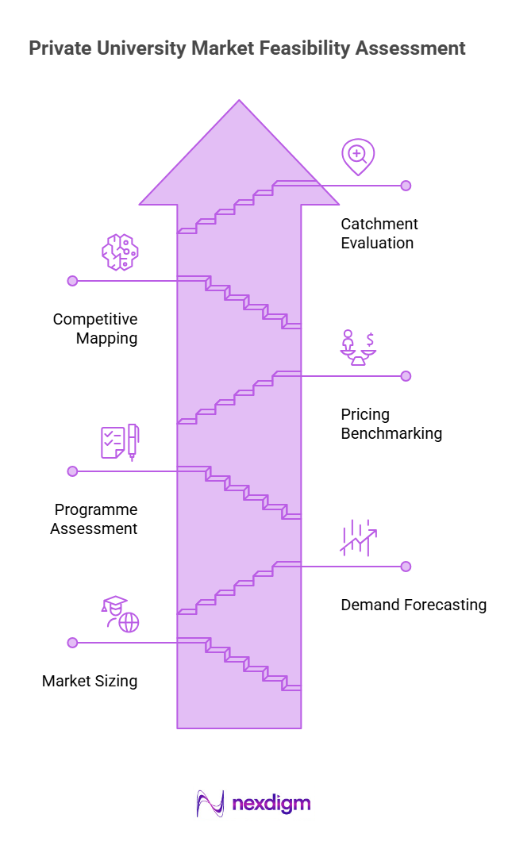
- Market Sizing: Estimate the total and addressable student population across target geographies, disciplines, and learner segments to understand the overall scale of market opportunity.
- Demand Forecasting: Assess current enrollment demand and future growth potential by analyzing demographic trends, higher education participation rates, and evolving student preferences.
- Programme Assessment: Identify disciplines and academic programmes with stronger demand while evaluating gaps, differentiation opportunities, and unmet needs within competing institutions.
- Pricing Benchmarking: Compare tuition fees and related charges across public and private universities to assess market competitiveness, affordability, and pricing potential.
- Competitive Mapping: Evaluate competitor institutions based on market positioning, capacity, reputation, programme portfolio, academic strengths, and overall student value proposition.
- Catchment Evaluation: Analyze recruitment geographies, student mobility patterns, accessibility, and regional demand concentrations to identify realistic student sourcing markets.
The resulting analysis can provide stakeholders with a structured view of market attractiveness, enrollment potential, competitive risks, and strategic requirements.
Nexdigm’s Expertise in Supporting Strategic Decisions for Private Universities
Establishing a private university involves significant long-term investments across infrastructure, faculty, academic programmes, technology, and operations. Nexdigm’s market feasibility assessment helps stakeholders optimize institutional strategies through:
- Validating Market Demand: Assess student demand, enrollment potential, and target segments to determine whether the proposed university concept aligns with market requirements and growth opportunities.
- Identifying Programme Opportunities: Evaluate academic disciplines, emerging fields, and competitor offerings to identify programme gaps and develop a differentiated academic portfolio.
- Assessing Commercial Viability: Analyze pricing dynamics, affordability levels, and competitive benchmarks to determine sustainable fee structures and long-term revenue potential.
- Evaluating Market Entry Strategies: Assess geographic opportunities, competitive intensity, and recruitment potential to support decisions on location selection and market positioning.
- Supporting Phased Growth Planning: Identify strategic priorities and investment considerations that can help institutions optimize resource allocation and implement expansion in stages.
By strategic evaluation, Nexdigm helps promoters refine university concepts, mitigate risks, and make informed decisions that support sustainable growth and long-term institutional success.
Nexdigm’s Case Study
Nexdigm supported an education stakeholder evaluating a proposed private university across 8 potential catchment markets. The assessment benchmarked 22 competing institutions, tested three tuition scenarios, and evaluated 18 programme-market combinations, ultimately identifying five priority opportunities for further development and helping refine the institution’s proposed enrollment strategy.
To take the next step, simply visit our Request a Consultation page and share your requirements with us.
Harsh Mittal
+91-8422857704