
Processed food consumption in India is changing in ways that go beyond the simple shift from loose to packaged products. Consumers are balancing convenience with nutrition, affordability with quality, and traditional preferences with newer food formats.
That makes consumption analysis increasingly important for food manufacturers. The opportunity lies in understanding which lifestyle changes are creating additional consumption, which categories are gaining relevance, and where consumers are willing to pay for added convenience or health benefits.
Convenience Is Becoming Part of the Consumption Decision
India’s food processing market reached approximately US382.2 billion in FY25 and is projected to reach US 689.0 billion by FY34.
Food consumption itself is expected to reach around US$1.2 trillion in CY26.
The scale of the market creates room for multiple consumption formats, but convenience is becoming a more important differentiator.
India’s 2025 consumer research found that more than 70% of Indian consumers use supermarkets, 60% use local retailers and 55% use digital delivery platforms. The same research found that 63% were concerned about food costs, showing that convenience does not remove the need for affordability.
This creates several distinct consumption occasions:
- Time-saving meals
Ready-to-eat and ready-to-cook products can reduce preparation time for working households and consumers with increasingly compressed schedules. - Portable consumption
Snacks, beverages and individually portioned foods can fit work, travel, school and between-meal occasions. - Easy replenishment
Digital ordering is making it easier to purchase frequently consumed products without a planned shopping trip. - Simplified preparation
Pre-cut, pre-mixed, frozen and partially prepared formats can shift consumption toward processed alternatives without completely changing the underlying meal.
The relevant demand signal is therefore not simply “convenience.” It is the specific task that the product makes easier.
Health Is Changing What Consumers Expect From Processed Food
Health-conscious consumption is creating pressure on food manufacturers to reconsider formulation and positioning.
A 2025 India survey found that 84% of consumers highlighted food safety as an important consideration. It also found that 29% cited health benefits among their top three reasons for switching brands, while 21% identified health benefits as the single most important switching factor.
This is expanding the opportunity for:
- High-protein products
- Lower-calorie formats
- Reduced-sugar products
- Functional ingredients
- Fortified foods
- Products with clearer ingredient communication
The distinction between processed and healthy is also becoming less useful as a market category. Consumers are increasingly evaluating the nutritional profile, ingredients and degree of processing rather than rejecting processed food as a whole.
Lifestyle Changes Are Creating New Consumption Occasions
The organised foodservice segment, including QSRs, cafés and cloud kitchens, represented approximately 45% to 50% of the foodservice market in 2025 and is expected to reach around 55% by 2030. The organised segment is projected to grow at 12% to 14% annually, compared with 5% to 7% for the unorganised segment.
This matters for processed food manufacturers because restaurant and foodservice demand can influence packaged ingredients, ready-to-use components, sauces, dairy products, frozen foods and other processed inputs.
Consumption is therefore moving across channels rather than existing within a single household grocery basket.
Digital Channels Are Reinforcing the Shift
NIQ’s Q2 2026 FMCG snapshot found that e-commerce accounted for 7% of FMCG sales nationally. In the top eight metros, e-commerce represented 18% of FMCG sales during Q4 2025.
The difference between national and metro penetration is commercially important.
Urban consumers may encounter new processed-food products through quick commerce, digital grocery and targeted discovery much earlier than consumers in less digitally penetrated markets. This can accelerate trial, but it also increases competitive visibility.
Nexdigm’s processed food consumption trend analysis helps companies understand changing consumption occasions, consumer preferences, category migration, pricing behaviour and channel shifts to identify emerging demand opportunities.
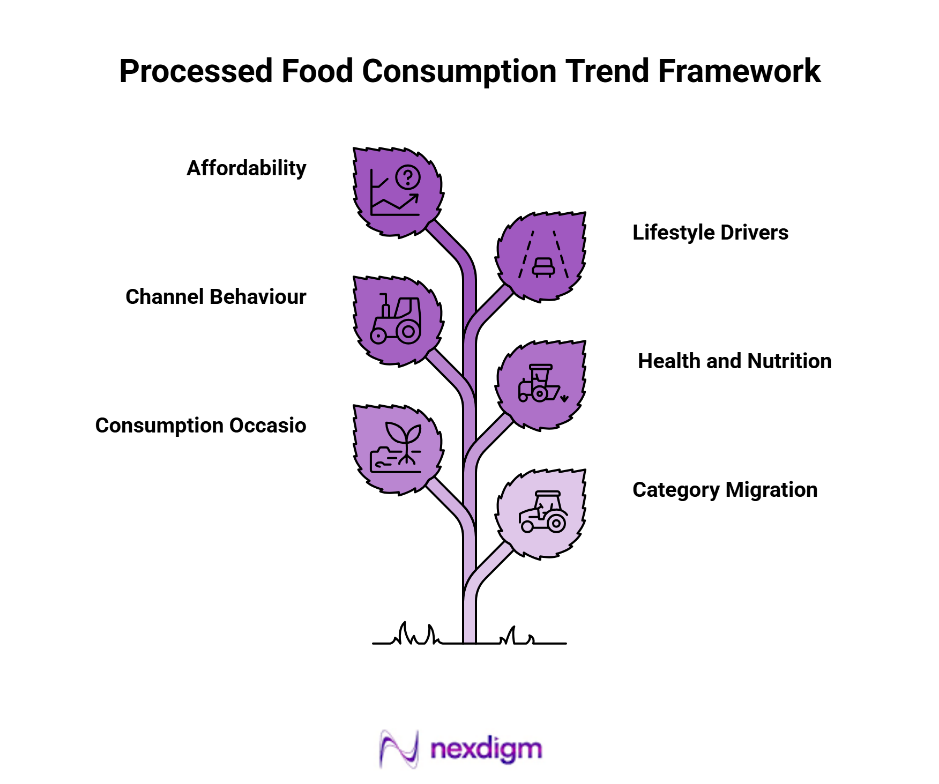
Nexdigm’s Processed Food Consumption Trend Framework
- Consumption Occasion
Map when, where and why consumers consume processed foods, including meals, snacks, beverages and convenience formats. - Lifestyle Drivers
Assess working patterns, urbanisation, household structures, mobility and time constraints influencing food choices. - Health and Nutrition
Track protein, calorie, sugar, ingredient, safety and functional-food preferences. - Affordability
Measure price sensitivity, pack-size preferences, promotions and willingness to pay for additional benefits. - Channel Behaviour
Compare traditional retail, modern trade, e-commerce, quick commerce and foodservice consumption. - Category Migration
Identify movement from unpackaged to packaged, basic to value-added and conventional to health-oriented products.
This creates a consumption map that distinguishes temporary trends from structural changes in how food is purchased and consumed.
Nexdigm Case: Identifying High-Growth Processed Food Segments
A packaged-food company assessed 6 categories across 4 cities and 1,800 consumers. Nexdigm identified health, convenience and affordability as key purchase drivers, helping prioritize 3 high-growth segments and a portfolio expected to improve trial conversion by 14%.
To take the next step, simply visit our Request a Consultation page and share your requirements with us.
Harsh Mittal
+91-8422857704