

Processor markets rarely change simply because a new architecture is technically superior. A processor can deliver better performance-per-watt and still struggle to secure commercial adoption if developers cannot compile existing software, operating systems lack mature support, or customers face substantial migration costs. The commercial viability of a new platform therefore depends on the entire technology stack surrounding the silicon.
Performance Alone Does Not Determine Adoption
Processor development often places considerable emphasis on benchmark performance, but enterprise purchasing decisions extend well beyond isolated tests. A 20% to 30% performance advantage may have limited commercial value if adopting the architecture introduces software instability, toolchain incompatibility, hardware redesign, or delays to product launches.
A new platform needs a sufficiently large economic or technical advantage to compensate customers for the friction of migration. Depending on the target market, this could mean substantially higher performance, significantly lower power consumption, or a structural reduction in unit costs. The relevant benchmark is therefore the customer’s total economic outcome rather than the processor’s peak specification.
Workload Fit Determines Where New Architectures Can Enter
Incumbent architectures have developed strong positions within particular workload environments. x86 remains deeply embedded in enterprise PCs, servers, and legacy applications, supported by decades of operating-system and software compatibility. ARM has established a strong position in smartphones and other power-constrained systems through its performance-per-watt characteristics. RISC-V offers an alternative model through an open, royalty-free ISA that allows designers to customize extensions for applications including microcontrollers, automotive controllers, and specialized accelerators.
This makes workload selection central to market entry. A new architecture does not necessarily need to displace incumbents across general-purpose computing. It can establish commercial relevance by targeting workloads where software dependencies are limited, the performance requirements are distinctive, or the economic benefits of customization are substantial.
The Software Stack Is Part of the Product
The physical processor represents only one layer of the platform. Commercial adoption depends on a sequence of software dependencies extending from silicon to end-user applications.
The stack typically includes:
- Physical Silicon & Micro-Architecture: Processor design, tape-out, packaging, and physical implementation.
- Compilers & Toolchains: LLVM, GCC, linkers, assemblers, debuggers, and associated development tools.
- Operating Systems & Drivers: Linux kernel support, Windows hardware abstraction, and real-time operating systems.
- Virtualization & Hypervisors: KVM, VMware ESXi, Xen, and container environments.
- Runtime & Mathematical Libraries: BLAS, oneDNN, OpenCL, and specialized hardware runtimes.
- Enterprise Applications: Databases, ERP systems, web servers, and machine-learning frameworks.
A missing compiler feature or operating-system driver can prevent an otherwise capable processor from being deployed. Established architectures benefit from years of optimization across instruction scheduling, cache utilization, vectorization, and runtime libraries. New platforms must therefore build ecosystem readiness alongside silicon development.
For investors and semiconductor companies, a Processor market feasibility study should assess this software dependency chain alongside technical performance. The question is whether the target customer can deploy the processor within its existing technology environment and what investment would be required to close remaining ecosystem gaps.
Switching Costs Create a High Commercial Barrier
Processor migration can require much more than purchasing new chips. Enterprise software may contain legacy code, architecture-specific optimizations, and proprietary libraries that cannot be migrated automatically. Hardware platforms may also require changes to printed circuit boards, power-delivery systems, thermal designs, and electromagnetic compatibility testing.
Qualification requirements become even more demanding in automotive, industrial, and aerospace applications, where components can undergo extended environmental, thermal, and vibration testing before deployment. These requirements can make technically attractive architectures commercially irrelevant unless their value proposition is strong enough to compensate for the transition.
The most practical entry strategies therefore focus on beachhead markets. Hyperscalers can deploy internally controlled processors because they manage much of their own software stack. Embedded applications can offer simpler software dependencies. AI inference workloads can often be accessed through high-level frameworks such as PyTorch and ONNX. Sovereign and defense applications may place greater value on architectural independence and control over intellectual property.
Nexdigm Processor Feasibility Evaluation Framework
A structured feasibility assessment can evaluate a new processor platform through six decision gates:
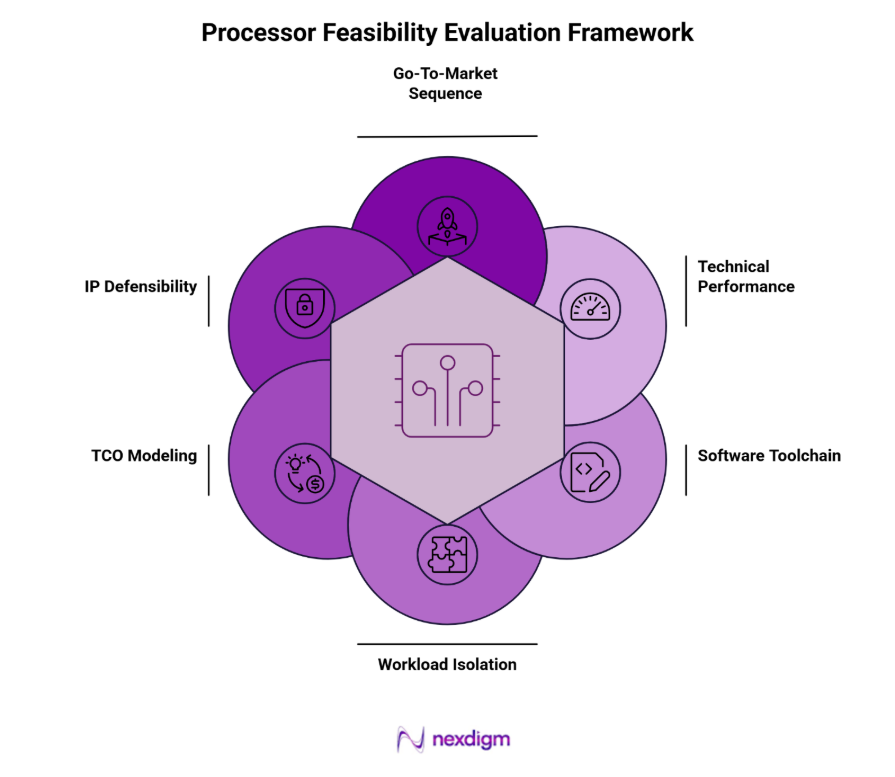
- Technical Performance-per-Watt Benchmarking: Test the architecture against representative real-world workloads rather than relying solely on synthetic benchmarks.
- Software Toolchain & Kernel Readiness: Assess LLVM/GCC support, operating-system integration, drivers, virtualization, and runtime compatibility.
- Addressable Workload Isolation: Identify workloads that can migrate without extensive application refactoring.
- Customer TCO & Switching-Cost Modeling: Quantify hardware, software migration, validation, and deployment costs against expected savings.
- IP & Licensing Defensibility: Evaluate ISA licensing, patent exposure, royalty structures, and geopolitical dependencies.
- Commercial Go-To-Market Sequence: Prioritize beachhead segments where ecosystem barriers are manageable before pursuing broader adoption.
Nexdigm Case Study: Semiconductor Market and Ecosystem Assessment
Nexdigm’s semiconductor and memory technology market assessment for India demonstrates how technology-market analysis can connect ecosystem conditions with investment decisions. The assessment mapped chip design houses, OEMs, packaging units, localization policies, data-center capacity expansion, and fabless ecosystem constraints across Bengaluru, Hyderabad, Gujarat, and Assam.
The Indian semiconductor market was estimated at $3.83 billion in 2024 and projected to reach $12.13 billion by 2030, representing a 21.2% CAGR. The work also identified strategic joint-venture and investment priorities alongside ecosystem bottlenecks, illustrating the importance of evaluating market demand, ecosystem readiness, and investment feasibility together when assessing semiconductor opportunities.
To take the next step, simply visit our Request a Consultation page and share your requirements with us.
Harsh Mittal
+91-8422857704