

Procurement is increasingly being asked to manage category costs while also anticipating supply and market risks. Recent Global CPO Survey found that 74% of procurement leaders identified alternative supply sources as an effective risk-mitigation strategy, while 64% prioritized greater supply-chain visibility.
CIPS reported that 22% of surveyed procurement professionals expected shipping and logistics costs to rise by more than 10% by the end of 2025, highlighting the pressure on category economics. Meanwhile, CIPS found 64% of respondents said procurement’s influence was growing within their organizations.
These developments make procurement category intelligence research increasingly important for understanding where spend is moving, which supply markets are becoming attractive, how pricing is changing, and where category-level risks may emerge
Monitoring Cost Pressures Across Procurement Categories
Category costs are influenced by multiple factors, including raw material prices, freight rates, supplier competition, energy costs, and regional market conditions. Procurement category intelligence helps organizations track these variables across spending categories to identify emerging cost pressures before they impact budgets. By monitoring supplier markets and pricing trends, businesses can evaluate alternative sourcing options and improve category planning while maintaining supply continuity and cost efficiency.
Evaluating Category Risks and Supply Market Shifts
Supply markets can change rapidly due to geopolitical events, regulatory developments, capacity constraints, and demand fluctuations. Procurement category intelligence enables organizations to assess supplier concentration, market dependency, and sourcing risks at a category level. Insights into supplier landscapes, regional procurement trends, and market developments help procurement teams identify resilient supply options, strengthen category strategies, and support informed decision-making in an increasingly complex global sourcing environment.
Nexdigm’s Expert-led View on Category Risks and Changing Supply Markets
Nexdigm brings a category-specific perspective to help procurement teams understand how external market movements can influence sourcing performance, cost structures, and supply resilience by conducting:
- Category Cost Intelligence: Assessment of raw materials, energy, freight, tariffs, and supplier pricing to identify the external factors influencing category-level cost movements.
- Supplier Market Intelligence: Nexdigm evaluates supplier concentration, production capacity, trade activity, and emerging sourcing markets to identify opportunities and potential supply dependencies.
- Strategic Category Prioritization: Identification of spend, market, and competitive signals to help procurement teams prioritize categories requiring cost optimization, diversification, or closer risk monitoring.
By bringing these perspectives together, Nexdigm helps businesses make more informed category decisions based on both current procurement performance and changing market conditions.
Nexdigm’s Procurement Category Prioritization Approach
Not every procurement category carries the same level of opportunity or exposure. Nexdigm can prioritize categories by assessing their financial importance, market dynamics, sourcing complexity, and future risk, through a procurement category intelligence research, helping procurement teams focus on:
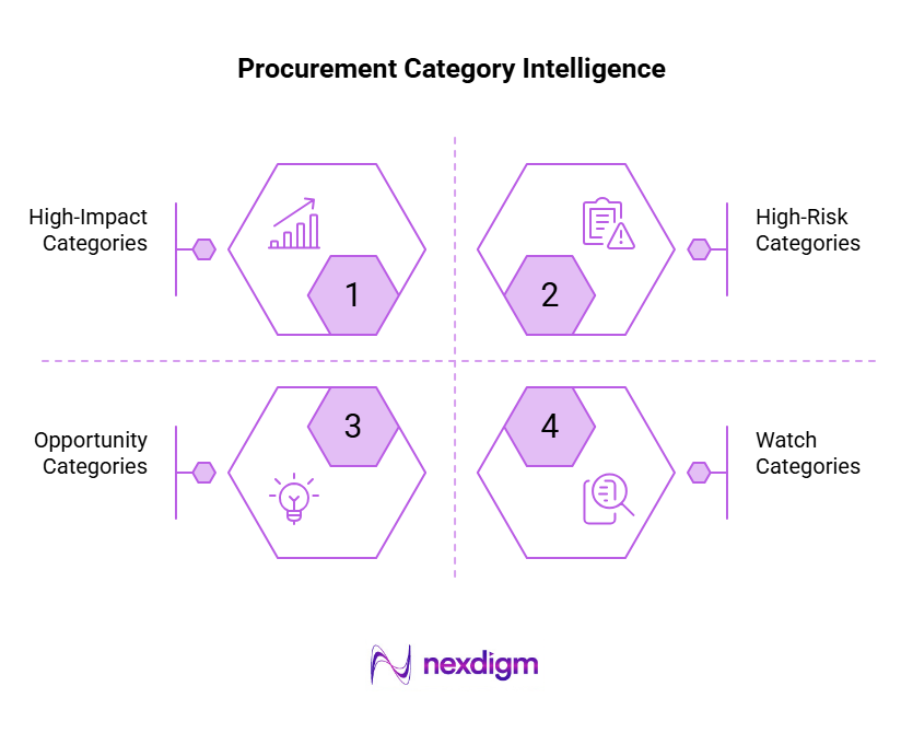
- High-Impact Categories: Identify categories with significant spend, high price sensitivity, or substantial savings potential.
- High-Risk Categories: Flag categories exposed to supplier concentration, capacity constraints, trade dependencies, or volatile input costs.
- Opportunity Categories: Highlight areas where new suppliers, expanding capacity, or favorable market conditions could create sourcing alternatives.
- Watch Categories: Monitor categories showing early changes in pricing, demand, supplier activity, or trade flows that may require future action.
This prioritization helps procurement teams direct attention toward the categories where market intelligence can have the greatest commercial and strategic impact.
Experts at Nexdigm Turning Category Insights into Procurement Action
Once priority categories are identified, the next step is to determine the appropriate procurement response. Nexdigm’s analysis can help businesses:
- Renegotiate: Use supplier-market and cost-driver evidence to identify categories where changing market conditions may support stronger commercial terms.
- Diversify: Identify alternative suppliers or sourcing markets where capacity, trade activity, and competitive conditions provide credible alternatives.
- Reconfigure: Evaluate categories where regional sourcing, supplier relocation, or changes in the sourcing mix could improve cost or resilience.
- Monitor: Establish ongoing visibility for categories where emerging pricing, capacity, or trade signals could materially affect future procurement performance.
This approach helps procurement teams move from knowing which categories matter to determining what action each category requires.
Why Businesses Trust Nexdigm
Procurement decisions often require confidence in both the data and the interpretation behind it. Nexdigm brings together sector knowledge, market intelligence, supplier research, trade analysis, and category-level insights to provide a grounded view of changing procurement conditions. Our approach helps businesses evaluate opportunities and risks using multiple external signals, supporting decisions that are evidence-led, commercially relevant, and aligned with evolving sourcing priorities.
Nexdigm’s Case
Nexdigm assessed procurement categories across 15 supplier markets, identifying 9 markets with over 17% export growth and alternative sourcing clusters with expanding capacity. The analysis highlighted 7 key cost drivers, enabling the client to prioritize categories for supplier diversification, cost optimization, and procurement-risk management.
To take the next step, simply visit our Request a Consultation page and share your requirements with us.
Harsh Mittal
+91-8422857704