

Procurement performance is increasingly being judged by measurable business outcomes rather than activity volumes alone. The Hackett Group’s 2026 research found that 76% of organizations report AI-driven improvements of 25% or more in key performance metrics, while procurement workloads are expected to rise by 8% as resources remain constrained.
CIPS’ 2026 Global State of Procurement & Supply found that 47% of procurement professionals are prioritizing new technology skills, while the same proportion is prioritizing risk management. Procurement is also gaining greater strategic visibility, with 33% of respondents now reporting directly to a CEO, managing director, or owner, compared with 15% previously.
These developments make procurement KPIs and metrics increasingly important for demonstrating savings, spend control, supplier performance, compliance, and broader business value.
Why Procurement Metrics Need a Broader View
A procurement function can report substantial savings while still experiencing weak compliance, supplier delays, inefficient processes, or unmanaged spend. Conversely, strong operational metrics may not translate into meaningful financial impact. Effective measurement therefore requires a balanced view covering cost, spend, process efficiency, supplier outcomes, compliance, and risk. CIPS recommends using metrics that support both efficiency and strategic outcomes rather than relying on a single measure.
Identifying the Metrics That Matter Most
Not every available measure deserves equal management attention. The most useful metrics connect procurement activity with outcomes that matter to the wider business.
- Financial Performance: Track realized savings, cost avoidance, procurement ROI, spend under management, and price variance to understand measurable financial contribution.
- Supplier and Process Outcomes: Monitor OTIF delivery, quality, lead times, contract compliance, cycle times, and purchasing efficiency to identify operational performance gaps.
The strongest KPI framework therefore combines financial results with operational and supplier indicators, creating a more complete view of procurement effectiveness.
Nexdigm’s Approach to Prioritizing Procurement Metrics
Nexdigm helps businesses turn a broad set of procurement data into a focused performance view. Our approach to procurement KPIs and metrics emphasizes measures that are relevant to business priorities. These measures are:
- Business-Relevant Measures: Nexdigm aligns KPIs with objectives such as savings, spend control, supplier performance, compliance, resilience, and process efficiency.
- Performance Interpretation: Rather than viewing metrics in isolation, Nexdigm connects changes in spend, savings, supplier outcomes, and processes to identify meaningful performance patterns.
- Action-Oriented Insights: Nexdigm helps identify which KPI movements require investigation, corrective action, deeper benchmarking, or changes to procurement strategy.
This helps procurement leaders focus on the metrics that explain performance and support decisions, rather than managing dashboards filled with measures that have limited practical value.
The Need for Procurement Performance Assessment
Tracking procurement KPIs alone does not explain why performance is changing or where improvement is needed. A structured assessment helps businesses interpret metric movements in context, identify meaningful gaps, and distinguish isolated issues from broader performance challenges. It also provides a basis for prioritizing improvement opportunities and aligning procurement actions with measurable business outcomes.
Nexdigm’s Procurement Performance Assessment
Once the relevant KPIs are identified, Nexdigm assesses how procurement is performing across the selected measures. The assessment brings together the following factors to establish a clearer picture of strengths and gaps, such as:
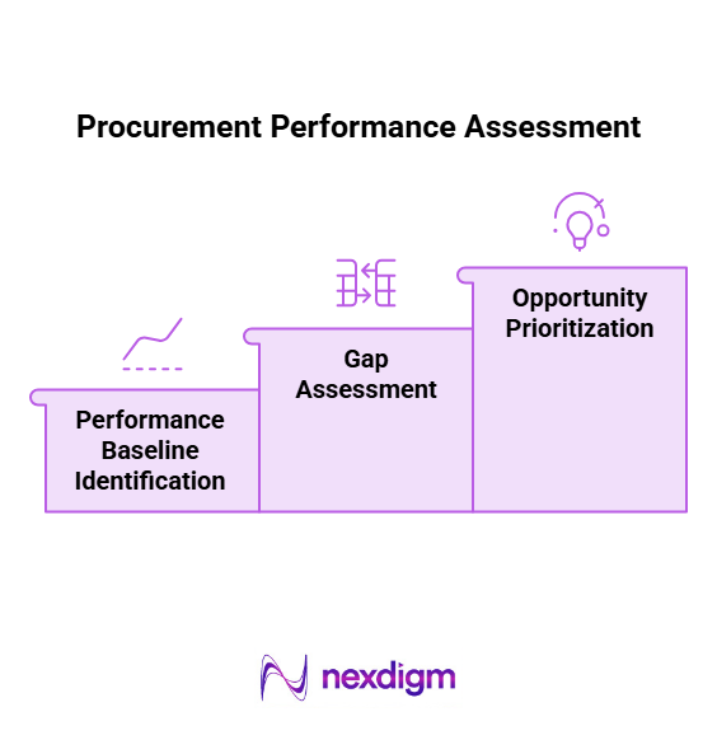
- Performance Baseline: Establish current performance levels across spend, savings, supplier, process, and compliance indicators to create a consistent starting point.
- Gap Assessment: Compare actual results against internal targets, historical performance, or relevant benchmarks to identify areas requiring closer attention.
- Opportunity Prioritization: Evaluate the significance of identified gaps based on financial impact, operational importance, risk, and potential improvement.
This assessment helps procurement teams move from tracking KPIs to understanding what the numbers reveal, and where focused action can create the greatest value.
Business Benefits of Nexdigm’s Procurement Assessment
A structured procurement assessment can help businesses turn performance data into clearer priorities and measurable improvement opportunities by focusing on the following areas:
- Sharper Cost Visibility: Identify where spend, pricing, savings leakage, or inefficient purchasing practices may be affecting procurement’s financial contribution.
- Stronger Supplier Management: Use performance trends to identify supplier issues, improvement opportunities, and areas where sourcing strategies may need adjustment.
- Better Process Efficiency: Highlight process bottlenecks, unnecessary effort, and areas where automation or workflow changes could improve procurement performance.
- Improved Governance: Identify compliance gaps, uncontrolled spend, and inconsistencies that may weaken procurement discipline or increase operational exposure.
- Focused Decision-Making: Prioritize improvement initiatives according to potential value, business relevance, risk, and implementation feasibility.
Overall, the assessment helps businesses move from measuring procurement performance to using those measurements to guide targeted improvement and strategic decisions.
Nexdigm’s Case
Nexdigm assessed procurement performance across key spend, supplier, process, and compliance indicators, identifying 16% potential improvement in overall KPI performance, a 12% opportunity to improve process efficiency, and 9% scope to strengthen supplier performance. The assessment helped the client prioritize performance gaps and focus improvement efforts on the areas with the greatest potential business impact.
To take the next step, simply visit our Request a Consultation page and share your requirements with us.
Harsh Mittal
+91-8422857704