
In the dynamic business environment, organizations increasingly rely on procurement logistics benchmarking to enhance efficiency and reduce costs across supply chains. By systematically comparing procurement processes, supplier performance, and logistics operations against industry standards or competitors, companies can identify gaps and implement best practices.
Integrating it with competitive intelligence allows firms to gain actionable insights into market trends, supplier strategies, and cost structures, enabling more informed sourcing decisions and stronger supply chain competitiveness. Effective benchmarking not only drives cost optimization but also strengthens strategic positioning in a highly competitive marketplace.
Data show that optimizing procurement can materially reduce supply chain costs: benchmarking often reveals that average procurement spend constitutes 50–70% of total corporate costs, with 8–12% annual savings achievable through best‑practice sourcing and process improvements. Firms that benchmark procurement logistics and performance report 2 times greater cost savings than peers, while automation and digital tools can cut purchase order processing costs by up to 60%, underscoring the financial value of systematic benchmarking.
Using Competitive Intelligence to Identify Cost Reduction Opportunities
Using competitive intelligence to identify cost reduction opportunities involves analyzing competitor strategies, supplier pricing, and market trends to uncover inefficiencies, negotiate better terms, and implement best practices across procurement and supply chains:
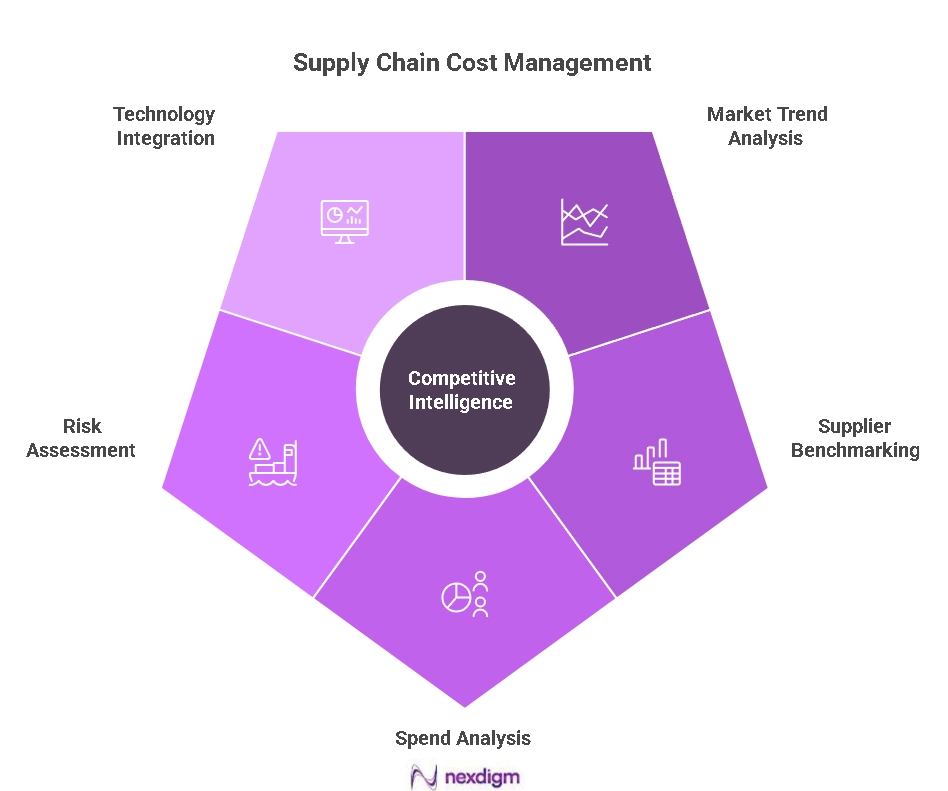
- Market Trend Analysis – Track industry pricing, demand shifts, and competitor strategies to pinpoint cost-saving opportunities in procurement and logistics.
- Supplier Benchmarking – Compare supplier performance, pricing, and delivery metrics to negotiate better contracts and reduce operational expenses.
- Spend Analysis – Examine historical procurement data to identify high-cost categories, inefficiencies, and areas for consolidation or strategic sourcing.
- Risk Assessment – Use intelligence to anticipate supply disruptions, mitigate risks, and avoid unexpected costs in the supply chain.
- Technology Integration – Leverage digital tools and analytics for real-time insights, improving decision-making and uncovering additional cost reduction avenues.
Nexdigm Procurement Diagnostics and Competitive Intelligence Assessment
Nexdigm Procurement Diagnostics and Competitive Intelligence Assessment evaluates an organization’s procurement processes, spend patterns, and supplier relationships. By combining data analytics with market and competitor insights, Nexdigm identifies inefficiencies, cost drivers, and improvement opportunities. This assessment enables informed sourcing decisions, strategic supplier management, and targeted cost reduction initiatives, ultimately enhancing procurement efficiency and supply chain competitiveness.
Nexdigm Procurement Technology Enablement and Benchmarking Tools
Nexdigm Procurement Technology Enablement and Benchmarking Tools implement digital solutions and analytics platforms to automate procurement processes, monitor supplier performance, and benchmark efficiency, driving cost reduction and data-driven decision-making.
- Digital Procurement Platforms – Implement cloud-based systems for purchase orders, invoicing, and supplier management, enhancing accuracy and efficiency.
- Automated Spend Analytics – Use tools to analyze procurement data, identify high-cost areas, and support strategic sourcing decisions.
- Supplier Performance Dashboards – Real-time monitoring of delivery, quality, and compliance metrics for proactive supplier management.
- Benchmarking Tools – Compare procurement efficiency against industry standards and peers to identify improvement opportunities.
- Predictive Analytics for Cost Optimization – Leverage AI-driven insights to forecast price trends and optimize procurement strategies.
Nexdigm’s case:
Nexdigm’s Recent procurement transformation engagement with a global pharmaceutical client, involved direct sourcing strategy which eliminated intermediaries and reduced raw material costs by approximately 23 % while improving lead time by up to 30 % and enhancing packaging quality. This intervention established a scalable sourcing model that strengthened supply chain efficiency and competitive positioning.
To take the next step, simply visit our Request a Consultation page and share your requirements with us.
Harsh Mittal
+91-8422857704