
A procurement team can negotiate a lower unit price while making the supply chain more expensive.
The reason is straightforward. Procurement determines the supplier, purchase quantity, sourcing geography and commercial terms. Logistics absorbs the consequences through freight, inventory, warehousing, handling and lead times. Optimising each function separately can therefore produce a poorer result for the business as a whole.
In India, transportation accounts for about 62% of overall logistics costs, according to NITI Aayog. With road still carrying the majority of freight, sourcing decisions that increase distance or shipment complexity can have a material effect on the final cost of goods.
The Supplier With the Lowest Price May Not Be the Lowest-Cost Option
Consider two suppliers offering the same component.
Supplier A is cheaper at the factory gate but requires long-distance transportation and larger order quantities. Supplier B charges more per unit but is closer to the manufacturing facility and can replenish in smaller batches.
The first quotation favours A. The supply-chain economics may favour B.
That difference can emerge through freight, inventory in transit, safety stock, warehousing and the cost of responding to an unexpected shortage. The procurement decision has effectively changed the logistics requirement before the logistics team has even planned the shipment.
Distance Has a Price Beyond Freight
Longer sourcing routes create several costs simultaneously.
Inventory spends more time in transit. Lead-time uncertainty can require additional buffer stock. Smaller or urgent shipments become more expensive to move. A disruption at a port, border or transport corridor has a larger impact when there are few practical alternatives.
NITI Aayog’s freight analysis makes a similar point when comparing road and rail. Lower rail line-haul costs do not automatically produce lower total logistics costs because transit time, reliability, first- and last-mile connectivity and inventory requirements also enter the calculation.
The same principle applies to supplier selection. A sourcing location cannot be assessed independently of the network required to bring its products into production.
Order Quantity Changes More Than the Purchase Price
Minimum-order quantities are another point where procurement and logistics collide.
A larger order can secure a better unit price. It can also mean more inventory sitting in a warehouse, higher working capital and greater exposure to slow-moving stock.
Smaller, more frequent orders reverse some of that trade-off. Purchase prices may rise, but inventory exposure falls and replenishment becomes more responsive.
For volatile or seasonal categories, the difference can be particularly important. The best order quantity is the one that works across purchase price, transportation, inventory and service requirements rather than the one that produces the lowest invoice value.
Incoterms Can Change the Economics of a Supplier Quote
International procurement adds another layer because the quoted price does not necessarily cover the same set of costs.
Under different Incoterms, responsibility for freight, insurance, customs clearance and delivery changes between buyer and seller. Two suppliers offering similar prices can consequently produce very different landed costs.
This becomes more significant when sourcing routes involve multiple ports, long inland movements or volatile freight markets. Comparing suppliers without normalising these costs can make an apparently competitive quotation look better than it actually is.
Total Landed Cost Is Where the Two Functions Meet
The useful comparison is the cost of getting the product into the business and keeping it available for use.
A total-cost model can bring together:
- Supplier price and commercial terms
- Freight and transport mode
- Customs, duties and port charges
- Minimum-order quantities
- Transit and safety-stock requirements
- Warehousing and handling
- Lead-time and service implications
- Disruption and switching costs
The result can change the sourcing decision. A more expensive supplier may become preferable once logistics and inventory are included. A low-cost overseas source may remain attractive for stable, high-volume products but lose its advantage for urgent or fragmented demand.
Procurement and Logistics Need a Shared View of the Network
The intersection is ultimately a question of trade-offs.
Procurement may prioritise price, payment terms and supplier capacity. Logistics may prioritise distance, shipment frequency, reliability and network efficiency. Neither set of metrics captures the full economics independently.
A sourcing decision should therefore be tested against its effect on the downstream network before it is finalised. The same applies in reverse: a logistics redesign can create opportunities to renegotiate supplier locations, order quantities or delivery terms.
How Nexdigm Connects Procurement and Logistics Economics
Nexdigm assesses the combined economics through five areas:
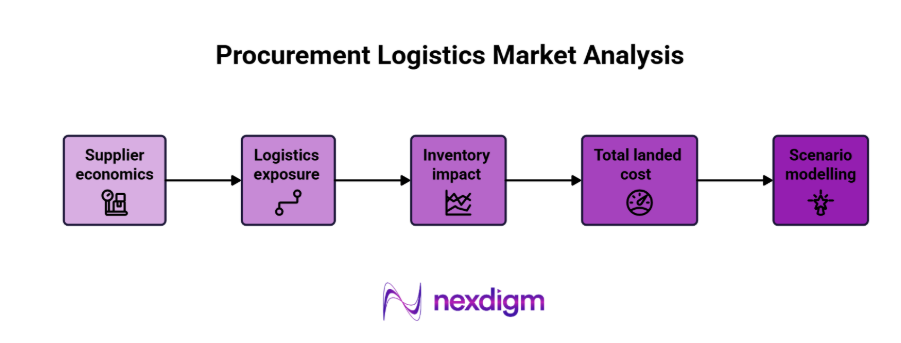
- Supplier economics: Compare prices, commercial terms, MOQs and supplier capabilities.
- Logistics exposure: Model transport routes, modes, freight and handling costs.
- Inventory impact: Quantify lead times, safety stock and working-capital requirements.
- Total landed cost: Establish a comparable cost position across sourcing alternatives.
- Scenario modelling: Test supplier, geography, order-frequency and transport alternatives.
A procurement logistics market analysis can help companies identify where sourcing and logistics decisions are creating cost leakage and where changes to the supplier or distribution model can improve the economics of the wider network.
How Nexdigm Reduced Cost Through Direct Sourcing
For a global healthcare company procuring key chemical raw materials through an intermediary, Nexdigm analysed spend, volumes and cross-functional supply requirements before supporting direct manufacturer sourcing. The change reduced raw-material costs by approximately 23% and improved delivery times by up to 30%.
To take the next step, simply visit our Request a Consultation page and share your requirements with us.
Harsh Mittal
+91-8422857704