


Germany’s retail sector runs on very tight margins, with strong price pressure across grocery and everyday goods. When total retail sales exceed €650 billion and essentials alone cross €250 billion, even small changes in sourcing costs can quickly affect profits. Ongoing swings in energy, packaging, and logistics expenses make supplier pricing harder to judge, pushing retailers to rely more on structured procurement research instead of routine buying.
Retailers need clearer supplier comparisons and better visibility into real costs. Procurement research helps by mapping suppliers, checking cost structures, and guiding sourcing choices so teams can evaluate quotes and avoid over-reliance on a few vendors. Companies that use it stay better prepared in negotiations and keep sourcing decisions steadier in Germany’s price-sensitive retail environment.
The Need for Procurement Research in Modern Retail
Retailers that lack structured procurement intelligence and supplier market analysis face several structural risks.
This is why investing in professional procurement research is time-critical:
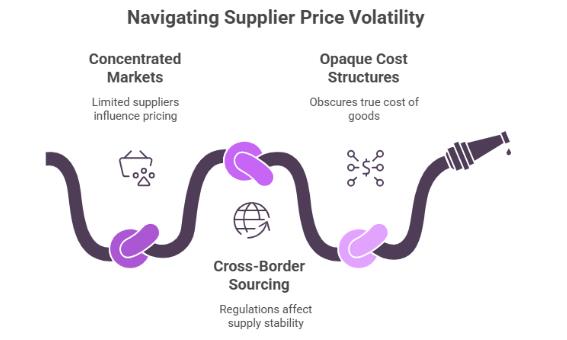
- Supplier Price Volatility: Commodity-linked inputs such as packaging resins, paperboard, and transport fuels show frequent price swings across European indices, making validated cost baselines essential.
- Concentrated Supplier Markets: Many retail categories in Germany rely on limited regional manufacturers, increasing dependency risk without supplier landscape mapping.
- Cross-border Sourcing Complexity: EU regulatory compliance, sustainability reporting, and due-diligence rules add cost layers that require researched sourcing strategies.
Nexdigm’s Procurement Research for Sourcing and Cost Control
Germany’s retail market exceeds €650 billion, with food and essentials above €250 billion. In such a price-driven environment, swings in packaging, freight, and energy costs have made supplier negotiations more complex and sourcing costs harder to control for retailers.
Nexdigm supports procurement teams with research that improves supplier selection, sourcing choices, and cost visibility across large retail supply chains.
Supplier Intelligence:
Clear mapping of European and nearby suppliers widens sourcing options in a market where over 70% of Germany’s retail goods are sourced within EU trade networks, improving price visibility across packaging, private-label production, and logistics vendors.
- Should-Cost Modeling: Cost breakdowns for packaging, manufacturing, and transport align supplier quotes with real inputs such as energy and freight, where European industrial energy prices rose more than 40% during the recent energy shock period.
- Contract Benchmarking: Comparison of pricing terms, service levels, and index-linked clauses with common European retail contracting practices.
How Nexdigm Provides Real Results
Germany’s retail sector sources well over €100 billion in goods and supply services each year, while the wider economy imports more than €1.3 trillion in products (Destatis). In a market of this scale and price pressure, clear supplier insight and cost transparency directly strengthen negotiations and sourcing stability.
- Supplier Landscape Analysis: A clear view of qualified European and nearby suppliers helps retailers widen sourcing choices and reduce dependence on a small vendor base.
- Should-Cost Benchmarking: Supplier quotes are broken into materials, labor, overhead, and logistics so teams can compare prices with real market cost movements.
- Sourcing Risk Evaluation: Supplier concentration, import exposure, and compliance factors are assessed to help retailers diversify sourcing and avoid sudden supply or cost disruptions.
- Procurement Opportunity Identification: Spend and supplier patterns are reviewed to identify consolidation, renegotiation, and alternative sourcing actions that improve cost control over time.
Nexdigm’s Case
A grocery retailer engaged Nexdigm to assess packaging and private-label supplier costs amid repeated vendor price increases. Nexdigm’s procurement research built should-cost models and mapped alternative EU suppliers, revealing 8–12% price gaps versus market benchmarks. The retailer renegotiated contracts and dual-sourced key inputs, stabilizing procurement costs and protecting category margins.
To take the next step, simply visit our Request a Consultation page and share your requirements with us.
Harsh Mittal
+91-8422857704