

Procurement spend is being reshaped by cost volatility, supplier risk, and changing trade conditions. CIPS’ Q2 2026 Pulse Survey found that 35% of procurement professionals expected shipping and logistics prices to rise by more than 10%, while 30% anticipated similar increases for chemicals and chemical products. Petroleum, metals, and mining products recorded an even higher 41% expectation of price increases above 10%.
A recent CPO Survey meanwhile found that 72% of CPOs ranked improving margins through cost reduction among their top priorities, while 68% prioritized operational efficiency. These conditions make procurement spend analysis consulting increasingly relevant for identifying where spending is concentrated, which categories and vendors influence costs, and where procurement teams can find realistic optimization opportunities.
Where Procurement Costs Are Moving
Procurement spend rarely changes for one reason. Commodity movements, supplier pricing, freight, tariffs, currency fluctuations, demand changes, and purchasing volumes can all influence category economics. Rising expenditure may reflect genuine volume growth, supplier price increases, or changes in the sourcing mix. Examining these factors together allows businesses to distinguish between unavoidable cost increases and areas where procurement intervention could improve commercial outcomes.
What Spend Patterns Can Reveal
Looking beyond total expenditure can uncover relationships between categories, vendors, and market conditions that are difficult to see in aggregate procurement reports.
- Category and Pricing Movements: Comparing spend, purchase volumes, and supplier prices can reveal categories where inflation, fragmented buying, or inconsistent pricing is affecting procurement performance.
- Vendor and Supply Shifts: Examining supplier concentration, market positions, capacity, and alternative sources can reveal opportunities for negotiation, consolidation, or sourcing diversification.
Together, these perspectives help procurement teams determine where spending is changing, what is driving the movement, and which areas have the greatest potential for optimization.
How Nexdigm’s Experts Assess These Spend Patterns
Nexdigm’s experts examine procurement spend through a procurement spend analysis consulting approach, helping businesses separate routine expenditure from areas with meaningful optimization potential by conducting:
- Category-Level Assessment: Analysis of spend by category, subcategory, volume, and purchasing pattern to identify high-value areas, fragmented buying, and categories with potential savings opportunities.
- Supplier and Pricing Assessment: Comparison of supplier-level spend, pricing, market benchmarks, and commercial terms to identify price gaps, supplier concentration, and opportunities for negotiation or consolidation.
- Market and Cost Assessment: Connecting spend movements with raw-material costs, freight, tariffs, currency, capacity, and demand to determine the external factors influencing procurement economics.
By combining internal spend patterns with external market evidence, Nexdigm helps procurement teams identify addressable spend, prioritize opportunities, and develop more targeted cost-optimization strategies.
Nexdigm’s Procurement Spend Optimization Assessment
Nexdigm translates spending findings into a structured view of where procurement teams can act, balancing financial impact, supplier dynamics, market conditions, and implementation feasibility. This is done through assessing:
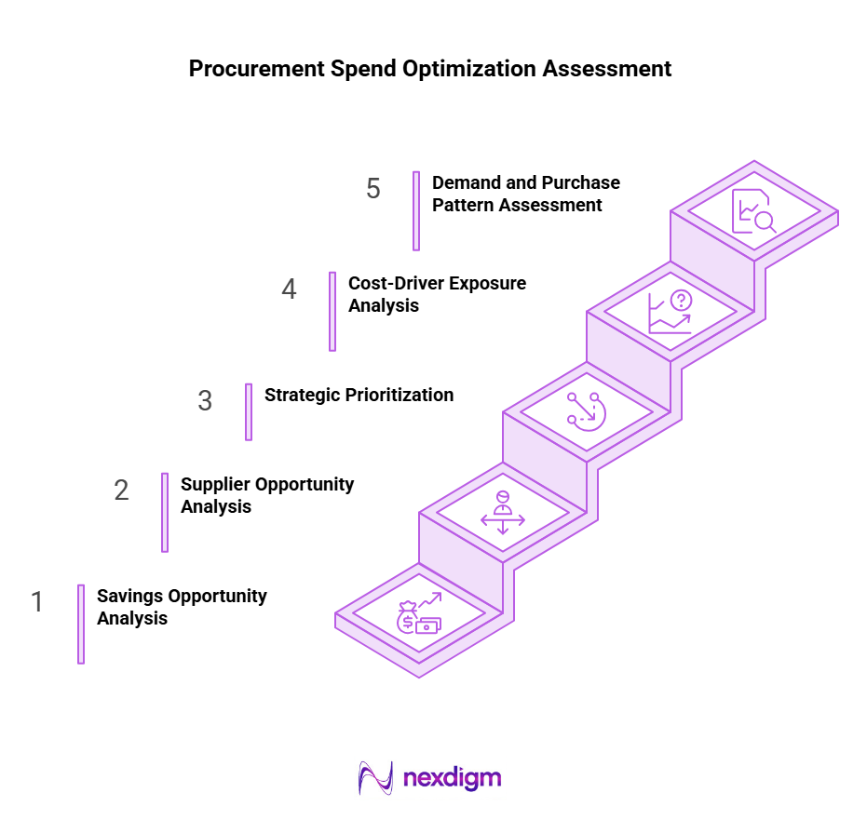
- Savings Opportunities: Categories and suppliers with pricing gaps, fragmented purchasing, unfavorable terms, or opportunities for commercial renegotiation.
- Supplier Opportunities: Consolidation, alternative suppliers, and sourcing-market changes to improve leverage while maintaining appropriate supply resilience.
- Strategic Priorities: Ranking opportunities based on spend value, savings potential, risk exposure, sourcing complexity, and ease of implementation.
- Cost-Driver Exposure: Raw materials, energy, freight, tariffs, and currency movements to identify categories where external cost pressures could affect future spend.
- Demand and Purchase Patterns: Volumes, order frequency, business-unit buying, and purchasing behavior to identify fragmented or inefficient spending patterns.
This assessment helps procurement teams move from spend visibility to prioritized, actionable opportunities, ensuring that optimization efforts focus on areas with meaningful commercial potential.
How Nexdigm’s Assessment Prioritizes Spending Opportunities
Not every identified savings opportunity should receive the same level of attention. Nexdigm evaluates opportunities against their financial impact, feasibility, risk, and strategic relevance to help procurement teams focus on:
- High-Value Opportunities: Prioritize categories with substantial spend, significant pricing gaps, or strong potential for measurable savings.
- Quick-Win Opportunities: Identify initiatives that require limited supplier or process changes and can deliver relatively rapid procurement benefits.
- Strategic Opportunities: Highlight areas requiring supplier restructuring, sourcing-market changes, or longer-term negotiations where the potential value justifies greater effort.
- Risk-Adjusted Opportunities: Balance savings potential against supplier concentration, capacity constraints, switching costs, and supply-continuity considerations.
This approach creates a ranked opportunity pipeline, helping procurement teams determine what to address immediately, what to develop over time, and what to monitor.
Nexdigm’s Case
Nexdigm assessed procurement categories across 15 supplier markets, identifying seven categories with significant cost-optimization potential and five supplier groups with pricing gaps against market benchmarks. The assessment supported a 14% improvement in addressable savings potential and a 9% reduction in supplier-related cost exposure, helping the client prioritize negotiations, supplier rationalization, and targeted procurement initiatives.
To take the next step, simply visit our Request a Consultation page and share your requirements with us.
Harsh Mittal
+91-8422857704