

Product launch research and analysis helps companies reduce failure risk by validating customer demand, pricing, positioning, competition, distribution channels, and product-market fit before launch. A strong market entry strategy connects product launch planning with local market realities, ensuring that the offering matches customer needs, regulatory requirements, and competitive conditions.
By using product launch research and analysis, companies can identify demand gaps, refine value propositions, test launch readiness, and build a more practical roadmap for successful market introduction and long-term growth. When nearly 60% of new products underperform, businesses cannot rely only on assumptions or internal expectations.
Nearly 60% of new products underperform after launch due to weak demand validation, poor positioning, pricing gaps, or limited customer adoption. Research also shows that 42% of startups fail because there is no market need, while many product failures stem from entering without enough customer insight. These figures highlight why launch research must support every market entry strategy before investment and rollout.
Importance of Product Launch Research and Analysis in Strengthening Market Entry Strategy
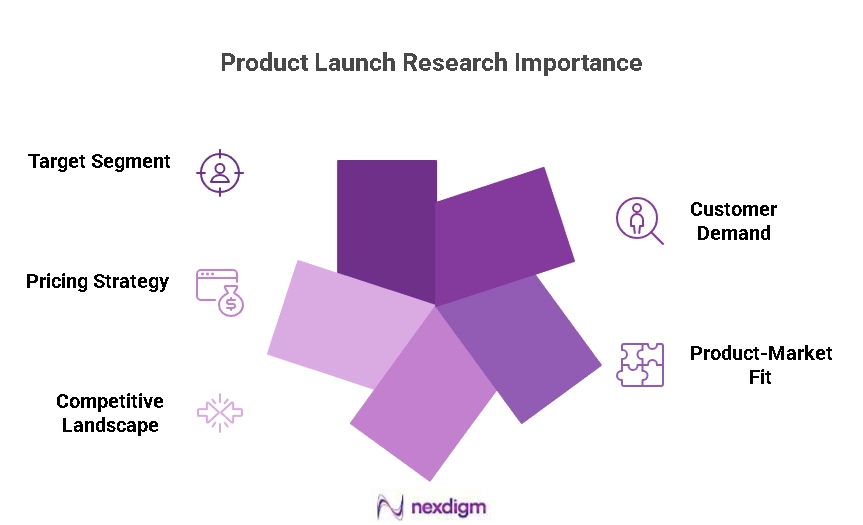
Importance of Product Launch Research and Analysis in Strengthening Market Entry Strategy means validating demand, customer needs, pricing, competition, positioning, and launch risks before entering a market to improve product success:
-
Customer Demand Validation
Product launch research confirms whether customers need the product, understand its value, and are willing to purchase.
-
Product-Market Fit Assessment
Analysis helps determine whether product features, benefits, pricing, and positioning match target market expectations.
-
Competitive Landscape Review
Studying competitors helps identify pricing pressure, product gaps, differentiation opportunities, and potential barriers to adoption.
-
Pricing Strategy Evaluation
Research assesses affordability, willingness to pay, competitor pricing, and value perception before market entry.
-
Target Segment Identification
Companies identify priority customer groups based on needs, behavior, income, geography, and likelihood of adoption.
Nexdigm’s Go-to-Market Planning for Successful New Product Introduction
Nexdigm’s Go-to-Market Planning for Successful New Product Introduction helps companies convert product research into a practical launch plan. Nexdigm supports target customer identification, demand validation, pricing strategy, competitive positioning, channel selection, regulatory review, and launch execution planning. This helps businesses reduce product failure risk, improve market acceptance, and build a stronger market entry strategy.
Nexdigm’s Risk Assessment Framework for Product Launch and Market Entry Planning
Nexdigm’s Risk Assessment Framework for Product Launch and Market Entry Planning helps companies identify demand, pricing, competition, compliance, channel, and adoption risks before launch to improve execution success.
-
Demand Risk Assessment
Nexdigm evaluates customer need, adoption potential, market size, and demand gaps before product launch and market entry.
-
Pricing Risk Review
Nexdigm assesses affordability, willingness to pay, competitor pricing, and value perception to reduce pricing-related launch risks.
-
Competitive Risk Mapping
Nexdigm analyzes competitor strength, product differentiation, positioning, and market barriers that may affect launch performance.
-
Regulatory and Compliance Check
Nexdigm reviews product approvals, standards, licenses, documentation, and compliance requirements before market entry execution.
-
Channel Risk Evaluation
Nexdigm assesses distributors, sales channels, route-to-market options, and partner reliability to improve product reach.
-
Customer Adoption Risk Analysis
Nexdigm studies buying behavior, usage patterns, objections, and adoption barriers to support stronger launch planning.
Nexdigm’s case:
Nexdigm helped a global consumer electronics company reduce product launch risk before entering India with a new smart home device. Nexdigm assessed customer demand, pricing sensitivity, competitor offerings, retail channels, regulatory requirements, and adoption barriers. The research found that nearly 58% of surveyed customers preferred bundled after-sales support, while 42% considered price the biggest purchase barrier. Nexdigm’s risk assessment helped refine pricing, positioning, and channel strategy before launch.
To take the next step, simply visit our Request a Consultation page and share your requirements with us.
Harsh Mittal
+91-8422857704