

Building a great product is a big challenge, as it needs to make sure that product solves a real problem, appeals to the right audience, and delivers enough value for customers to choose it over competing alternatives. This is where product-market alignment becomes essential.
When a product aligns with market needs, customers adopt it more readily, stay engaged for longer, and are more willing to pay for its value. Achieving this alignment, however, requires businesses to continuously test demand, validate use cases, refine pricing strategies, and understand evolving customer expectations.
Does the Product Fit the Market?
Businesses must determine whether their product truly fits the market. A product-market fit exists when a product effectively solves a meaningful customer problem, delivers clear value, and generates sustained demand within its target audience. Strong indicators of product-market fit include growing adoption, positive customer feedback, high retention rates, repeat purchases, and a willingness among customers to pay for the solution. By continuously assessing customer demand, usage patterns, competitive alternatives, and pricing perceptions, businesses can gain a deeper understanding of the product and frame launch strategies accordingly.
What Is Product-Market Alignment?
Product-market alignment is the point at which a product successfully addresses the needs, challenges, and preferences of a defined target market. It indicates that customers not only understand the product’s value but also consider it a solution worth purchasing and recommending. Strong product-market alignment is represented by:
- Consistent customer demand
- Positive feedback and user satisfaction
- Higher retention and repeat purchases
- Growing market adoption
- Sustainable revenue growth
With these factors, it clearly shows that product-market alignment is an ongoing process which requires businesses to stay connected to changing market conditions.
Understanding the Product Demand
Many products fail not because they lack innovation, but because they are built for problems that customers do not consider important enough to solve. Before investing heavily in development or expansion, businesses need to determine whether genuine demand exists. Understanding demand involves answering critical questions:
- Is there a clear market need?
- How large is the opportunity?
- Who are the most likely buyers?
- What factors influence purchasing decisions?
Nexdigm’s Perspective about Product Demand
According to Nexdigm’s market research insights, businesses should assess market feasibility, customer demand, competitive dynamics, and product-market fit before entering new markets. This helps reduce risk and improves the likelihood of successful commercialization. Some common demand validation methods include:
- Customer interviews
- Surveys and feedback studies
- Pilot launches
- Competitive analysis
Applying Real-World Cases for Product-Market Alignment
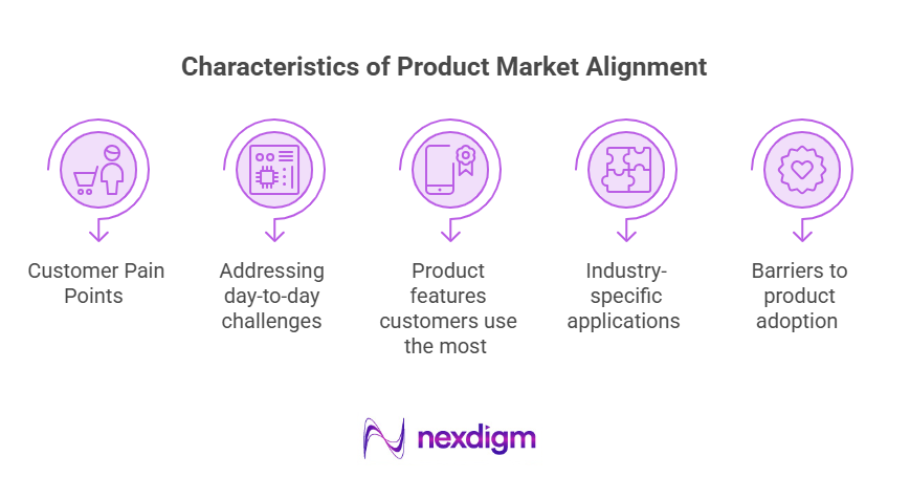
A product may have impressive features, but customers care more about outcomes than capabilities. They want to know how a product solves a specific problem in their personal lives. This is why use case validation is a critical step toward product-market alignment. Businesses in such cases should identify:
- Key customer pain points
- How the product addresses those challenges
- Which features customers use most
- Industry-specific applications
- Barriers to adoption
Nexdigm emphasizes product-market fit assessments and customer segmentation as important components of market-entry and growth strategies. Understanding how different customer groups interact with a product enables businesses to prioritize features and benefits that matter most to users. When organizations focus on validated use cases, they can improve product messaging, strengthen positioning, and increase adoption rates.
Testing Price for Product-Market Alignment
Price influences purchase decisions, perceived value, market competitiveness, and profitability. Many organizations make the mistake of setting prices based solely on costs. However, successful pricing strategies are built around customer value and market realities.
Nexdigm’s pricing research highlights the importance of evaluating customer willingness to pay, competitive benchmarks, market acceptance, and pricing sensitivity by focusing on the following questions:
- What customers believe the product is worth
- How competitors are pricing similar solutions
- Price sensitivity across different customer segments
- Subscription, usage-based, or one-time pricing models
- Regional and market-specific pricing variations
Nexdigm also provides deep-industry expertise of effective pricing analysis that helps organizations optimize margins while maintaining competitiveness and delivering value to customers.
Useful Pricing Validation Techniques used by Nexdigm
- A/B pricing tests
- Customer willingness-to-pay surveys
- Competitive pricing studies
- Focus groups
- Pilot-market experiments
Understanding Customer Expectations
Customer expectations are constantly evolving. Today, customers look for more than just functionality. They look upto the on-going trends to stay updated. They usually look for the following features in any product:
- Ease of use
- Fast support
- Reliable performance
- Personalization
- Transparent pricing
- Consistent value delivery
Organizations that actively listen to customers and their demands, can identify changing preferences to gain competitive edge in the rapidly evolving market.
Nexdigm’s research on customer willingness-to-pay and pricing intelligence shows that businesses gain stronger market positions when pricing, product offerings, and customer value perceptions are consistently aligned. Customer-centric businesses often monitor:
- Customer satisfaction scores
- Product reviews
- User behavior data
- Feature requests
- Support interactions
These insights help organizations adapt quickly and maintain strong product-market alignment.
Why Continuous Validation Matters?
Markets are constantly changing. New competitors emerge, customer preferences evolve, and economic conditions influence buying behavior. As a result, product-market alignment is becoming important. Successful companies continuously test and refine their assumptions by reviewing:
- Market trends
- Customer feedback
- Product usage patterns
- Pricing effectiveness
- Competitive positioning
Nexdigm supports businesses through market intelligence, pricing analysis, customer segmentation, demand assessment, competitive intelligence, and go-to-market strategy development. These capabilities help organizations validate opportunities, improve adoption, and create scalable growth plans.
Nexdigm’s Case
Nexdigm helped a global company validate product-market fit before launch, testing demand across four use cases, three pricing models, and key customer expectations. Insights prompted product and pricing refinements, increasing purchase intent by 32% and projected first-year adoption by 27%.
To take the next step, simply visit our Request a Consultation page and share your requirements with us.
Harsh Mittal
+91-8422857704